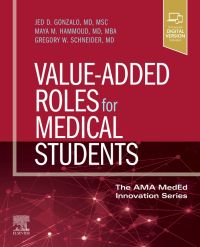
Value-Added Roles for Medical Students, 1st Edition
Author :
By Jed D. Gonzalo, MSc, MD, Maya M. Hammoud, MD, MBA and Gregory W. Schneider, MD
Providing real-life clinical experiences and context to medical students is an essential part of today’s medical education, and the partnerships between medical schools and health systems are an integral part of this approach. Value-Added Roles for
...view more
Providing real-life clinical experiences and context to medical students is an essential part of today’s medical education, and the partnerships between medical schools and health systems are an integral part of this approach. Value-Added Roles for Medical Students, the second volume in the American Medical Association’s MedEd Innovation Series, is a first-of-its-kind, instructor-focused field book that inspires educators to transform the relationship between medical schools and health systems with authentic workplace roles for medical students, adding relevance to medical education and patient care.
Providing real-life clinical experiences and context to medical students is an essential part of today’s medical education, and the partnerships between medical schools and health systems are an integral part of this approach. Value-Added Roles for Medical Students, the second volume in the American Medical Association’s MedEd Innovation Series, is a first-of-its-kind, instructor-focused field book that inspires educators to transform the relationship between medical schools and health systems with authentic workplace roles for medical students, adding relevance to medical education and patient care.
Key Features
Gives instructors the tools needed to create roles for medical students in the health system that benefit the student’s growth, empathy, and understanding of patient needs; develop a working knowledge of the health system itself; and provide true value to both the health system and patient experience.
Contains both theoretical and practical material for instructors and administrators, including guidance on how to implement value-added roles for medical students in today’s institutions.
Explains how to apply a framework to implement value-added clinical systems learning roles for students, develop meaningful medical school-health system partnerships, and train a generation of future physicians prepared to lead health systems change.
Provides numerous examples from schools with successful implementation of value-added medical student roles such as patient navigators, community-based health care programs involving medical students, and more.
Describes real-world strategies for building mutually beneficial medical school-health system partnerships, including developing a shared vision and strategy and identifying learning goals and objectives; empowering broad-based action and overcoming barriers in implementation; and generating short-term wins in implementation.
Helps medical school faculty and instructors address gaps in physician training and prepare new doctors to practice effectively in 21st century health care systems.
One of the American Medical Association Change MedEd initiatives and innovations, written and edited by members of the Accelerating Change in Medical Education Consortium – a unique, innovative collaborative that allows for the sharing and dissemination of groundbreaking ideas and projects.
Enhanced eBook version included with purchase. Your enhanced eBook allows you to access all of the text, figures, and references from the book on a variety of devices.
Author Information
By Jed D. Gonzalo, MSc, MD, Hospitalist, Internal Medicine, Penn State Medical Center, Hershey, Pennsylvania; Maya M. Hammoud, MD, MBA, Professor, Obstetrics and Gynecology, University of Michigan, Ann Arbor, Michigan and Gregory W. Schneider, MD, Associate Professor, Florida International University, Herbert Wertheim College of Medicine, Miami, Florida
By Jed D. Gonzalo, MSc, MD, Hospitalist, Internal Medicine, Penn State Medical Center, Hershey, Pennsylvania; Maya M. Hammoud, MD, MBA, Professor, Obstetrics and Gynecology, University of Michigan, Ann Arbor, Michigan and Gregory W. Schneider, MD, Associate Professor, Florida International University, Herbert Wertheim College of Medicine, Miami, Florida
Part 1 Theory 1. Concept of Value-Added Roles: Creating a Community of Practice 2. Current and Emerging Models 3. The Role of Program Evaluation in Valued-Added Medical Education: Overall Outcomes and Connections to the Assessment of Learning Part 2 Practice/Preclerkship, Clerkship, and Longitudinal Experiences 4. Students as Patient Navigators: The Penn State College of Medicine 5. Students as Patient Navigators: Case Western Reserve University School of Medicine 6. Primary Care Quality Improvement: The University of North Carolina at Chapel Hill 7. Household-Centered Service-Learning: Florida International University Herbert Wertheim College of Medicine 8. Early Medical Students as Clinical Microsystem Agents of Change—Improving Quality, Value, and the Patient Experience: University of California, San Francisco, School of Medicine 9. Plan-Do-Study-Act: Vanderbilt University School of Medicine 10. Community Health in Action: A.T. Still University’s School of Osteopathic Medicine in Arizona Part 3 Implementation 11. Vision and Planning Value-Added Roles 12. Launching and Sustaining Value-Added Roles 13. Improving and Growing Value-Added Roles
https://www.elsevierhealth.com.au/value-added-roles-for-medical-students-9780323759502.html297005Value-Added Roles for Medical Studentshttps://www.elsevierhealth.com.au/media/catalog/product/9/7/9780323759502_5.jpg73.4697.94AUDInStock/Medicine & Surgery/Education in Medicine/Books/Medicine/Education in Medicine/Books/Books/Medicine/Education in Medicine/Japan Titles/Medical Students/Medical education/Medical Students/Medical education433517043887225054652505466452550395259942526316054964465496447141826924335088488653650545535145120525983353030195303018Providing real-life clinical experiences and context to medical students is an essential part of today’s medical education, and the partnerships between medical schools and health systems are an integral part of this approach. Value-Added Roles for Medical Students, the second volume in the American Medical Association’s MedEd Innovation Series, is a first-of-its-kind, instructor-focused field book that inspires educators to transform the relationship between medical schools and health systems with authentic workplace roles for medical students, adding relevance to medical education and patient care. Providing real-life clinical experiences and context to medical students is an essential part of today’s medical education, and the partnerships between medical schools and health systems are an integral part of this approach. Value-Added Roles for Medical Students, the second volume in the American Medical Association’s MedEd Innovation Series, is a first-of-its-kind, instructor-focused field book that inspires educators to transform the relationship between medical schools and health systems with authentic workplace roles for medical students, adding relevance to medical education and patient care.00add-to-cart97803237595022021ProfessionalBy Jed D. Gonzalo, MSc, MD, Maya M. Hammoud, MD, MBA and Gregory W. Schneider, MD20221Book191w x 235h (7.50" x 9.25")Elsevier1623 Sep 2021IN STOCKBy <STRONG>Jed D. Gonzalo</STRONG>, MSc, MD, Hospitalist, Internal Medicine, Penn State Medical Center, Hershey, Pennsylvania; <STRONG>Maya M. Hammoud</STRONG>, MD, MBA, Professor, Obstetrics and Gynecology, University of Michigan, Ann Arbor, Michigan and <STRONG>Gregory W. Schneider</STRONG>, MD, Associate Professor, Florida International University, Herbert Wertheim College of Medicine, Miami, FloridaBooksBookThe AMA MedEd Innovation SeriesUnited StatesNoNoNoNoPlease SelectPlease SelectPlease Select