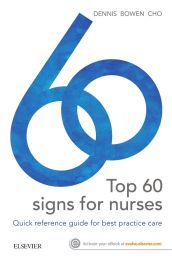
By Mark Dennis, MBBS (Honours), William Talbot Bowen, MBBS, MD and Lucy Cho, MBBS, MIPH, BA (University of Sydney)
Presented in a useful handbook style, Top 60 Signs for Nurses: Quick reference guide for best practice care outlines the evidence base and clinical value of each clinical sign to assist with interpretation.
Each of the signs is related back to the m
...view more
Presented in a useful handbook style, Top 60 Signs for Nurses: Quick reference guide for best practice care outlines the evidence base and clinical value of each clinical sign to assist with interpretation.
Each of the signs is related back to the mechanism of action along with clearly documented research to demonstrate the evidence base associated with this sign.
Presented in a useful handbook style, Top 60 Signs for Nurses: Quick reference guide for best practice care outlines the evidence base and clinical value of each clinical sign to assist with interpretation.
Each of the signs is related back to the mechanism of action along with clearly documented research to demonstrate the evidence base associated with this sign.
Key Features
Signs are ordered alphabetically within each chapter outlining a specific body system
Extensive reference lists of up-to-date literature strengthen the authority of the content
Clinical Pearls highlight the main signs which students and graduate nurses should look out for to help them identify conditions with which the patients present
Author Information
By Mark Dennis, MBBS (Honours), Medical Registrar, Royal Prince Alfred Hospital, Sydney, Australia; William Talbot Bowen, MBBS, MD, Resident, Division of Emergency Medicine, Louisiana State University Health Sciences Center - New Orleans (LSUHSC), New Orleans, Louisiana and Lucy Cho, MBBS, MIPH, BA (University of Sydney), Emergency Registrar, Royal Prince Alfred Hospital, Sydney, Australia
By Mark Dennis, MBBS (Honours), Medical Registrar, Royal Prince Alfred Hospital, Sydney, Australia; William Talbot Bowen, MBBS, MD, Resident, Division of Emergency Medicine, Louisiana State University Health Sciences Center - New Orleans (LSUHSC), New Orleans, Louisiana and Lucy Cho, MBBS, MIPH, BA (University of Sydney), Emergency Registrar, Royal Prince Alfred Hospital, Sydney, Australia
https://www.elsevierhealth.com.au/top-60-signs-for-nurses-9780729542388.html299051Top 60 signs for Nurseshttps://www.elsevierhealth.com.au/media/catalog/product/9/7/9780729542388_6.jpg38.3763.95AUDInStock/Nursing & Midwifery/General Nursing/Books/Australian Titles/Flash Sale/Nursing/Books/Japan Titles43351164388722438872151126335255039526316014182692433510551126315145120<P>Presented in a useful handbook style, <i>Top 60 Signs for Nurses: Quick reference guide for best practice care</i> outlines the evidence base and clinical value of each clinical sign to assist with interpretation.</P>
<P>Each of the signs is related back to the mechanism of action along with clearly documented research to demonstrate the evidence base associated with this sign.</P> <P>Presented in a useful handbook style, <i>Top 60 Signs for Nurses: Quick reference guide for best practice care</i> outlines the evidence base and clinical value of each clinical sign to assist with interpretation.</P>
<P>Each of the signs is related back to the mechanism of action along with clearly documented research to demonstrate the evidence base associated with this sign.</P>00add-to-cart97807295423882017ProfessionalBy Mark Dennis, MBBS (Honours), William Talbot Bowen, MBBS, MD and Lucy Cho, MBBS, MIPH, BA (University of Sydney)20171Book125w x 190h (4.92" x 7.48")Elsevier9023 Jun 2017IN STOCKBy <STRONG>Mark Dennis</STRONG>, MBBS (Honours), Medical Registrar, Royal Prince Alfred Hospital, Sydney, Australia; <STRONG>William Talbot Bowen</STRONG>, MBBS, MD, Resident, Division of Emergency Medicine, Louisiana State University Health Sciences Center - New Orleans (LSUHSC), New Orleans, Louisiana and <STRONG>Lucy Cho</STRONG>, MBBS, MIPH, BA (University of Sydney), Emergency Registrar, Royal Prince Alfred Hospital, Sydney, AustraliaBooksBookAustraliaNoNoNoNoPlease SelectPlease SelectPlease Select