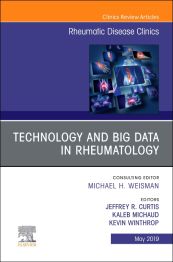
Technology and Big Data in Rheumatology , An Issue of Rheumatic Disease Clinics of North America, 1st Edition
Author :
By Jeffrey Curtis, MD, MS, MPH, Kevin Winthrop, MD, MPH and Kaleb Michaud, PhD
Guest edited by Drs. Jeffrey Curtis, Kevin Winthrop and Kaleb Michaud, this issue of Rheumatic Disease Clinics will cover several key areas of interest related to Technology and Big Data in Rheumatology. This issue is one of four selected each year b
...view more
Guest edited by Drs. Jeffrey Curtis, Kevin Winthrop and Kaleb Michaud, this issue of Rheumatic Disease Clinics will cover several key areas of interest related to Technology and Big Data in Rheumatology. This issue is one of four selected each year by our series Consulting Editor, Dr. Michael Weisman of Cedars-Sinai. Articles in this issue include, but are not limited to: Adherence & Adverse Event Ascertainment through mHealth; Digital Patient Education and Decision Aids; Imaging in the mobile domain; Quality Measures made easier with mHealth data; Patient self-management and tracking; Motivational Counseling and SMS Reminders; Digital Interventions to build community support; Telehealth to solve cases in under-resourced areas; Trials, eConsents, Data Linkage & the Future; Clinical experience with devices; and PROMIS vs legacy data instruments.
Guest edited by Drs. Jeffrey Curtis, Kevin Winthrop and Kaleb Michaud, this issue of Rheumatic Disease Clinics will cover several key areas of interest related to Technology and Big Data in Rheumatology. This issue is one of four selected each year by our series Consulting Editor, Dr. Michael Weisman of Cedars-Sinai. Articles in this issue include, but are not limited to: Adherence & Adverse Event Ascertainment through mHealth; Digital Patient Education and Decision Aids; Imaging in the mobile domain; Quality Measures made easier with mHealth data; Patient self-management and tracking; Motivational Counseling and SMS Reminders; Digital Interventions to build community support; Telehealth to solve cases in under-resourced areas; Trials, eConsents, Data Linkage & the Future; Clinical experience with devices; and PROMIS vs legacy data instruments.
Author Information
By Jeffrey Curtis, MD, MS, MPH, Marguerite Jones Harbert – Gene Ball Endowed Professor of Medicine, UAB Division of Clinical Immunology & Rheumatology, Birmingham, Alabama; Kevin Winthrop, MD, MPH, Associate Professor of Infectious Diseases, Ophthalmology, Professor of Public Health and Preventive Medicine, Division of Infectious Diseases, Oregon Health & Science University, Portland, Oregon and Kaleb Michaud, PhD, Associate Professor, Internal Medicine, Division of Rheumatology, University of Nebraska Medical Center, Omaha, Nebraska
By Jeffrey Curtis, MD, MS, MPH, Marguerite Jones Harbert – Gene Ball Endowed Professor of Medicine, UAB Division of Clinical Immunology & Rheumatology, Birmingham, Alabama; Kevin Winthrop, MD, MPH, Associate Professor of Infectious Diseases, Ophthalmology, Professor of Public Health and Preventive Medicine, Division of Infectious Diseases, Oregon Health & Science University, Portland, Oregon and Kaleb Michaud, PhD, Associate Professor, Internal Medicine, Division of Rheumatology, University of Nebraska Medical Center, Omaha, Nebraska
https://www.elsevierhealth.com.au/technology-and-big-data-in-rheumatology-an-issue-of-rheumatic-disease-clinics-of-north-america-9780323678629.html296322Technology and Big Data in Rheumatology , An Issue of Rheumatic Disease Clinics of North Americahttps://www.elsevierhealth.com.au/media/catalog/product/9/7/9780323678629_6.jpg198.85220.95AUDInStock/Medicine & Surgery/Rheumatology/Clinics/Medicine/Rheumatology/Clinics/Clinics/Medicine/Rheumatology/Japan Titles43350904388725505455550546665255041525983552631601418269243350884886536505455351451205259833Guest edited by Drs. Jeffrey Curtis, Kevin Winthrop and Kaleb Michaud, this issue of Rheumatic Disease Clinics will cover several key areas of interest related to Technology and Big Data in Rheumatology. This issue is one of four selected each year by our series Consulting Editor, Dr. Michael Weisman of Cedars-Sinai. Articles in this issue include, but are not limited to: Adherence & Adverse Event Ascertainment through mHealth; Digital Patient Education and Decision Aids; Imaging in the mobile domain; Quality Measures made easier with mHealth data; Patient self-management and tracking; Motivational Counseling and SMS Reminders; Digital Interventions to build community support; Telehealth to solve cases in under-resourced areas; Trials, eConsents, Data Linkage & the Future; Clinical experience with devices; and PROMIS vs legacy data instruments. Guest edited by Drs. Jeffrey Curtis, Kevin Winthrop and Kaleb Michaud, this issue of Rheumatic Disease Clinics will cover several key areas of interest related to Technology and Big Data in Rheumatology. This issue is one of four selected each year by our series Consulting Editor, Dr. Michael Weisman of Cedars-Sinai. Articles in this issue include, but are not limited to: Adherence & Adverse Event Ascertainment through mHealth; Digital Patient Education and Decision Aids; Imaging in the mobile domain; Quality Measures made easier with mHealth data; Patient self-management and tracking; Motivational Counseling and SMS Reminders; Digital Interventions to build community support; Telehealth to solve cases in under-resourced areas; Trials, eConsents, Data Linkage & the Future; Clinical experience with devices; and PROMIS vs legacy data instruments.00add-to-cart97803236786292019ProfessionalBy Jeffrey Curtis, MD, MS, MPH, Kevin Winthrop, MD, MPH and Kaleb Michaud, PhD20191Book152w x 229h (6.00" x 9.00")Elsevier03 May 2019Please allow 10-14 working days for deliveryBy <STRONG>Jeffrey Curtis</STRONG>, MD, MS, MPH, Marguerite Jones Harbert – Gene Ball Endowed Professor of Medicine, UAB Division of Clinical Immunology & Rheumatology, Birmingham, Alabama; <STRONG>Kevin Winthrop</STRONG>, MD, MPH, Associate Professor of Infectious Diseases, Ophthalmology, Professor of Public Health and Preventive Medicine, Division of Infectious Diseases, Oregon Health & Science University, Portland, Oregon and <STRONG>Kaleb Michaud</STRONG>, PhD, Associate Professor, Internal Medicine, Division of Rheumatology, University of Nebraska Medical Center, Omaha, NebraskaClinicsClinicsThe Clinics: Internal MedicineUnited StatesNoNoNoNoPlease SelectPlease SelectPlease Select