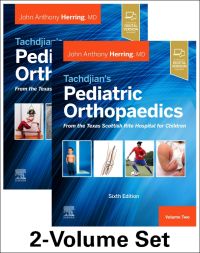
Tachdjian's Pediatric Orthopaedics: From the Texas Scottish Rite Hospital for Children, 6th edition, 6th Edition
Key Features
- Presents complete coverage of the latest knowledge on etiology, imaging, differential diagnosis, growth instrumentation, and non-operative and surgical techniques for a wide range of pediatric orthopaedic conditions.
- Provides expert guidance on difficult diagnostic and clinical management issues for your most challenging cases.
- Covers today’s most effective approaches for management of severe spinal deformities, early onset scoliosis, hip preservation methods, long-term follow-up of trauma conditions, and much more.
- Offers superb visual guidance with nearly 2,500 full-color illustrations and 70 videos (many are new!) of pediatric surgical procedures, including a number that highlight clinical examination and unusual clinical findings.
- Enhanced eBook version included with purchase. Your enhanced eBook allows you to access all of the text, figures, and references from the book on a variety of devices.
Author Information
| ISBN Number | 9780323567695 |
|---|---|
| Description Author List | By John A. Herring, MD, Chief of Staff Emeritus, Texas Scottish Rite Hospital for Children and Professor of Orthopaedic Surgery, University of Texas Southwestern Medical Center, Dallas, Texas |
| Copyright Year | 2022 |
| Edition Number | 6 |
| Format | Book |
| Trim | 216w x 276h (8.50" x 10.875") |
| Illustrations | 2500 illustrations (1300 in full color) |
| Imprint | Elsevier |
| Page Count | 2132 |
| Publication Date | 14 Jan 2021 |
| Stock Status | Please allow 3-4 weeks for delivery |


eBooks : Built for busy schedules & tailored for your goals.


Affordable knowledge, built for you
Get the resources you need-often at a lower cost than print. Quality content designed to support your goals, without stretching your budget.


Seamless access wherever you are


Always in sync


Tools the make learning stick
Your eBook is ready whenever you are!
1. Check your email for your access code.


2. Sign into or create your VitalSource account and redeem your code.


3. Open your eBook - ready whenever you are!
FAQ
The access code for your new eBook will be sent in your order confirmation email. Your code can also be accessed in your My Account section on the Elsevier webshop. If you do not receive your code within a few minutes, please check your spam folder.
Step-by-step guidance on how to download Bookshelf and also redeem your code can be found here.
The access code for your new eBook does not expire. However, we always suggest redeeming immediately after purchase to start experiencing the benefits of and insights from your purchase. Important to note - the code provided is a single use code and only valid for the edition you purchase. It does not provide access to past nor future editions of the title.
You will have unlimited access to your eBook on the device to which it was downloaded.
Discover the various learning features that our eBooks offer on the Bookshelf® Reader! For example, you can highlight different text passages, create notes and flashcards, have the text read to you, etc. Particularly practical: You can also use your eBooks offline. More information on the learning functions can be found on the Vitalsource page.
Quality is our top priority. That's why we collaborate with the leading eBook reader provider VitalSource. VitalSource has its own eBook reader Bookshelf®, which you can easily download. This reader is very user-friendly and offers more features than other standard readers. For example, you can highlight different text passages, create notes and flashcards, have the text read to you, etc. Particularly practical: You can also use your eBooks offline. More information can be found on the Vitalsource page.
Elsevier offers its eBooks in ePub format, as we believe this format is best suited to display our content ideally on as many devices as possible.
You can return your eBook within 13 days of purchase. eBooks that have been partially printed or flipped through more than 15% are excluded from returns.
Any questions ?
Top Picks from Our Community
Section 1
1. Growth and Development
2. Orthopaedic History
3. The Orthopaedic Examination: A Comprehensive Overview
4. The Orthopaedic Examination: Clinical Application
5. Gait Analysis
6. The Limping Child
7. Back Pain
Section 2 Anatomic Disorders
8. Disorders of the Neck
9. Scoliosis
10. Kyphosis
11. Other Anatomic Disorders of the Spine
12. Disorder of the Upper Extremity
13. Developmental Dysplasia of the Hip
14. Legg-Calve-Perthes Disease
15. Slipped Capital Femoral Epiphysis
16. Congenital Coxa Vara
17. Disorders of the Femur
18. Disorders of the Leg
19. Disorders of the Foot
20. Limb Length Discrepancy
Section 3 Common Orthopaedic Disorders
21. Limb Deficiencies
22. Arthritis
23. Infections of the Musculoskeletal System
Section 4 Musculoskeletal Tumors
24. General Principles of Tumor Management
25. Benign Musculoskeletal Tumors
26. Malignant Bone Tumors
Section 5 Injuries
27. General Principles of Managing Orthopaedic Injuries
28. Spinal Injuries
29. Upper Extremity Injuries
30. Lower Extremity Injuries
Section 6: Neuromuscular Disorders
31. Disorders of the Brain
32. Disorders of the Spinal Cord
33. Poliomyelitis
34. Disorders of the Peripheral Nervous System
35. Muscle Diseases
Section 7: Other Orthopaedic Disorders
36. Skeletal Dysplasias
37. Orthopaedic Related Syndromes
38. Metabolic and Endocrine Bone Diseases
39. Hematologic Disorders
40. Sports