
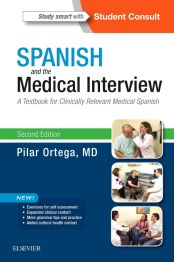
Spanish and the Medical Interview, 2nd Edition
Focusing on communication needs in real-world clinical situations, Dr. Pilar Ortega’s updated edition of this practical text helps you address today’s growing demand for Spanish-speaking physicians and healthcare workers. This pocket-sized resource provides basic Spanish skills, sample interview questions, relevant cultural information, and more, in addition to online videos of physician-patient interactions, interactive self-assessment tools, and clinical vignettes. You’ll find exactly what you need to develop better physician-patient communication skills, increase your cultural competence, and make better clinical decisions in your practice.
New to this edition
- Improve your skills with new and expanded content including more practice exercises for self-assessment, information on cultural issues, grammar tips and practice, complex clinical scenarios, and how to best use interpreters in your practice
- Stay up to date with new chapters on pediatric health; common procedures and informed consent; the physician’s impression and plan; diabetes medication; travel history and special exposures; adult immunization history; exercise and adult health safety screening; and specialized physical examination
- Gauge and hone your doctor-patient communication skills with interactive self-assessment tools and practice exercises
- Watch video of real-time physician-patient exchanges (with English and Spanish subtitles), complete interactive practice exercises, and learn from clinical vignettes—all online at Student Consult
- eBook version included! Access the entire book online or offline across all devices with the Student Consult eBook
Key Features
- Understand the nuts and bolts of better communication through Spanish grammar, vocabulary, pronunciation, sample interview questions, and helpful interview techniques.
- Pocket size allows for quick reference in an easily accessible format.
Author Information
| ISBN Number | 9780323371148 |
|---|---|
| Description Author List | By Pilar Ortega, MD, Clinical Assistant Professor, Department of Emergency Medicine, Department of Medical Education, Hispanic Center of Excellence in Medicine, University of Illinois at Chicago College of Medicine; Attending Physician, Department of Emergency Medicine, Advocate Illinois Masonic Medical Center and Chicago, Illinois, USA |
| Copyright Year | 2016 |
| Edition Number | 2 |
| Format | Book |
| Trim | 152w x 229h (6.00" x 9.00") |
| Illustrations | 40 illustrations |
| Imprint | Elsevier |
| Page Count | 490 |
| Publication Date | 6 Jul 2015 |
| Stock Status | Please allow 3-4 weeks for delivery |


eBooks : Built for busy schedules & tailored for your goals.


Affordable knowledge, built for you
Get the resources you need-often at a lower cost than print. Quality content designed to support your goals, without stretching your budget.


Seamless access wherever you are


Always in sync


Tools the make learning stick
Your eBook is ready whenever you are!
1. Check your email for your access code.


2. Sign into or create your VitalSource account and redeem your code.


3. Open your eBook - ready whenever you are!
FAQ
The access code for your new eBook will be sent in your order confirmation email. Your code can also be accessed in your My Account section on the Elsevier webshop. If you do not receive your code within a few minutes, please check your spam folder.
Step-by-step guidance on how to download Bookshelf and also redeem your code can be found here.
The access code for your new eBook does not expire. However, we always suggest redeeming immediately after purchase to start experiencing the benefits of and insights from your purchase. Important to note - the code provided is a single use code and only valid for the edition you purchase. It does not provide access to past nor future editions of the title.
You will have unlimited access to your eBook on the device to which it was downloaded.
Discover the various learning features that our eBooks offer on the Bookshelf® Reader! For example, you can highlight different text passages, create notes and flashcards, have the text read to you, etc. Particularly practical: You can also use your eBooks offline. More information on the learning functions can be found on the Vitalsource page.
Quality is our top priority. That's why we collaborate with the leading eBook reader provider VitalSource. VitalSource has its own eBook reader Bookshelf®, which you can easily download. This reader is very user-friendly and offers more features than other standard readers. For example, you can highlight different text passages, create notes and flashcards, have the text read to you, etc. Particularly practical: You can also use your eBooks offline. More information can be found on the Vitalsource page.
Elsevier offers its eBooks in ePub format, as we believe this format is best suited to display our content ideally on as many devices as possible.
You can return your eBook within 13 days of purchase. eBooks that have been partially printed or flipped through more than 15% are excluded from returns.
Any questions ?
Top Picks from Our Community
1. Basics of Conversational Spanish
1.1 Pronunciation
1.2 Syntax and Grammar
1.3 Verb Conjugation
1.4 Addressing the Patient: Tú versus Usted
2. Setting the Stage for the Clinical Encounter
2.1 General Greetings
2.2 Addressing the Patient
2.3 Provider’s Introduction
2.4 Extended Introduction: Getting to Know the Patient
2.5 Setting the Agenda
3. History of the Present Illness
3.1 Basic Anatomy
3.2 Chief Complaint
3.3 History of the Present Illness
4. Past Medical History and Review of Systems
4.1 Past Medical History of Chronic Diseases
4.2 Past Medical History of Acute Diseases
4.3 Past Surgical History
4.4 Review of Systems
5. Medications and Drug Effects
5.1 Medication History
5.2 Allergy History
5.3 Medication Instructions
5.4 Drug Side Effects
5.5 Diabetes Medication
6. Family History
6.1 Naming Family Members
6.2 Talking about Family Life and Health
6.3 Family History
7. Social and Sexual History
7.1 Assuring the Patient of Confidentiality
7.2 Social History
7.3 Travel History and Special Exposures
7.4 Substance Use History
7.5 Sexual History
7.6 Review of Reproductive Systems
8. Mental Health and Cognition
8.1 General Mental Health
8.2 Spirituality and Health
8.3 Cognitive Assessment
8.4 Psychiatric History and Review of Systems
9. Preventive Health and Nutrition
9.1 Access to Preventive Medical Care
9.2 Preventive Routine Screening Tests
9.3 Adult Immunization History
9.4 Exercise and Adult Health Safety Screening
9.5 Diet History
9.6 Body Mass Index, Special Diets, and Recommendations
10. Pediatrics
10.1 Addressing the Pediatric Patient
10.2 Pregnancy, Delivery, and Neonatal History
10.3 Developmental History
10.4 Pediatric Safety
10.5 Immunization History
10.6 Infant Diet
10.7 Common Pediatric Illnesses
11. Physical Examination
11.1 General Physical Examination
11.2 Specialized Physical Examination
11.3 Physical Findings
12. Procedures and Informed Consent
12.1 Informed Consent
12.2 Discussing Common Procedures
12.3 Discussing Emergent Procedures
12.4 Advanced Directives
13. Impression and Plan
13.1 Physician’s Impression
13.2 Plan of Care: Additional Testing
13.3 Plan of Care: Treatment and Follow-up
13.4 Discussing Test Results
13.5 Delivering Bad News
13.6 System-Based Summary of Impression and Plan
13.7 Concluding the Visit
14. Knowing your Limitations: When and How to Use a Medical Interpreter
14.1 When to Use a Medical Interpreter
14.2 Types of Medical Interpretation
14.3 Working Effectively with a Medical Interpreter
APPENDIX
Abbreviated Spanish Medical Interview Guide
Extended Spanish Medical Interview Guide