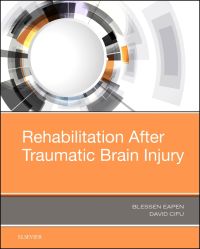
Rehabilitation After Traumatic Brain Injury, 1st Edition
Author :
By Blessen C. Eapen, MD and David X. Cifu, MD
Covering the full spectrum of rehabilitation after traumatic brain injury, this practical reference by Drs. Blessen C. Eapen and David X. Cifu presents best practices and considerations for numerous patient populations and their unique needs. In an e
...view more
Covering the full spectrum of rehabilitation after traumatic brain injury, this practical reference by Drs. Blessen C. Eapen and David X. Cifu presents best practices and considerations for numerous patient populations and their unique needs. In an easy-to-read, concise format, it covers the key information you need to guide your treatment plans and help patients relearn critical life skills and regain their independence.
Covering the full spectrum of rehabilitation after traumatic brain injury, this practical reference by Drs. Blessen C. Eapen and David X. Cifu presents best practices and considerations for numerous patient populations and their unique needs. In an easy-to-read, concise format, it covers the key information you need to guide your treatment plans and help patients relearn critical life skills and regain their independence.
Key Features
Covers neuroimaging, neurosurgical and critical care management, management of associated complications after TBI, pharmacotherapy, pain management, sports concussion, assistive technologies, and preparing patients for community reintegration.
Discusses special populations, including pediatric, geriatric, and military and veteran patients.
Consolidates today’s available information and guidance in this challenging and diverse area into one convenient resource.
Author Information
By Blessen C. Eapen, MD, Chief, Department of Physical Medicine and Rehabilitation (PM&R), VA Greater Los Angeles Healthcare System; Health Sciences Associate Clinical Professor, David Geffen School of Medicine at UCLA, Los Angeles, California and David X. Cifu, MD, Associate Dean of Innovation and System Integration and Eminent Scholar, Herman J. Flax, MD Professor and Chair, Department of, Physical Medicine and Rehabilitation, Senior Consultant, Sheltering Arms Institute, Virginia Commonwealth University School of Medicine, USA
By Blessen C. Eapen, MD, Chief, Department of Physical Medicine and Rehabilitation (PM&R), VA Greater Los Angeles Healthcare System; Health Sciences Associate Clinical Professor, David Geffen School of Medicine at UCLA, Los Angeles, California and David X. Cifu, MD, Associate Dean of Innovation and System Integration and Eminent Scholar, Herman J. Flax, MD Professor and Chair, Department of, Physical Medicine and Rehabilitation, Senior Consultant, Sheltering Arms Institute, Virginia Commonwealth University School of Medicine, USA
https://www.elsevierhealth.com.au/rehabilitation-after-traumatic-brain-injury-9780323544566.html295400Rehabilitation After Traumatic Brain Injuryhttps://www.elsevierhealth.com.au/media/catalog/product/9/7/9780323544566_7.jpg140.35155.95AUDInStock/Medicine & Surgery/Physical Medicine & Rehabilitation/Books/Medicine/Physical Medicine & Rehabilitation/Books/Books/Medicine/Physical Medicine & Rehabilitation/Japan Titles43351324388722505460950546645255039525989652631601418269243350884886536505455351451205259833<p>Covering the full spectrum of rehabilitation after traumatic brain injury, this practical reference by Drs. Blessen C. Eapen and David X. Cifu presents <b>best practices and considerations for numerous patient populations</b> and their unique needs. In an <b>easy-to-read, concise format</b>, it covers the key information you need to guide your treatment plans and help patients relearn critical life skills and regain their independence.</p> <p>Covering the full spectrum of rehabilitation after traumatic brain injury, this practical reference by Drs. Blessen C. Eapen and David X. Cifu presents <b>best practices and considerations for numerous patient populations</b> and their unique needs. In an <b>easy-to-read, concise format</b>, it covers the key information you need to guide your treatment plans and help patients relearn critical life skills and regain their independence.</p>00add-to-cart97803235445662018ProfessionalBy Blessen C. Eapen, MD and David X. Cifu, MD20191Book191w x 235h (7.50" x 9.25")Elsevier35026 Jan 2018Please allow 10-14 working days for deliveryBy <STRONG>Blessen C. Eapen</STRONG>, MD, Chief, Department of Physical Medicine and Rehabilitation (PM&R), VA Greater Los Angeles Healthcare System; Health Sciences Associate Clinical Professor, David Geffen School of Medicine at UCLA, Los Angeles, California and <STRONG>David X. Cifu</STRONG>, MD, Associate Dean of Innovation and System Integration and Eminent Scholar, Herman J. Flax, MD Professor and Chair, Department of, Physical Medicine and Rehabilitation, Senior Consultant, Sheltering Arms Institute, Virginia Commonwealth University School of Medicine, USABooksBookUnited StatesNoNoNoNoPlease SelectPlease SelectPlease Select