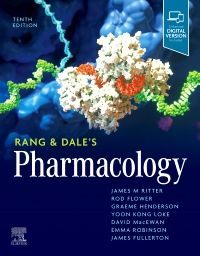
By James M. Ritter, DPhil FRCP FBPhS FMedSci, Rod J. Flower, PhD DSc FBPhS FMedSci FRS, Graeme Henderson, BSc PhD FBPhS FSB, Yoon Kong Loke, MB, BS, MRCP, MD, David MacEwan, PhD, FRSB, FBPhS, SFHEA, Emma Robinson, PhD, FBPhS and James Fullerton, MA, MBChB, MRCP, PhD, FHEA.
Rang and Dale’s Pharmacology is internationally acknowledged as the core textbook for students of pharmacology, and has provided accessible, up-to-date information on drugs and their mechanism of action for more than 30 years.Now in its tenth e
...view more
Rang and Dale’s Pharmacology is internationally acknowledged as the core textbook for students of pharmacology, and has provided accessible, up-to-date information on drugs and their mechanism of action for more than 30 years.
Now in its tenth edition, it has been updated to include important new drugs such as gene therapies, personalised medicines and the new wave of RNA drugs. However it has not lost any of the elements that have contributed to its popularity, such as color coding and illustrations, making it reader-friendly while comprehensively covering the depth of detail required.
This essential book is recommended as the first-choice undergraduate text for science and medical students and junior doctors and will also be useful for students in other professional disciplines such as pharmacy, veterinary medicine and nursing.
Rang and Dale’s Pharmacology is internationally acknowledged as the core textbook for students of pharmacology, and has provided accessible, up-to-date information on drugs and their mechanism of action for more than 30 years.
Now in its tenth edition, it has been updated to include important new drugs such as gene therapies, personalised medicines and the new wave of RNA drugs. However it has not lost any of the elements that have contributed to its popularity, such as color coding and illustrations, making it reader-friendly while comprehensively covering the depth of detail required.
This essential book is recommended as the first-choice undergraduate text for science and medical students and junior doctors and will also be useful for students in other professional disciplines such as pharmacy, veterinary medicine and nursing.
New to this edition
New chapters on drugs and the eye and the pharmacological management of headache
Revised information on biopharmaceuticals (including RNA drugs), antivirals (including Covid-19 therapies) as well as general principles of antimicrobial therapy.
A completely revised and updated chapter on lifestyle drugs
Recent advances in oxygen sensing and response to reduced oxygen tension
Expanded chapters on dementia and analgesic drugs
Key Features
Comprehensive information on drug mechanisms, basic physiology and biochemistry, and underlying pathophysiology of disease – suitable for students from many disciplines
Clear figures to aid understanding, including data figures as well as mechanistic diagrams,
Key points box summaries, clinical boxes and colour-coded chapters help to master difficult concepts
Emphasis on therapeutic drugs to help apply theory to practice
Over 150 questions and 12 clinical cases to test your knowledge
An enhanced eBook version is included with purchase. The eBook allows you to access all the text, figures and references, with the ability to search, customise your content, make notes and highlights, and have content read aloud
Author Information
By James M. Ritter, DPhil FRCP FBPhS FMedSci, Emeritus Professor of Clinical Pharmacology, King’s College London, and Medical Research Director, Quintiles, London, UK; Rod J. Flower, PhD DSc FBPhS FMedSci FRS, Professor, Biochemical Pharmacology, The William Harvey Research Institute, Barts and the London School of Medicine and Dentistry, Queen Mary University of London , London, UK; Graeme Henderson, BSc PhD FBPhS FSB, Professor of Pharmacology, University of Bristol, Bristol, UK; Yoon Kong Loke, MB, BS, MRCP, MD, Senior Lecturer in Clinical Pharmacology, School of Medicine, Health Policy and Practice, University of East Anglia, Norwich, UK; David MacEwan, PhD, FRSB, FBPhS, SFHEA, Professor of Molecular Pharmacology/Toxicology & Head of Department, Department of Molecular and Clinical Pharmacology, University of Liverpool, Liverpool, UK; Emma Robinson, PhD, FBPhS, Professor of Psychopharmacology, University of Bristol, Bristol, UK and James Fullerton, MA, MBChB, MRCP, PhD, FHEA., Associate Professor of Clinical Therapeutics and Honorary Consultant in Acute General Medicine and Clinical Pharmacology, University of Oxford, Oxford, UK
By James M. Ritter, DPhil FRCP FBPhS FMedSci, Emeritus Professor of Clinical Pharmacology, King’s College London, and Medical Research Director, Quintiles, London, UK; Rod J. Flower, PhD DSc FBPhS FMedSci FRS, Professor, Biochemical Pharmacology, The William Harvey Research Institute, Barts and the London School of Medicine and Dentistry, Queen Mary University of London , London, UK; Graeme Henderson, BSc PhD FBPhS FSB, Professor of Pharmacology, University of Bristol, Bristol, UK; Yoon Kong Loke, MB, BS, MRCP, MD, Senior Lecturer in Clinical Pharmacology, School of Medicine, Health Policy and Practice, University of East Anglia, Norwich, UK; David MacEwan, PhD, FRSB, FBPhS, SFHEA, Professor of Molecular Pharmacology/Toxicology & Head of Department, Department of Molecular and Clinical Pharmacology, University of Liverpool, Liverpool, UK; Emma Robinson, PhD, FBPhS, Professor of Psychopharmacology, University of Bristol, Bristol, UK and James Fullerton, MA, MBChB, MRCP, PhD, FHEA., Associate Professor of Clinical Therapeutics and Honorary Consultant in Acute General Medicine and Clinical Pharmacology, University of Oxford, Oxford, UK
SECTION 1 GENERAL PRINCIPLES 1. What is pharmacology? 2. How drugs act: general principles 3. How drugs act: molecular aspects 4. How drugs act: cellular aspects - excitation, contraction and secretion 5. How drugs act: Biopharmaceuticals and gene therapy 6. Cell proliferation, apoptosis, repair and regeneration 7. Cellular mechanisms: host defence 8. Method and measurement in pharmacology 9. Absorption and distribution of drugs 10. Drug metabolism and elimination 11. Pharmacokinetics 12. Individual variation, pharmacogenomics and personalised medicine
SECTION 2 CHEMICAL MEDIATORS 13. Chemical mediators and the autonomic nervous system 14. Cholinergic transmission 15. Noradrenergic transmission 16. 5-Hydroxytryptamine and purines 17. Local hormones: histamine, lipids, peptides and proteins 18. Cannabinoids 19. Nitric oxide and related mediators
SECTION 3 DRUGS AFFECTING MAJOR ORGAN SYSTEMS 20. The heart 21. The vascular system 22. Atherosclerosis and lipoprotein metabolism 23. Haemostasis and thrombosis 24. Haemopoietic system and treatment of anaemia 25. Anti-inflammatory and immunosuppressant drugs 26. Skin 27. Eye 28. Respiratory system 29. The kidney and urinary system 30. The gastrointestinal tract 31. The control of blood glucose and drug treatment of diabetes mellitus 32. Obesity 33. The pituitary and the adrenal cortex 34. Thyroid 35. The reproductive system 36. Bone metabolism
SECTION 4 NERVOUS SYSTEM 37. Chemical transmission and drug action in the central nervous system 38. Amino acid transmitters 39. Other transmitters and modulators 40. Neurodegenerative diseases 41. General anaesthetic agents 42. Headache 43. Analgesic drugs 44. Local anaesthetics and other drugs affecting sodium channels 45. Anxiolytic and hypnotic drugs 46. Antiepileptic drugs 47. Antipsychotic drugs 48. Antidepressant drugs 49. Psychoactive drugs 50. Drug use and addiction
SECTION 5 DRUGS USED FOR THE TREATMENT OF INFECTIONS AND CANCER 51. Basic principles of antimicrobial chemotherapy 52. Antibacterial drugs 53. Antiviral drugs 54. Antifungal drugs 55. Antiprotozoal drugs 56. Antihelminthic drugs 57. Anticancer drugs
SECTION 6 SPECIAL TOPICS 58. Harmful effects of drugs 59. Lifestyle drugs and drugs in sport 60. Drug discovery and development
https://www.elsevierhealth.com.au/rang-dales-pharmacology-9780323873956.html297876Rang & Dale's Pharmacologyhttps://www.elsevierhealth.com.au/media/catalog/product/9/7/9780323873956_5.jpg112.45124.95AUDInStock/Books/Books/Medicine & Surgery/Pharmacology/Medicine/Pharmacology/Students/First years/Students/Pharmacology/Books/Medicine/Pharmacology/Japan Titles/Students/Pharmacology/Students/Pharmacology/Bestsellers/Bestsellers/Medical Students/Medical education/Medical Students/Medical education/Medical Students/Pharmacology/Students/Basic Science4388722505466443351295054602505802550596535255039525988952631605261565526156650613774695389549644654964475310973505802714182692488653643350885054553505802451451205259833526155053030195303018<p><i>Rang and Dale’s Pharmacology</i> is internationally acknowledged as the core textbook for students of pharmacology, and has provided accessible, up-to-date information on drugs and their mechanism of action for more than 30 years.<BR><BR>Now in its tenth edition, it has been updated to include important new drugs such as gene therapies, personalised medicines and the new wave of RNA drugs. However it has not lost any of the elements that have contributed to its popularity, such as color coding and illustrations, making it reader-friendly while comprehensively covering the depth of detail required.<BR><BR>This essential book is recommended as the first-choice undergraduate text for science and medical students and junior doctors and will also be useful for students in other professional disciplines such as pharmacy, veterinary medicine and nursing.</p> <p><i>Rang and Dale’s Pharmacology</i> is internationally acknowledged as the core textbook for students of pharmacology, and has provided accessible, up-to-date information on drugs and their mechanism of action for more than 30 years.<BR><BR>Now in its tenth edition, it has been updated to include important new drugs such as gene therapies, personalised medicines and the new wave of RNA drugs. However it has not lost any of the elements that have contributed to its popularity, such as color coding and illustrations, making it reader-friendly while comprehensively covering the depth of detail required.<BR><BR>This essential book is recommended as the first-choice undergraduate text for science and medical students and junior doctors and will also be useful for students in other professional disciplines such as pharmacy, veterinary medicine and nursing.</p>00add-to-cart97803238739562023ProfessionalBy James M. Ritter, DPhil FRCP FBPhS FMedSci, Rod J. Flower, PhD DSc FBPhS FMedSci FRS, Graeme Henderson, BSc PhD FBPhS FSB, Yoon Kong Loke, MB, BS, MRCP, MD, David MacEwan, PhD, FRSB, FBPhS, SFHEA, Emma Robinson, PhD, FBPhS and James Fullerton, MA, MBChB, MRCP, PhD, FHEA.202410Book216w x 276h (8.50" x 10.875")Elsevier85426 May 2023IN STOCKBy <STRONG>James M. Ritter</STRONG>, DPhil FRCP FBPhS FMedSci, Emeritus Professor of Clinical Pharmacology, King’s College London, and Medical Research Director, Quintiles, London, UK; <STRONG>Rod J. Flower</STRONG>, PhD DSc FBPhS FMedSci FRS, Professor, Biochemical Pharmacology, The William Harvey Research Institute, Barts and the London School of Medicine and Dentistry, Queen Mary University of London , London, UK; <STRONG>Graeme Henderson</STRONG>, BSc PhD FBPhS FSB, Professor of Pharmacology, University of Bristol, Bristol, UK; <STRONG>Yoon Kong Loke</STRONG>, MB, BS, MRCP, MD, Senior Lecturer in Clinical Pharmacology, School of Medicine, Health Policy and Practice, University of East Anglia, Norwich, UK; <STRONG>David MacEwan</STRONG>, PhD, FRSB, FBPhS, SFHEA, Professor of Molecular Pharmacology/Toxicology & Head of Department, Department of Molecular and Clinical Pharmacology, University of Liverpool, Liverpool, UK; <STRONG>Emma Robinson</STRONG>, PhD, FBPhS, Professor of Psychopharmacology, University of Bristol, Bristol, UK and <STRONG>James Fullerton</STRONG>, MA, MBChB, MRCP, PhD, FHEA., Associate Professor of Clinical Therapeutics and Honorary Consultant in Acute General Medicine and Clinical Pharmacology, University of Oxford, Oxford, UKBooksBookUnited StatesYesYesNoNoPlease SelectPlease SelectPlease Select