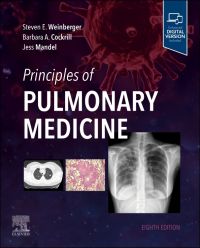
Using a concise, understandable approach, Principles of Pulmonary Medicine, 8th Edition, provides a broad overview of this fast-changing field, integrating clinical topics with underlying physiologic, pathophysiologic, and basic science concepts. Fro
...view more
Using a concise, understandable approach, Principles of Pulmonary Medicine, 8th Edition, provides a broad overview of this fast-changing field, integrating clinical topics with underlying physiologic, pathophysiologic, and basic science concepts. From cover to cover, it clearly explains and illustrates even the most challenging concepts in a uniquely readable and digestible fashion. With its emphasis on pathophysiology and diagnosis as the basis for optimal management of respiratory disorders, this popular text is an essential reference for medical students, trainees, and those looking for a practical update on both acute and chronic pulmonary diseases.
Using a concise, understandable approach, Principles of Pulmonary Medicine, 8th Edition, provides a broad overview of this fast-changing field, integrating clinical topics with underlying physiologic, pathophysiologic, and basic science concepts. From cover to cover, it clearly explains and illustrates even the most challenging concepts in a uniquely readable and digestible fashion. With its emphasis on pathophysiology and diagnosis as the basis for optimal management of respiratory disorders, this popular text is an essential reference for medical students, trainees, and those looking for a practical update on both acute and chronic pulmonary diseases.
Key Features
Presents physiologic concepts, pathogenetic and pathophysiologic mechanisms, and radiologic and pathologic correlates of disease in a clear, understandable manner.
Features extensive content updates on interstitial lung disease, emerging and/or viral infections (including COVID-19), lung cancer, asthma, and new biologic and immunologic treatments available for a variety of diseases.
Contains excellent visuals for understanding and interpreting pulmonary disease with easy-to-understand anatomic illustrations and accompanying radiologic and pathophysiologic images—now all in full color for the first time. This edition provides even more images, especially chest radiographs and CT scans, that offer more examples of clinical disorders.
Provides therapeutic strategies, including evidence for assessing relative benefits, harms, and costs.
Includes useful appendices that provide simplified methods for interpreting pulmonary function tests and arterial blood gases, while also presenting sample problems that test the reader’s ability to use respiratory equations, assess pulmonary function abnormalities, and interpret arterial blood gases.
Provides access to extensive online content such as author commentaries, video clips, audio recordings of lung sounds, and over 200 case-based self-assessment questions modeled after the USMLE exam.
Includes margin notes throughout the text that summarize the major points and concepts and allow the reader to quickly review the material.
An eBook version is included with purchase. The eBook allows you to access all of the text, figures and references, with the ability to search, customize your content, make notes and highlights, and have content read aloud.
Author Information
By Steven E. Weinberger, MD, MACP, FRCP, Executive Vice President and Chief Executive Officer, American College of Physicians; Adjunct Professor of Medicine, Perelman School of Medicine at the University of Pennsylvania, Philadelphia, Pennsylvania.; Barbara A. Cockrill, MD, Pulmonary Vascular Disease Center, Brigham and Women's Hospital; Harold Amos Associate Professor of Medicine, Harvard Medical School, Boston, Massachusetts and Jess Mandel, MD, FACP, Chief, Division of Pulmonary, Critical Care, and Sleep Medicine, University of California San Diego School of Medicine, La Jolla, California
By Steven E. Weinberger, MD, MACP, FRCP, Executive Vice President and Chief Executive Officer, American College of Physicians; Adjunct Professor of Medicine, Perelman School of Medicine at the University of Pennsylvania, Philadelphia, Pennsylvania.; Barbara A. Cockrill, MD, Pulmonary Vascular Disease Center, Brigham and Women's Hospital; Harold Amos Associate Professor of Medicine, Harvard Medical School, Boston, Massachusetts and Jess Mandel, MD, FACP, Chief, Division of Pulmonary, Critical Care, and Sleep Medicine, University of California San Diego School of Medicine, La Jolla, California
1 Pulmonary Anatomy and Physiology: The Basics 2 Presentation of the Patient With Pulmonary Disease 3 Evaluation of the Patient With Pulmonary Disease 4 Anatomic and Physiologic Aspects of Airways 5 Asthma 6 Chronic Obstructive Pulmonary Disease 7 Miscellaneous Airway Diseases 8 Anatomic and Physiologic Aspects of the Pulmonary Parenchyma 9 Overview of Diffuse Parenchymal Lung Diseases 10 Diffuse Parenchymal Lung Diseases Associated With Known Etiologic Agents 11 Diffuse Parenchymal Lung Diseases of Unknown Etiology 12 Anatomic and Physiologic Aspects of the Pulmonary Vasculature 13 Pulmonary Embolism 14 Pulmonary Hypertension 15 Pleural Disease 16 Mediastinal Disease 17 Anatomic and Physiologic Aspects of Neural, Muscular, and Chest Wall Interactions With the Lungs 18 Disorders of Ventilatory Control 19 Disorders of the Respiratory Pump 20 Lung Cancer: Etiologic and Pathologic Aspects 21 Lung Cancer: Clinical Aspects 22 Lung Defense Mechanisms 23 Pneumonia 24 Bacterial and Viral Organisms Causing Pneumonia 25 Tuberculosis and Nontuberculous Mycobacteria 26 Miscellaneous Infections Caused by Fungi, Including Pneumocystis 27 Pulmonary Complications in the Immunocompromised Host 28 Classification and Pathophysiologic Aspects of Respiratory Failure 29 Acute Respiratory Distress Syndrome 30 Management of Respiratory Failure Appendix A Sample Problems Using Respiratory Equations Appendix B Pulmonary Function Tests: Guidelines for Interpretation and Sample Problems Appendix C Arterial Blood Gases: Guidelines for Interpretation and Sample Problems Index
https://www.elsevierhealth.com.au/principles-of-pulmonary-medicine-9780323880565.html297935Principles of Pulmonary Medicinehttps://www.elsevierhealth.com.au/media/catalog/product/9/7/9780323880565_4.jpg95.22126.95AUDInStock/Medicine & Surgery/Respiratory Medicine /Books/Medicine/Respiratory Medicine /Books/Books/Medicine/Respiratory Medicine/Japan Titles43351234388722505459550546645255039525987952631601418269243350884886536505455351451205259833Using a concise, understandable approach, Principles of Pulmonary Medicine, 8th Edition, provides a broad overview of this fast-changing field, integrating clinical topics with underlying physiologic, pathophysiologic, and basic science concepts. From cover to cover, it clearly explains and illustrates even the most challenging concepts in a uniquely readable and digestible fashion. With its emphasis on pathophysiology and diagnosis as the basis for optimal management of respiratory disorders, this popular text is an essential reference for medical students, trainees, and those looking for a practical update on both acute and chronic pulmonary diseases. Using a concise, understandable approach, Principles of Pulmonary Medicine, 8th Edition, provides a broad overview of this fast-changing field, integrating clinical topics with underlying physiologic, pathophysiologic, and basic science concepts. From cover to cover, it clearly explains and illustrates even the most challenging concepts in a uniquely readable and digestible fashion. With its emphasis on pathophysiology and diagnosis as the basis for optimal management of respiratory disorders, this popular text is an essential reference for medical students, trainees, and those looking for a practical update on both acute and chronic pulmonary diseases. 00add-to-cart97803238805652023ProfessionalBy Steven E. Weinberger, MD, MACP, FRCP, Barbara A. Cockrill, MD and Jess Mandel, MD, FACP20248Book216w x 276h (8.50" x 10.875")Elsevier4286 Jul 2023Please allow 3-4 weeks for deliveryBy <STRONG>Steven E. Weinberger</STRONG>, MD, MACP, FRCP, Executive Vice President and Chief Executive Officer, American College of Physicians; Adjunct Professor of Medicine, Perelman School of Medicine at the University of Pennsylvania, Philadelphia, Pennsylvania.; <STRONG>Barbara A. Cockrill</STRONG>, MD, Pulmonary Vascular Disease Center, Brigham and Women's Hospital; Harold Amos Associate Professor of Medicine, Harvard Medical School, Boston, Massachusetts and <STRONG>Jess Mandel</STRONG>, MD, FACP, Chief, Division of Pulmonary, Critical Care, and Sleep Medicine, University of California San Diego School of Medicine, La Jolla, CaliforniaBooksBookUnited StatesNoNoNoNoPlease SelectPlease SelectPlease Select