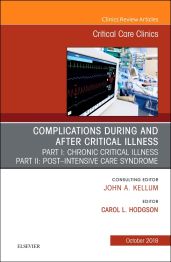
Post-intensive Care Syndrome & Chronic Critical Illness, An Issue of Critical Care Clinics, 1st Edition
Author :
By Carol Hodgson
This issue of Critical Care Clinics focuses on Post-intensive Care Syndrome & Chronic Critical Illness, with topics including: Chronic Critical Illness; Chronic Critical Illness and Predicting Outcomes; Persistent Critical Illness; Reho
...view more
This issue of Critical Care Clinics focuses on Post-intensive Care Syndrome & Chronic Critical Illness, with topics including: Chronic Critical Illness; Chronic Critical Illness and Predicting Outcomes; Persistent Critical Illness; Rehospitalization and Preventing CCI; Measuring Post-Intensive Care Syndrome; Post-Intensive Care Syndrome and teh Role of the ICU Clinician; Frailty and the Association between Long-Term Recovery After ICU; The Role of the Muscles in Post-Intensive Care Syndrome; Intensive Care Nutrition and Post-Intensive Care Recovery; Early mobilization in the ICU to Improve Long Term Recovery; The Use of Sedation in the ICU and Long-Term Outcomes; Cognitive Function after Critical Illness; Anxiety and Depression after ICU; and Family and Support Networks after ICU.
This issue of Critical Care Clinics focuses on Post-intensive Care Syndrome & Chronic Critical Illness, with topics including: Chronic Critical Illness; Chronic Critical Illness and Predicting Outcomes; Persistent Critical Illness; Rehospitalization and Preventing CCI; Measuring Post-Intensive Care Syndrome; Post-Intensive Care Syndrome and teh Role of the ICU Clinician; Frailty and the Association between Long-Term Recovery After ICU; The Role of the Muscles in Post-Intensive Care Syndrome; Intensive Care Nutrition and Post-Intensive Care Recovery; Early mobilization in the ICU to Improve Long Term Recovery; The Use of Sedation in the ICU and Long-Term Outcomes; Cognitive Function after Critical Illness; Anxiety and Depression after ICU; and Family and Support Networks after ICU.
https://www.elsevierhealth.com.au/post-intensive-care-syndrome-chronic-critical-illness-an-issue-of-critical-care-clinics-9780323641098.html295979Post-intensive Care Syndrome & Chronic Critical Illness, An Issue of Critical Care Clinicshttps://www.elsevierhealth.com.au/media/catalog/product/9/7/9780323641098_9.jpg104.21138.95AUDInStock/Medicine & Surgery/Critical Care/Clinics/Medicine/Critical Care/Clinics/Clinics/Medicine/Critical Care/Japan Titles43351044388725505456850546665255041525984952631601418269243350884886536505455351451205259833This issue of Critical Care Clinics focuses on Post-intensive Care Syndrome & Chronic Critical Illness, with topics including: Chronic Critical Illness; Chronic Critical Illness and Predicting Outcomes; Persistent Critical Illness; Rehospitalization and Preventing CCI; Measuring Post-Intensive Care Syndrome; Post-Intensive Care Syndrome and teh Role of the ICU Clinician; Frailty and the Association between Long-Term Recovery After ICU; The Role of the Muscles in Post-Intensive Care Syndrome; Intensive Care Nutrition and Post-Intensive Care Recovery; Early mobilization in the ICU to Improve Long Term Recovery; The Use of Sedation in the ICU and Long-Term Outcomes; Cognitive Function after Critical Illness; Anxiety and Depression after ICU; and Family and Support Networks after ICU. This issue of Critical Care Clinics focuses on Post-intensive Care Syndrome & Chronic Critical Illness, with topics including: Chronic Critical Illness; Chronic Critical Illness and Predicting Outcomes; Persistent Critical Illness; Rehospitalization and Preventing CCI; Measuring Post-Intensive Care Syndrome; Post-Intensive Care Syndrome and teh Role of the ICU Clinician; Frailty and the Association between Long-Term Recovery After ICU; The Role of the Muscles in Post-Intensive Care Syndrome; Intensive Care Nutrition and Post-Intensive Care Recovery; Early mobilization in the ICU to Improve Long Term Recovery; The Use of Sedation in the ICU and Long-Term Outcomes; Cognitive Function after Critical Illness; Anxiety and Depression after ICU; and Family and Support Networks after ICU.00add-to-cart97803236410982018ProfessionalBy Carol Hodgson20181Book152w x 229h (6.00" x 9.00")Elsevier24025 Oct 2018Please allow 10-14 working days for deliveryBy <STRONG>Carol Hodgson</STRONG>ClinicsClinicsThe Clinics: Internal MedicineUnited StatesNoNoNoNoPlease SelectPlease SelectPlease Select