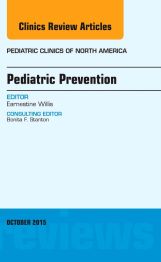
Pediatric Prevention, An Issue of Pediatric Clinics, 1st Edition
Author :
By Earnestine Willis, MD
Preventive pediatrics remains the foundation for pediatricians to offer benefits for future generations. Social conditions often complicate health status and bureaucracies pose challenges for families and children to navigate service systems. Theref
...view more
Preventive pediatrics remains the foundation for pediatricians to offer benefits for future generations. Social conditions often complicate health status and bureaucracies pose challenges for families and children to navigate service systems. Therefore, it is crucial to emphasize a host of topics that children and families face in addition to highlighting opportunities for overcoming some of those challenges. In this issue, an array of authors will update pediatricians on the prevalence and management of chronic health and social conditions such as childhood poverty, youth violence, oral health, asthma, foster care, toxin exposures including tobacco, and childhood obesity. Promising interventions that pediatricians should continue to examine include: how pediatricians can advocate for breastfeeding as a wellness concept for working mothers in the workplace; promotion of childhood literacy development; maximizing immunization compliance; monitor the impact of public policy such as the Affordable Care Act (ACA) on children’s health; and how community health workers (CHWs) can be vital to community health improvement. Proposed interventions include a description of how the medical and legal partnership model can be an empowering strategy for families to address social determinants of health (SDH) when lawyers are included as a member of the health care team. In addition, pediatricians and all other child healthcare professionals must investigate epigenetic mechanisms that might predispose children to risk factors or good health outcomes.
Preventive pediatrics remains the foundation for pediatricians to offer benefits for future generations. Social conditions often complicate health status and bureaucracies pose challenges for families and children to navigate service systems. Therefore, it is crucial to emphasize a host of topics that children and families face in addition to highlighting opportunities for overcoming some of those challenges. In this issue, an array of authors will update pediatricians on the prevalence and management of chronic health and social conditions such as childhood poverty, youth violence, oral health, asthma, foster care, toxin exposures including tobacco, and childhood obesity. Promising interventions that pediatricians should continue to examine include: how pediatricians can advocate for breastfeeding as a wellness concept for working mothers in the workplace; promotion of childhood literacy development; maximizing immunization compliance; monitor the impact of public policy such as the Affordable Care Act (ACA) on children’s health; and how community health workers (CHWs) can be vital to community health improvement. Proposed interventions include a description of how the medical and legal partnership model can be an empowering strategy for families to address social determinants of health (SDH) when lawyers are included as a member of the health care team. In addition, pediatricians and all other child healthcare professionals must investigate epigenetic mechanisms that might predispose children to risk factors or good health outcomes.
Author Information
By Earnestine Willis, MD, Medical College of Wisconsin, Milwaukee, WI
https://www.elsevierhealth.com.au/pediatric-prevention-an-issue-of-pediatric-clinics-9780323400985.html294572Pediatric Prevention, An Issue of Pediatric Clinicshttps://www.elsevierhealth.com.au/media/catalog/product/9/7/9780323400985_7.jpg126.71168.95AUDInStock/Clinics/Medicine & Surgery/Pediatrics/Medicine/Pediatrics/Clinics/Clinics/Medicine/Pediatrics/Japan Titles43887254335149505457850546665255041525985952631601418269243350884886536505455351451205259833Preventive pediatrics remains the foundation for pediatricians to offer benefits for future generations. Social conditions often complicate health status and bureaucracies pose challenges for families and children to navigate service systems. Therefore, it is crucial to emphasize a host of topics that children and families face in addition to highlighting opportunities for overcoming some of those challenges. In this issue, an array of authors will update pediatricians on the prevalence and management of chronic health and social conditions such as childhood poverty, youth violence, oral health, asthma, foster care, toxin exposures including tobacco, and childhood obesity. Promising interventions that pediatricians should continue to examine include: how pediatricians can advocate for breastfeeding as a wellness concept for working mothers in the workplace; promotion of childhood literacy development; maximizing immunization compliance; monitor the impact of public policy such as the Affordable Care Act (ACA) on children’s health; and how community health workers (CHWs) can be vital to community health improvement. Proposed interventions include a description of how the medical and legal partnership model can be an empowering strategy for families to address social determinants of health (SDH) when lawyers are included as a member of the health care team. In addition, pediatricians and all other child healthcare professionals must investigate epigenetic mechanisms that might predispose children to risk factors or good health outcomes. Preventive pediatrics remains the foundation for pediatricians to offer benefits for future generations. Social conditions often complicate health status and bureaucracies pose challenges for families and children to navigate service systems. Therefore, it is crucial to emphasize a host of topics that children and families face in addition to highlighting opportunities for overcoming some of those challenges. In this issue, an array of authors will update pediatricians on the prevalence and management of chronic health and social conditions such as childhood poverty, youth violence, oral health, asthma, foster care, toxin exposures including tobacco, and childhood obesity. Promising interventions that pediatricians should continue to examine include: how pediatricians can advocate for breastfeeding as a wellness concept for working mothers in the workplace; promotion of childhood literacy development; maximizing immunization compliance; monitor the impact of public policy such as the Affordable Care Act (ACA) on children’s health; and how community health workers (CHWs) can be vital to community health improvement. Proposed interventions include a description of how the medical and legal partnership model can be an empowering strategy for families to address social determinants of health (SDH) when lawyers are included as a member of the health care team. In addition, pediatricians and all other child healthcare professionals must investigate epigenetic mechanisms that might predispose children to risk factors or good health outcomes.00add-to-cart97803234009852015ProfessionalBy Earnestine Willis, MD20151BookOtherElsevier07 Sep 2015Please allow 10-14 working days for deliveryBy <STRONG>Earnestine Willis</STRONG>, MD, Medical College of Wisconsin, Milwaukee, WIClinicsClinicsThe Clinics: Internal MedicineUnited StatesNoNoNoNoPlease SelectPlease SelectPlease Select