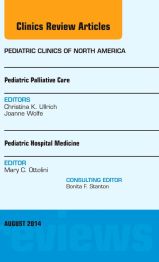
Pediatric Hospital Medicine and Pediatric Palliative Care, An Issue of Pediatric Clinics, 1st Edition
Author :
By Mary C. Ottolini, MD and Christina K. Ullrich, MD
For the first time, Pediatric Clinics is devoting one issue to two clinically focused topics: Pediatric Palliative Care and Pediatric Hospital Medicine. Dr. Ottolini has organized her section to focus on a variety of issues of relevant to all pediatr
...view more
For the first time, Pediatric Clinics is devoting one issue to two clinically focused topics: Pediatric Palliative Care and Pediatric Hospital Medicine. Dr. Ottolini has organized her section to focus on a variety of issues of relevant to all pediatricians, but which pose special challenge to the Pediatric Hospitalists. As pediatric care has advanced, children who would not have survived infancy are growing into young adults with complex chronic diseases and dependence upon technology. They frequently require hospitalization to address exacerbation of underlying disease processes and procedures to improve their quality of life. The articles are devoted to patient care challenges of troubleshooting malfunctioning technology, co-managing medically complex patients pre and post-op with surgical colleagues, and the Hospitalist’s evolving role in performing procedures and sedation in this population of vulnerable patients. Also discussed rare strategies to maximize communication with parents, patients and primary care providers during hospitalization, especially for medically complex patients. Dr. Ullrich and Dr. Wolfe Pediatric have worked to bring relevant articles on palliative care to the pediatrician. While life-threatening conditions in childhood are rare, children with LTC account for a high proportion of pediatric hospital care, and about one half of such children die in the inpatient setting. The number of hospital-based pediatric palliative care programs has increased dramatically over the past decade to meet the palliative care needs of hospitalized children including symptom management, facilitation of communication, decision-making and advance care planning support, and coordination of care. Given these considerations, it is evident that the topics of pediatric palliative care and hospital medicine are fitting counterparts for this comprehensive issue.
For the first time, Pediatric Clinics is devoting one issue to two clinically focused topics: Pediatric Palliative Care and Pediatric Hospital Medicine. Dr. Ottolini has organized her section to focus on a variety of issues of relevant to all pediatricians, but which pose special challenge to the Pediatric Hospitalists. As pediatric care has advanced, children who would not have survived infancy are growing into young adults with complex chronic diseases and dependence upon technology. They frequently require hospitalization to address exacerbation of underlying disease processes and procedures to improve their quality of life. The articles are devoted to patient care challenges of troubleshooting malfunctioning technology, co-managing medically complex patients pre and post-op with surgical colleagues, and the Hospitalist’s evolving role in performing procedures and sedation in this population of vulnerable patients. Also discussed rare strategies to maximize communication with parents, patients and primary care providers during hospitalization, especially for medically complex patients. Dr. Ullrich and Dr. Wolfe Pediatric have worked to bring relevant articles on palliative care to the pediatrician. While life-threatening conditions in childhood are rare, children with LTC account for a high proportion of pediatric hospital care, and about one half of such children die in the inpatient setting. The number of hospital-based pediatric palliative care programs has increased dramatically over the past decade to meet the palliative care needs of hospitalized children including symptom management, facilitation of communication, decision-making and advance care planning support, and coordination of care. Given these considerations, it is evident that the topics of pediatric palliative care and hospital medicine are fitting counterparts for this comprehensive issue.
Author Information
By Mary C. Ottolini, MD, Children's National Medical Center, Washington, DC and Christina K. Ullrich, MD, Dana Farber Cancer Institute, Boston, MA
https://www.elsevierhealth.com.au/pediatric-hospital-medicine-and-pediatric-palliative-care-an-issue-of-pediatric-clinics-9780323320221.html294144Pediatric Hospital Medicine and Pediatric Palliative Care, An Issue of Pediatric Clinicshttps://www.elsevierhealth.com.au/media/catalog/product/9/7/9780323320221_7.jpg126.71168.95AUDInStock/Clinics/Medicine & Surgery/Pediatrics/Medicine/Pediatrics/Clinics/Clinics/Medicine/Pediatrics/Japan Titles43887254335149505457850546665255041525985952631601418269243350884886536505455351451205259833For the first time, Pediatric Clinics is devoting one issue to two clinically focused topics: Pediatric Palliative Care and Pediatric Hospital Medicine. Dr. Ottolini has organized her section to focus on a variety of issues of relevant to all pediatricians, but which pose special challenge to the Pediatric Hospitalists. As pediatric care has advanced, children who would not have survived infancy are growing into young adults with complex chronic diseases and dependence upon technology. They frequently require hospitalization to address exacerbation of underlying disease processes and procedures to improve their quality of life. The articles are devoted to patient care challenges of troubleshooting malfunctioning technology, co-managing medically complex patients pre and post-op with surgical colleagues, and the Hospitalist’s evolving role in performing procedures and sedation in this population of vulnerable patients. Also discussed rare strategies to maximize communication with parents, patients and primary care providers during hospitalization, especially for medically complex patients. Dr. Ullrich and Dr. Wolfe Pediatric have worked to bring relevant articles on palliative care to the pediatrician. While life-threatening conditions in childhood are rare, children with LTC account for a high proportion of pediatric hospital care, and about one half of such children die in the inpatient setting. The number of hospital-based pediatric palliative care programs has increased dramatically over the past decade to meet the palliative care needs of hospitalized children including symptom management, facilitation of communication, decision-making and advance care planning support, and coordination of care. Given these considerations, it is evident that the topics of pediatric palliative care and hospital medicine are fitting counterparts for this comprehensive issue. For the first time, Pediatric Clinics is devoting one issue to two clinically focused topics: Pediatric Palliative Care and Pediatric Hospital Medicine. Dr. Ottolini has organized her section to focus on a variety of issues of relevant to all pediatricians, but which pose special challenge to the Pediatric Hospitalists. As pediatric care has advanced, children who would not have survived infancy are growing into young adults with complex chronic diseases and dependence upon technology. They frequently require hospitalization to address exacerbation of underlying disease processes and procedures to improve their quality of life. The articles are devoted to patient care challenges of troubleshooting malfunctioning technology, co-managing medically complex patients pre and post-op with surgical colleagues, and the Hospitalist’s evolving role in performing procedures and sedation in this population of vulnerable patients. Also discussed rare strategies to maximize communication with parents, patients and primary care providers during hospitalization, especially for medically complex patients. Dr. Ullrich and Dr. Wolfe Pediatric have worked to bring relevant articles on palliative care to the pediatrician. While life-threatening conditions in childhood are rare, children with LTC account for a high proportion of pediatric hospital care, and about one half of such children die in the inpatient setting. The number of hospital-based pediatric palliative care programs has increased dramatically over the past decade to meet the palliative care needs of hospitalized children including symptom management, facilitation of communication, decision-making and advance care planning support, and coordination of care. Given these considerations, it is evident that the topics of pediatric palliative care and hospital medicine are fitting counterparts for this comprehensive issue.00add-to-cart97803233202212014ProfessionalBy Mary C. Ottolini, MD and Christina K. Ullrich, MD20141BookOtherElsevier04 Aug 2014Please allow 10-14 working days for deliveryBy <STRONG>Mary C. Ottolini</STRONG>, MD, Children's National Medical Center, Washington, DC and <STRONG>Christina K. Ullrich</STRONG>, MD, Dana Farber Cancer Institute, Boston, MAClinicsClinicsThe Clinics: Internal MedicineUnited StatesNoNoNoNoPlease SelectPlease SelectPlease Select