
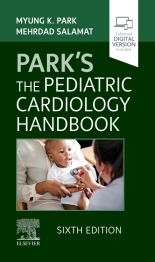
Park's The Pediatric Cardiology Handbook, 6th Edition
Key Features
-
Provides extensive updates on congenital heart defects, infective endocarditis, cardiomyopathies, cardiac arrhythmias, long QT syndrome, blood pressure,systemic hypertension, dyslipidemia and Kawasaki disease
-
Includes new recommendations on lipid screening for children, preventive cardiology including childhood obesity, sport participation using new 14-point evalaution as well as the normative blood pressure standards for auscillometric and oscillometric methods obtained in the San Antonio Children’s Blood Pressure Study.
-
Offers an expanded section on two-dimensional echocardiography, along with detailed normative values of echocardiography in the appendix.
-
Covers the newest approaches in the area of cardiac surgery, such as hybrid procedures as well as non-surgical, percutaneous management of certain heart defects.
-
Enhanced eBook version included with purchase. Your enhanced eBook allows you to access all of the text, figures, and references from the book on a variety of devices.
Author Information
| ISBN Number | 9780323718660 |
|---|---|
| Description Author List | By Myung K. Park, MD, FAAP, FACC, (Editor Emeritus), Professor Emeritus (Pediatrics), Former Director of Pediatric Cardiology, Former Director of Preventative Cardiology and Weight Management Clinics, University of Texas Health Science Center, San Antonio, Texas, USA and Mehrdad Salamat, MD, FAAP, FACC, Clinical Associate Professor of Pediatrics, Texas A&M University College of Medicine, Bryan, Texas, USA |
| Copyright Year | 2022 |
| Edition Number | 6 |
| Format | Book |
| Trim | Other |
| Illustrations | 110 illustrations |
| Imprint | Elsevier |
| Page Count | 536 |
| Publication Date | 6 Feb 2021 |
| Stock Status | Please allow 3-4 weeks for delivery |


eBooks : Built for busy schedules & tailored for your goals.


Affordable knowledge, built for you
Get the resources you need-often at a lower cost than print. Quality content designed to support your goals, without stretching your budget.


Seamless access wherever you are


Always in sync


Tools the make learning stick
Your eBook is ready whenever you are!
1. Check your email for your access code.


2. Sign into or create your VitalSource account and redeem your code.


3. Open your eBook - ready whenever you are!
FAQ
The access code for your new eBook will be sent in your order confirmation email. Your code can also be accessed in your My Account section on the Elsevier webshop. If you do not receive your code within a few minutes, please check your spam folder.
Step-by-step guidance on how to download Bookshelf and also redeem your code can be found here.
The access code for your new eBook does not expire. However, we always suggest redeeming immediately after purchase to start experiencing the benefits of and insights from your purchase. Important to note - the code provided is a single use code and only valid for the edition you purchase. It does not provide access to past nor future editions of the title.
You will have unlimited access to your eBook on the device to which it was downloaded.
Discover the various learning features that our eBooks offer on the Bookshelf® Reader! For example, you can highlight different text passages, create notes and flashcards, have the text read to you, etc. Particularly practical: You can also use your eBooks offline. More information on the learning functions can be found on the Vitalsource page.
Quality is our top priority. That's why we collaborate with the leading eBook reader provider VitalSource. VitalSource has its own eBook reader Bookshelf®, which you can easily download. This reader is very user-friendly and offers more features than other standard readers. For example, you can highlight different text passages, create notes and flashcards, have the text read to you, etc. Particularly practical: You can also use your eBooks offline. More information can be found on the Vitalsource page.
Elsevier offers its eBooks in ePub format, as we believe this format is best suited to display our content ideally on as many devices as possible.
You can return your eBook within 13 days of purchase. eBooks that have been partially printed or flipped through more than 15% are excluded from returns.
Any questions ?
Top Picks from Our Community
Frequently Used Abbreviations
Part I: Basic Tools in Evaluation of Cardiac Patients
Chapter 1 History and Physical Examination
Chapter 2 Electrocardiography
Chapter 3 Chest Roentgenography
Part II: Special Tools Used in Cardiac Evaluation
Chapter 4 Noninvasive Imaging Tools
Chapter 5 Other Noninvasive Tools
Chapter 6 Invasive Procedures
Part III: Congenital Heart Defects
Chapter 7 Left-to-Right Shunt Lesions
Chapter 8 Obstructive Lesions
Chapter 9 Cyanotic Congenital Heart Defects
Chapter 10 Miscellaneous Congenital Heart Diseases
Part IV: Acquired Heart Diseases
Chapter 11 Primary Myocardial Diseases (Cardiomyopathy)
Chapter 12 Cardiovascular Infections and Related Conditions
Chapter 13 Valvular Heart Disease
Chapter 14 Cardiac Tumors
Chapter 15 Cardiovascular Involvement in Systemic Diseases
Part V: Arrhythmias and Atrioventricular Conduction Disturbances
Chapter 16 Cardiac Arrhythmias
Chapter 17 Atrioventricular Conduction Disturbances
Chapter 18 Pacemakers and Implantable Cardioverter Defibrillators
Part VI: Special Problems
Chapter 19 Congestive Heart Failure
Chapter 20 Child with Chest Pain
Chapter 21 Syncope
Chapter 22 Palpitation
Chapter 23 Systemic Hypertension
Chapter 24 Pulmonary Hypertension
Chapter 25 Athletes with Cardiac Problems
Chapter 26 Dyslipidemias
Chapter 27 Preventive Cardiology
Part VII: Cardiac Surgical Patients
Chapter 28 Pre- and Postoperative Management
Chapter 29 Selected Postoperative Complications
Appendices
Appendix A. Miscellaneous
Appendix B. Blood Pressure


