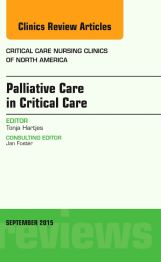
Palliative Care in Critical Care, An Issue of Critical Care Nursing Clinics of North America, 1st Edition
Author :
By Tonja Hartjes, DNP, CNS, APRN, CNE®cl, CCRN, FAANP
Intensive care units (ICUs) provide comprehensive, advanced care to patients with serious or life-threatening conditions and consequently, a significant amount of end-of-life care (EOLC). Indeed, approximately 20% of deaths in the U.S. are associated
...view more
Intensive care units (ICUs) provide comprehensive, advanced care to patients with serious or life-threatening conditions and consequently, a significant amount of end-of-life care (EOLC). Indeed, approximately 20% of deaths in the U.S. are associated with an ICU stay, and nearly half of U.S. patients who die in hospitals experience an ICU stay during the last 3 days of life. Despite the commonality of the ICU experience, ICU patients typically suffer from a range of distressing symptoms such as pain, fatigue, anxiety, and dyspnea, causing families significant distress on their behalf. Thus, there is a growing imperative for better provision of palliative care (PC) in the ICU, which may prevent and relieve suffering for patients with life threatening illnesses. Effective palliative care is accomplished through aggressive symptom management, communication about the patient and family’s physical, psychosocial and spiritual concerns, and aligning treatments with each patient’s goals, values, and preferences. PC is also patient-centered and uses a multidisciplinary, team-based approach that can be provided in conjunction with other life-sustaining treatments, or as a primary treatment approach. Failure to align treatment goals with individual and family preferences can create distress for patients, families, and providers. If implemented appropriately, palliative care may significantly reduce the health care costs associated with intensive hospital care, and help patients avoid the common, non-person centered treatment that is wasteful, distressing, and potentially harmful. Due to the success of many PC programs, administrators, providers, and accrediting bodies are beginning to understand that palliative care in the ICU is vital to optimal patient outcomes.
Intensive care units (ICUs) provide comprehensive, advanced care to patients with serious or life-threatening conditions and consequently, a significant amount of end-of-life care (EOLC). Indeed, approximately 20% of deaths in the U.S. are associated with an ICU stay, and nearly half of U.S. patients who die in hospitals experience an ICU stay during the last 3 days of life. Despite the commonality of the ICU experience, ICU patients typically suffer from a range of distressing symptoms such as pain, fatigue, anxiety, and dyspnea, causing families significant distress on their behalf. Thus, there is a growing imperative for better provision of palliative care (PC) in the ICU, which may prevent and relieve suffering for patients with life threatening illnesses. Effective palliative care is accomplished through aggressive symptom management, communication about the patient and family’s physical, psychosocial and spiritual concerns, and aligning treatments with each patient’s goals, values, and preferences. PC is also patient-centered and uses a multidisciplinary, team-based approach that can be provided in conjunction with other life-sustaining treatments, or as a primary treatment approach. Failure to align treatment goals with individual and family preferences can create distress for patients, families, and providers. If implemented appropriately, palliative care may significantly reduce the health care costs associated with intensive hospital care, and help patients avoid the common, non-person centered treatment that is wasteful, distressing, and potentially harmful. Due to the success of many PC programs, administrators, providers, and accrediting bodies are beginning to understand that palliative care in the ICU is vital to optimal patient outcomes.
Author Information
By Tonja Hartjes, DNP, CNS, APRN, CNE®cl, CCRN, FAANP, Associate Program Director and Associate Professor, DNP Program, Abilene Christian University, Abilene, TX
By Tonja Hartjes, DNP, CNS, APRN, CNE®cl, CCRN, FAANP, Associate Program Director and Associate Professor, DNP Program, Abilene Christian University, Abilene, TX
https://www.elsevierhealth.com.au/palliative-care-in-critical-care-an-issue-of-critical-care-nursing-clinics-of-north-america-9780323395595.html294522Palliative Care in Critical Care, An Issue of Critical Care Nursing Clinics of North Americahttps://www.elsevierhealth.com.au/media/catalog/product/9/7/9780323395595_7.jpg126.71168.95AUDInStock/Nursing & Midwifery/Specialist Nursing/Clinics/Nursing & Midwifery/Specialist Nursing/Clinics/Medicine/Critical Care/Medicine & Surgery/Critical Care/Clinics/Medicine/Critical Care/Nursing & Midwifery/Specialist Nursing/Japan Titles43351064388725505457250546665054568433510452550415259849525985352631601418269243351054886536505457150545534335088514512052598335259852<p>Intensive care units (ICUs) provide comprehensive, advanced care to patients with serious or life-threatening conditions and consequently, a significant amount of end-of-life care (EOLC). Indeed, approximately 20% of deaths in the U.S. are associated with an ICU stay, and nearly half of U.S. patients who die in hospitals experience an ICU stay during the last 3 days of life. Despite the commonality of the ICU experience, ICU patients typically suffer from a range of distressing symptoms such as pain, fatigue, anxiety, and dyspnea, causing families significant distress on their behalf. Thus, there is a growing imperative for better provision of palliative care (PC) in the ICU, which may prevent and relieve suffering for patients with life threatening illnesses. Effective palliative care is accomplished through aggressive symptom management, communication about the patient and family’s physical, psychosocial and spiritual concerns, and aligning treatments with each patient’s goals, values, and preferences. PC is also patient-centered and uses a multidisciplinary, team-based approach that can be provided in conjunction with other life-sustaining treatments, or as a primary treatment approach. Failure to align treatment goals with individual and family preferences can create distress for patients, families, and providers. If implemented appropriately, palliative care may significantly reduce the health care costs associated with intensive hospital care, and help patients avoid the common, non-person centered treatment that is wasteful, distressing, and potentially harmful. Due to the success of many PC programs, administrators, providers, and accrediting bodies are beginning to understand that palliative care in the ICU is vital to optimal patient outcomes.</p> <p>Intensive care units (ICUs) provide comprehensive, advanced care to patients with serious or life-threatening conditions and consequently, a significant amount of end-of-life care (EOLC). Indeed, approximately 20% of deaths in the U.S. are associated with an ICU stay, and nearly half of U.S. patients who die in hospitals experience an ICU stay during the last 3 days of life. Despite the commonality of the ICU experience, ICU patients typically suffer from a range of distressing symptoms such as pain, fatigue, anxiety, and dyspnea, causing families significant distress on their behalf. Thus, there is a growing imperative for better provision of palliative care (PC) in the ICU, which may prevent and relieve suffering for patients with life threatening illnesses. Effective palliative care is accomplished through aggressive symptom management, communication about the patient and family’s physical, psychosocial and spiritual concerns, and aligning treatments with each patient’s goals, values, and preferences. PC is also patient-centered and uses a multidisciplinary, team-based approach that can be provided in conjunction with other life-sustaining treatments, or as a primary treatment approach. Failure to align treatment goals with individual and family preferences can create distress for patients, families, and providers. If implemented appropriately, palliative care may significantly reduce the health care costs associated with intensive hospital care, and help patients avoid the common, non-person centered treatment that is wasteful, distressing, and potentially harmful. Due to the success of many PC programs, administrators, providers, and accrediting bodies are beginning to understand that palliative care in the ICU is vital to optimal patient outcomes.</p>00add-to-cart97803233955952015ProfessionalBy Tonja Hartjes, DNP, CNS, APRN, CNE®cl, CCRN, FAANP20151Book152w x 229h (6.00" x 9.00")Elsevier07 Sep 2015Please allow 10-14 working days for deliveryBy <STRONG>Tonja Hartjes</STRONG>, DNP, CNS, APRN, CNE®cl, CCRN, FAANP, Associate Program Director and Associate Professor, DNP Program, Abilene Christian University, Abilene, TXClinicsClinicsThe Clinics: NursingUnited StatesNoNoNoNoPlease SelectPlease SelectPlease Select