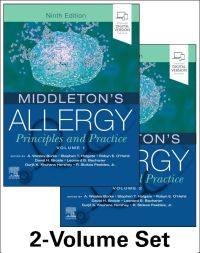
Edited by A Wesley Burks, MD, Robyn E. O'Hehir, FRACP, PhD, FRCPath, David H. Broide, Stephen T Holgate, MD, DSc, FMedSci, Leonard B. Bacharier, MD, Gurjit K. Khurana Hershey, MD, PhD and R. Stokes Peebles, Jr., MD
Through eight outstanding editions, Middleton’s Allergy: Principles and Practice has been the reference of choice for both clinicians and researchers as both a practical reference and an effective self-assessment tool for board preparation. The 9th
...view more
Through eight outstanding editions, Middleton’s Allergy: Principles and Practice has been the reference of choice for both clinicians and researchers as both a practical reference and an effective self-assessment tool for board preparation. The 9th Edition continues the tradition of excellence with comprehensive coverage of all basic science and clinical applications regarding allergy practice and disease mechanisms. It brings you fully up to date with recent innovations in the diagnosis, prevention, and management of allergic disorders, including emerging global issues, the advent of precision medicine, and new immunologic therapies.
Through eight outstanding editions, Middleton’s Allergy: Principles and Practice has been the reference of choice for both clinicians and researchers as both a practical reference and an effective self-assessment tool for board preparation. The 9th Edition continues the tradition of excellence with comprehensive coverage of all basic science and clinical applications regarding allergy practice and disease mechanisms. It brings you fully up to date with recent innovations in the diagnosis, prevention, and management of allergic disorders, including emerging global issues, the advent of precision medicine, and new immunologic therapies.
Key Features
Offers unparalleled depth and up-to-date guidance on the full spectrum of allergy across the lifespan, with significant updates throughout.
Contains new chapters on Innate Lymphoid Cells, Systems Biology, and Treatment of Primary Immunodeficiency Diseases.
Discusses emerging topics such as epidemic thunderstorm asthma and precision medicine in allergic disorders.
Features more than 730 full-color illustrations, including many new cellular and molecular drawings of disease mechanisms.
Includes new Summary of Important Concepts boxes, plus new multiple-choice questions online with explanations and answers.
Features a new team of expert editors and more international contributors for a global perspective of this complex field.
EnhancedeBook version included with purchase. Your enhanced eBook allows you to access all of the text, figures, and references from the book on a variety of devices.
Author Information
Edited by A Wesley Burks, MD, Dean, UNC School of Medicine; CEO of UNC Health, The University of North Carolina at Chapel Hill; Robyn E. O'Hehir, FRACP, PhD, FRCPath, Alfred Hospital and Monash University, Department of Allergy, Immunology, and Respiratory Medicine; David H. Broide, Professor of Medicine; Stephen T Holgate, MD, DSc, FMedSci, Clinical Professor of Immunopharmacology Medical Faculty in Clinical and Experimental Sciences; Leonard B. Bacharier, MD, Vanderbilt University, Doctors' Office Tower; Gurjit K. Khurana Hershey, MD, PhD, Cincinnati Children’s Hospital, Department of Pediatrics and R. Stokes Peebles, Jr., MD, Professor of Medicine, Division of Allergy, Pulmonary and Critical Care Medicine, Vanderbilt University Medical Center, Nashville, Tennessee, USA
Edited by A Wesley Burks, MD, Dean, UNC School of Medicine; CEO of UNC Health, The University of North Carolina at Chapel Hill; Robyn E. O'Hehir, FRACP, PhD, FRCPath, Alfred Hospital and Monash University, Department of Allergy, Immunology, and Respiratory Medicine; David H. Broide, Professor of Medicine; Stephen T Holgate, MD, DSc, FMedSci, Clinical Professor of Immunopharmacology Medical Faculty in Clinical and Experimental Sciences; Leonard B. Bacharier, MD, Vanderbilt University, Doctors' Office Tower; Gurjit K. Khurana Hershey, MD, PhD, Cincinnati Children’s Hospital, Department of Pediatrics and R. Stokes Peebles, Jr., MD, Professor of Medicine, Division of Allergy, Pulmonary and Critical Care Medicine, Vanderbilt University Medical Center, Nashville, Tennessee, USA
Volume 1 SECTION A Basic Sciences Underlying Allergy and Immunology 1 Innate Immunity 2 Adaptive Immunity 3 Immunoglobulin Structure and Function 4 Immune Tolerance 5 Cytokines in Allergic Inflammation 6 Cellular Adhesion in Inflammation 7 Chemokines 8 The Complement System 9 Lipid Mediators of Hypersensitivity and Inflammation 10 Molecular Biology and Genetic Engineering 11 Biology of Lymphocytes 12 Innate Lymphoid Cells 13 Antigen-Presenting Dendritic Cells 14 Biology of Mast Cells and Their Mediators 15 Biology of Basophils 16 Biology of Eosinophils 17 Biology of Neutrophils 18 Biology of Monocytes and Macrophages 19 Airway Epithelial Cells 20 Airway Smooth Muscle 21 Pathophysiology of Allergic Inflammation 22 Genetics and Epigenetics in Allergic Diseases and Asthma CONTENTS 23 Systems Biology 24 Immunobiology of IgE and Its Receptors 25 Neuronal Control of Airway Function in Allergy SECTION B Aerobiology and Allergens 26 The Structure and Function of Allergens 27 Aerobiology of Outdoor Allergens 28 Indoor Allergens 29 Preparation and Standardization of Allergen Extracts 30 Air Pollution: Indoor and Outdoor 31 Effect of the Food Matrix and Processing on the Allergenic Activity of Foods SECTION C The Skin 32 Structure of the Skin and Cutaneous Immunology 33 Atopic Dermatitis 34 Contact Dermatitis 35 Urticaria and Angioedema 36 Hereditary Angioedema and Bradykinin-Mediated Angioedema 37 Immune Complex Mediated Diseases SECTION D The Eye 38 Allergic and Immunologic Diseases of the Eye SECTION E Respiratory Tract 39 The Nose and Control of Nasal Airflow 40 Allergic and Nonallergic Rhinitis 41 Rhinosinusitis and Nasal Polyps 42 Development, Structure Lung and in Asthma 43 Respiratory Tract Mucosal Immunology 44 Airway Mucus and the Mucociliary System 45 Epidemiology of Asthma and Allergic Diseases 46 Ontogeny of Immune Development and Its Relationship to Allergic Diseases and Asthma 47 Asthma Pathogenesis 48 Animal Models of Allergic Disease 49 Diagnosis of Asthma in Infants and Children 50 Management of Asthma in Infants and Children 51 Diagnosis of Asthma in Adults 52 Management of Asthma in Adolescents and Adults 53 Emergency Treatment and Approach to the Patient with Acute Asthma 54 Approach to the Patient with Exercise-Induced Bronchoconstriction 55 Asthma and Allergic Diseases during Pregnancy 56 Occupational Allergy and Asthma 57 Pathology of Asthma 58 Allergic Bronchopulmonary Aspergillosis Hypersensitivity Pneumonitis and Epidemic Thunderstorm Asthma 59 Immunologic Nonasthmatic Diseases of the Lung 60 Approach to the Patient with Chronic Cough 61 Bronchial and Nasal Challenge Testing 62 Lung Imaging 63 Aerosols and Aerosol Drug Delivery Systems VOLUME 2 SECTION F Gastrointestinal Tract 64 Gastrointestinal Mucosal Immunology 65 Eosinophilic Gastroenteropathies Disorders SECTION G Systemic Disease 66 Clinical Significance of Immunoglobulin E 67 In Vivo Methods for the Study and Diagnosis of Allergy 68 Approach to the Patient with Recurrent Infections 69 Primary Immunodeficiency Diseases 70 Treatment of Primary Immunodeficiencies 71 Human Immunodeficiency Virus and Allergic Disease 72 Laboratory Tests for Allergic and Immunodeficiency Diseases 73 Eosinophilia and Eosinophil-Related Disorders 74 Mastocytosis 75 Anaphylaxis 76 Insect Allergy 77 Drug Allergy 78 Hypersensitivity to Aspirin and Other Nonsteroidal Antiinflammatory Drugs 79 Reactions to Foods 80 Reactions to Additives in Foods in Drugs 81 Oral Food Challenge Testing 82 Food Allergy Management 83 Adverse Reactions to Vaccines SECTION H Therapeutics 84 Allergen Control for Prevention and Management of Allergic Diseases 85 Injection Immunotherapy for Inhalant Allergens 86 Sublingual Immunotherapy for Inhalant Allergens 87 Principles of Pharmacotherapeutics 88 Precision Medicine in Allergic Disorders 89 Adherence 90 Anti-Immunoglobulin E Therapy 91 Cytokine-Specific Therapy in Asthma 92 Histamine and Antihistamines 93 Inhaled ß2-Agonists 94 Theophylline and Phosphodiesterase Inhibitors 95 Anticholinergic Therapies 96 Glucocorticosteroids 97 Antileukotriene Therapy in Asthma 98 Unconventional Theories and Unproven Methods in Allergy 99 Complementary and Alternative Medicine
"Since its inception, this two-volume book has served as a comprehensive resource for allergists, specifically fellows-in-training.The present edition continues the reputation of the original, enjoying contributions from over 200 experts in the field."
-Massoud Mahmoudi, DO, PhD (University of California San Francisco) Doodys Review Service
https://www.elsevierhealth.com.au/middletons-allergy-2-volume-set-9780323544245.html295393Middleton's Allergy 2-Volume Sethttps://www.elsevierhealth.com.au/media/catalog/product/9/7/9780323544245_7.jpg446.22594.95AUDInStock/Medicine & Surgery/Allergy & Clinical Immunology/Books/Medicine/Allergy & Clinical Immunology/Books/Books/Medicine/Allergy & Clinical Immunology/Japan Titles43351344388722505461250546645255039525990052631601418269243350884886536505455351451205259833<P>Through eight outstanding editions, <I>Middleton’s Allergy: Principles and Practice</I> has been the reference of choice for both clinicians and researchers as both <B>a practical reference and an effective self-assessment tool </B>for board preparation. The 9th Edition continues the tradition of excellence with <B>comprehensive coverage of all basic science and clinical applications</B> regarding allergy practice and disease mechanisms. It brings you fully up to date with <B>recent innovations in the diagnosis, prevention, and management of allergic disorders</B>, including emerging global issues, the advent of precision medicine, and new immunologic therapies<I>.</P></I> <P>Through eight outstanding editions, <I>Middleton’s Allergy: Principles and Practice</I> has been the reference of choice for both clinicians and researchers as both <B>a practical reference and an effective self-assessment tool </B>for board preparation. The 9th Edition continues the tradition of excellence with <B>comprehensive coverage of all basic science and clinical applications</B> regarding allergy practice and disease mechanisms. It brings you fully up to date with <B>recent innovations in the diagnosis, prevention, and management of allergic disorders</B>, including emerging global issues, the advent of precision medicine, and new immunologic therapies<I>.</P></I>00add-to-cart97803235442452019ProfessionalEdited by A Wesley Burks, MD, Robyn E. O'Hehir, FRACP, PhD, FRCPath, David H. Broide, Stephen T Holgate, MD, DSc, FMedSci, Leonard B. Bacharier, MD, Gurjit K. Khurana Hershey, MD, PhD and R. Stokes Peebles, Jr., MD20209Book216w x 276h (8.50" x 10.875")Approx. 731 illustrations (623 in full color)Elsevier180011 Dec 2019Please allow 3-4 weeks for deliveryEdited by <STRONG>A Wesley Burks</STRONG>, MD, Dean, UNC School of Medicine; CEO of UNC Health, The University of North Carolina at Chapel Hill; <STRONG>Robyn E. O'Hehir</STRONG>, FRACP, PhD, FRCPath, Alfred Hospital and Monash University, Department of Allergy, Immunology, and Respiratory Medicine; <STRONG>David H. Broide</STRONG>, Professor of Medicine; <STRONG>Stephen T Holgate</STRONG>, MD, DSc, FMedSci, Clinical Professor of Immunopharmacology Medical Faculty in Clinical and Experimental Sciences; <STRONG>Leonard B. Bacharier</STRONG>, MD, Vanderbilt University, Doctors' Office Tower; <STRONG>Gurjit K. Khurana Hershey</STRONG>, MD, PhD, Cincinnati Children’s Hospital, Department of Pediatrics and <STRONG>R. Stokes Peebles</STRONG>, Jr., MD, Professor of Medicine, Division of Allergy, Pulmonary and Critical Care Medicine, Vanderbilt University Medical Center, Nashville, Tennessee, USABooksBookUnited StatesNoNoNoNoPlease SelectPlease SelectPlease Select