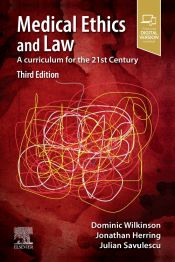
This short textbook of ethics and law is aimed at doctors in training and in practice. Medical ethics and law are now firmly embedded in the curricula of medical schools. The ability to make clinical decisions on the basis of critical reasoning is a
...view more
This short textbook of ethics and law is aimed at doctors in training and in practice. Medical ethics and law are now firmly embedded in the curricula of medical schools. The ability to make clinical decisions on the basis of critical reasoning is a skill that is rightly presumed as necessary in today's doctors. Medical decisions involve not only scientific understanding but also ethical values and legal analysis. The belief that it is ethically right to act in one way rather than another should be based on good reasons: it is not enough to follow what doctors have always done, nor what experienced doctors now do.
The third edition has been revised and updated to reflect changes in the core curriculum for students, developments in the law as well as advances in medicine and technology. It includes a new ‘extensions’ section, providing an outline of important developing areas in medical ethics.
This short textbook of ethics and law is aimed at doctors in training and in practice. Medical ethics and law are now firmly embedded in the curricula of medical schools. The ability to make clinical decisions on the basis of critical reasoning is a skill that is rightly presumed as necessary in today's doctors. Medical decisions involve not only scientific understanding but also ethical values and legal analysis. The belief that it is ethically right to act in one way rather than another should be based on good reasons: it is not enough to follow what doctors have always done, nor what experienced doctors now do.
The third edition has been revised and updated to reflect changes in the core curriculum for students, developments in the law as well as advances in medicine and technology. It includes a new ‘extensions’ section, providing an outline of important developing areas in medical ethics.
New to this edition
This new edition includes a new third section that provides an extension to the core curriculum focused on four key emerging topics in medical ethics – neuroethics, genethics, information ethics and public health ethics.
The chapters on Consent, Capacity and Mental Health Law have been extensively revised to reflect changes in legislation. Chapters on confidentiality and information ethics contain new sections relating to information technology, sharing information and breaching confidentiality.
Each chapter contains case examples drawn from personal experience or from the media.
This edition also includes cartoons to highlight cutting edge and topical issues.
Most chapters include revision questions and an extension case to encourage readers who are interested in a topic to explore further.
Key Features
The first part of the book covers the foundations of ethics and law in the context of medicine.
The second part covers specific core topics that are essential for health professionals to understand.
The third section of the book includes new chapters on cutting edge topics that will be crucial for the doctors and health professionals of tomorrow.
Author Information
By Dominic Wilkinson, MBBS BMedSci MBioeth DPhil FRACP FRCPCH, Professor of Medical Ethics, Director of Medical Ethics, Oxford Uehiro Centre for Practical Ethics; Consultant Neonatologist, John Radcliffe Hospital; Senior Research Fellow, Jesus College, Oxford.; Jonathan Herring, Professor of Law and Vice Dean, Faculty of Law, Oxford University, UK; Julian Savulescu, BMedSci, MBBS, MA, PhD, Uehiro Chair in Practical Ethics and Director, Oxford Uehiro Centre for Practical Ethics, University of Oxford, Oxford, UK; Visiting Professorial Fellow in Biomedical Ethics, Murdoch Children's Research Institute and Distinguished Visiting International Professorship in Law, University of Melbourne, Australia
By Dominic Wilkinson, MBBS BMedSci MBioeth DPhil FRACP FRCPCH, Professor of Medical Ethics, Director of Medical Ethics, Oxford Uehiro Centre for Practical Ethics; Consultant Neonatologist, John Radcliffe Hospital; Senior Research Fellow, Jesus College, Oxford.; Jonathan Herring, Professor of Law and Vice Dean, Faculty of Law, Oxford University, UK; Julian Savulescu, BMedSci, MBBS, MA, PhD, Uehiro Chair in Practical Ethics and Director, Oxford Uehiro Centre for Practical Ethics, University of Oxford, Oxford, UK; Visiting Professorial Fellow in Biomedical Ethics, Murdoch Children's Research Institute and Distinguished Visiting International Professorship in Law, University of Melbourne, Australia
https://www.elsevierhealth.com.au/medical-ethics-and-law-9780702075964.html298804Medical Ethics and Lawhttps://www.elsevierhealth.com.au/media/catalog/product/9/7/9780702075964_6.jpg50.2266.95AUDInStock/Medicine & Surgery/Medical Ethics/Books/Medicine/Medical Ethics/Books/Books/Medicine/Medical Ethics/Japan Titles43351774388722505465950546645255039525995652631601418269243350884886536505455351451205259833<P>This short textbook of ethics and law is aimed at doctors in training and in practice. Medical ethics and law are now firmly embedded in the curricula of medical schools. The ability to make clinical decisions on the basis of critical reasoning is a skill that is rightly presumed as necessary in today's doctors. Medical decisions involve not only scientific understanding but also ethical values and legal analysis. The belief that it is ethically right to act in one way rather than another should be based on good reasons: it is not enough to follow what doctors have always done, nor what experienced doctors now do.</P>
<P></P>
<P>The third edition has been revised and updated to reflect changes in the core curriculum for students, developments in the law as well as advances in medicine and technology. It includes a new ‘extensions’ section, providing an outline of important developing areas in medical ethics.</P> <P>This short textbook of ethics and law is aimed at doctors in training and in practice. Medical ethics and law are now firmly embedded in the curricula of medical schools. The ability to make clinical decisions on the basis of critical reasoning is a skill that is rightly presumed as necessary in today's doctors. Medical decisions involve not only scientific understanding but also ethical values and legal analysis. The belief that it is ethically right to act in one way rather than another should be based on good reasons: it is not enough to follow what doctors have always done, nor what experienced doctors now do.</P>
<P></P>
<P>The third edition has been revised and updated to reflect changes in the core curriculum for students, developments in the law as well as advances in medicine and technology. It includes a new ‘extensions’ section, providing an outline of important developing areas in medical ethics.</P>00add-to-cart97807020759642019StudentBy Dominic Wilkinson, MBBS BMedSci MBioeth DPhil FRACP FRCPCH, Jonathan Herring and Julian Savulescu, BMedSci, MBBS, MA, PhD20203Book152w x 229h (6.00" x 9.00")IllustratedElsevier35813 Sep 2019Please allow 3-4 weeks for deliveryBy <STRONG>Dominic Wilkinson</STRONG>, MBBS BMedSci MBioeth DPhil FRACP FRCPCH, Professor of Medical Ethics, Director of Medical Ethics, Oxford Uehiro Centre for Practical Ethics; Consultant Neonatologist, John Radcliffe Hospital; Senior Research Fellow, Jesus College, Oxford.; <STRONG>Jonathan Herring</STRONG>, Professor of Law and Vice Dean, Faculty of Law, Oxford University, UK; <STRONG>Julian Savulescu</STRONG>, BMedSci, MBBS, MA, PhD, Uehiro Chair in Practical Ethics and Director, Oxford Uehiro Centre for Practical Ethics, University of Oxford, Oxford, UK; Visiting Professorial Fellow in Biomedical Ethics, Murdoch Children's Research Institute and Distinguished Visiting International Professorship in Law, University of Melbourne, AustraliaBooksBookUnited KingdomNoNoNoNoPlease SelectPlease SelectPlease Select