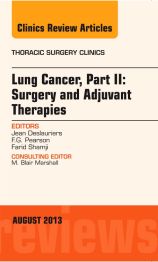
This issue of Thoracic Surgery Clinics, Guest Edited by Drs. Jean Deslauriers, F.G. Pearson, and Farid Shamji, is devoted to surgery and chemotherapy for lung cancer. This issue was written as a tribute to Dr. Robert J. Ginsberg, and will include art
...view more
This issue of Thoracic Surgery Clinics, Guest Edited by Drs. Jean Deslauriers, F.G. Pearson, and Farid Shamji, is devoted to surgery and chemotherapy for lung cancer. This issue was written as a tribute to Dr. Robert J. Ginsberg, and will include articles on: Contemporary results of surgical resection of NSCLC after induction therapy; Prediction of operative morbidity and mortality before operation; Limited resection for small diameter tumors; Management of tumors involving the chest wall, including Pancoast tumors and tumors invading the spine; Role of surgery in patients with clinical N2 disease; Reconstruction of the bronchus and pulmonary artery; Current status of systematic lymph node dissection versus lymph node sampling; Intraoperative nodal staging: Role of sentinel node technology; Stereotactic body radiation therapy (SBRT) in early stage tumors; Palliative resection; Adjuvant chemotherapy after pulmonary resection for lung cancer; Targeted therapy and new anti-cancer drugs in advanced disease; Biologic approaches to drug selection and targeted therapies; Cost effective methods for follow-up after lung cancer surgery; Quality of life after pulmonary resection; and Principles of palliative care.

eBooks : Built for busy schedules & tailored for your goals.
Affordable knowledge, built for you
Get the resources you need-often at a lower cost than print. Quality content designed to support your goals, without stretching your budget.
Seamless access wherever you are
Open your eBook on your laptop, tablet, or phone - online or offline. Learning fits into your life, no matter where you go.
Always in sync
Start reading on one device and pick up right where you left off on another. Your progress and notes stay with you, every step of the way.
Tools the make learning stick
Highlight key points, take notes, create flashcards, or listen to your eBook read aloud. Interactive features help you deepen your knowledge, your way.
Your eBook is ready whenever you are!
1. Check your email for your access code.
2. Sign into or create your VitalSource account and redeem your code.
The access code for your new eBook will be sent in your order confirmation email. Your code can also be accessed in your My Account section on the Elsevier webshop.
If you do not receive your code within a few minutes, please check your spam folder.
Step-by-step guidance on how to download Bookshelf and also redeem your code can be found here.
The access code for your new eBook does not expire. However, we always suggest redeeming immediately after purchase to start experiencing the benefits of and insights from your purchase. Important to note - the code provided is a single use code and only valid for the edition you purchase. It does not provide access to past nor future editions of the title.
You will have unlimited access to your eBook on the device to which it was downloaded.
Discover the various learning features that our eBooks offer on the Bookshelf® Reader! For example, you can highlight different text passages, create notes and flashcards, have the text read to you, etc. Particularly practical: You can also use your eBooks offline. More information on the learning functions can be found on the Vitalsource page.
Quality is our top priority. That's why we collaborate with the leading eBook reader provider VitalSource. VitalSource has its own eBook reader Bookshelf®, which you can easily download. This reader is very user-friendly and offers more features than other standard readers. For example, you can highlight different text passages, create notes and flashcards, have the text read to you, etc. Particularly practical: You can also use your eBooks offline. More information can be found on the Vitalsource page.
Elsevier offers its eBooks in ePub format, as we believe this format is best suited to display our content ideally on as many devices as possible.
You can return your eBook within 13 days of purchase. eBooks that have been partially printed or flipped through more than 15% are excluded from returns.