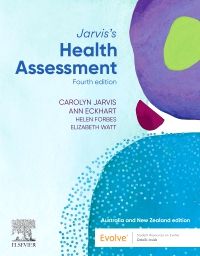
By Helen Forbes, RN, BAppSc (Adv Nurs) (La Trobe University), MEdSt (Monash University), PhD (University of Sydney) and Elizabeth Watt, RN, DipN (College of Nursing Australia), BAppSc (Adv Nurs) (Lincoln Institute of Health Sciences), MNS (La Trobe University), Cert Prom Cont, FACN
The ideal student guide to assessing a person’s healthJarvis’s Health Assessment provides the foundational knowledge and skills every nurse needs to assess people’s health.Written by leading academics and clinicians, this text will
...view more
The ideal student guide to assessing a person’s health
Jarvis’s Health Assessment provides the foundational knowledge and skills every nurse needs to assess people’s health.
Written by leading academics and clinicians, this text will help the learner seamlessly combine their knowledge of human anatomy and physiology with clinical assessment, communication and clinical reasoning skills. Its logical structure covers key theories, frameworks, techniques, specific areas of human function and how to apply health assessment knowledge and skills in practice.
The fourth edition has been fully updated for Australia and Aotearoa New Zealand and is relevant for each year of the undergraduate or pre-registration curriculum across multiple subjects. It is accompanied by a wealth of learning and teaching resources to help learners grasp both theoretical and practical concepts.
The ideal student guide to assessing a person’s health
Jarvis’s Health Assessment provides the foundational knowledge and skills every nurse needs to assess people’s health.
Written by leading academics and clinicians, this text will help the learner seamlessly combine their knowledge of human anatomy and physiology with clinical assessment, communication and clinical reasoning skills. Its logical structure covers key theories, frameworks, techniques, specific areas of human function and how to apply health assessment knowledge and skills in practice.
The fourth edition has been fully updated for Australia and Aotearoa New Zealand and is relevant for each year of the undergraduate or pre-registration curriculum across multiple subjects. It is accompanied by a wealth of learning and teaching resources to help learners grasp both theoretical and practical concepts.
New to this edition
Fully updated, reflecting current practice and guidelines in Australia and Aotearoa New Zealand
Restructured content to support learning
Significant revisions of chapters on screening for family violence and substance misuse
Revisions of chapters on communication skills
Further development of approaches to gender diversity and inclusion
Key Features
Ideal for pre-registration course students, beginning and experienced registered nurses and those undertaking advanced practice roles
Clearly separates knowledge and skills for nurses at a beginning level and those who have clinical experience, making it easy for teachers and students to identify content relevant to their level of learning
Includes case studies to illustrate the initial parts of the clinical reasoning process and documentation of health assessments
Easy to navigate, with a clear structure and colour-coding
Extensive use of illustrations to clarify important anatomical and physiological concepts
Accompanying resources include videos showcasing physical examination skills, PowerPoints and summative MCQ test banks
A focus on person-centred care, health education, inclusive practice and lifespan
Instructor resources on Evolve
PowerPoints
Image collection
Test banks
Student and instructor resources on Evolve
Skills videos
Author Information
By Helen Forbes, RN, BAppSc (Adv Nurs) (La Trobe University), MEdSt (Monash University), PhD (University of Sydney), Nurse Consultant (Education), Formerly Associate Professor and Associate Head of School (Teaching & Learning), School of Nursing & Midwifery, Deakin University, Melbourne, Victoria, Australia and Elizabeth Watt, RN, DipN (College of Nursing Australia), BAppSc (Adv Nurs) (Lincoln Institute of Health Sciences), MNS (La Trobe University), Cert Prom Cont, FACN, Nurse Consultant (Education), Senior Research Fellow, National Ageing Research Institute, Melbourne, Victoria, Australia
By Helen Forbes, RN, BAppSc (Adv Nurs) (La Trobe University), MEdSt (Monash University), PhD (University of Sydney), Nurse Consultant (Education), Formerly Associate Professor and Associate Head of School (Teaching & Learning), School of Nursing & Midwifery, Deakin University, Melbourne, Victoria, Australia and Elizabeth Watt, RN, DipN (College of Nursing Australia), BAppSc (Adv Nurs) (Lincoln Institute of Health Sciences), MNS (La Trobe University), Cert Prom Cont, FACN, Nurse Consultant (Education), Senior Research Fellow, National Ageing Research Institute, Melbourne, Victoria, Australia
UNIT 1 Approaches and contexts of health assessment in nursing 1 The context and frameworks of health assessment Introduction What is health assessment? What is health? What is nursing? Quality and safety in health care Developmental considerations Cultural and social considerations Assessment approaches for different situations Frameworks for assessment
2 Clinical decision making Introduction Critical thinking and clinical decision making Clinical reasoning and documentation Developing your clinical reasoning skills
3 Developmental tasks across the life span Introduction Infancy (birth to 1 year) Early childhood—toddler (1 to 3 years) Early childhood—preschooler (3 to 5 or 6 years) Middle childhood—school-aged child (6 to 10 or 11 years) Preadolescence (10 or 11 to 12 or 13 years) Adolescence (12 or 13 to 19 years) Early adulthood (20 to 40 years) Middle adulthood (40 to 65 years) Late adulthood (65_ years) Cultural and social considerations Developmental screening tools
4 Cultural safety Introduction Australia: colonisation and the current population context Aotearoa New Zealand: colonization and the current population context Culture, ethnicity, race, racism and health Cultural safety Cultural competence versus cultural safety Communication Cultural identity Ideas about causes of illness and disease Expression of illness Australian nursing standards Aotearoa New Zealand guidelines for cultural safety Strategies for collaborative assessment Conclusion: culturally safe nursing
5 Screening for family violence Introduction Types of violence Drivers of family violence Impact of family violence Intersectionality Cultural and social considerations Documenting family violence Subjective data Objective data
6 Screening for substance misuse Introduction Tobacco use Alcohol use Drug misuse Illicit drug use Developmental considerations Screening tools Subjective data Objective data
UNIT 2 Health assessment tools and techniques 7 Person-centred communication in health assessment Introduction The process of communication Techniques of communication Developmental considerations Interviewing people with diverse needs Cultural and social considerations Overcoming communication barriers
8 The health history Introduction The health history—adults and adults aged 65 years or older The health history—children The health history—adolescents
9 Physical examination techniques Introduction Preventing healthcare-associated infections Performing a physical examination Techniques of a physical examination Developmental considerations
10 General survey and vital signs Introduction Objective data—general survey Objective data—vital signs
UNIT 3 Assessing mental health, neurological and sensory function 11 Mental health assessment Introduction Key concepts and terminology Developmental considerations Cultural and social considerations Subjective data Objective data Abnormal findings
12 Neurological assessment Introduction Structure and function Developmental considerations Cultural and social considerations Subjective data Objective data Abnormal findings Advanced practice—additional data Abnormal findings for advanced practice
13 Pain assessment Introduction Structure and function Developmental considerations Cultural and social considerations Subjective data Pain assessment tools Objective data Abnormal findings
14 Eye assessment Introduction Structure and function Developmental considerations Cultural and social considerations Subjective data Objective data Abnormal findings Advanced practice—additional data Abnormal findings for advanced practice
15 Ear assessment Introduction Structure and function Developmental considerations Cultural and social considerations Subjective data Objective data Abnormal findings Advanced practice—additional data Abnormal findings for advanced practice
UNIT 4 Assessing cardiovascular function 16 Peripheral vascular assessment Introduction Structure and function Developmental considerations Cultural and social considerations Subjective data Objective data Abnormal findings Advanced practice—additional data Abnormal findings for advanced practice
17 Cardiac assessment Introduction Structure and function Developmental considerations Cultural and social considerations Subjective data Objective data Abnormal findings Advanced practice—additional data Abnormal findings for advanced practice
UNIT 5 Assessing respiratory function 18 Upper airways assessment Introduction Structure and function Developmental considerations Cultural and social considerations Subjective data Objective data Abnormal findings Advanced practice—additional data Abnormal findings—advanced practice
19 Lower airways assessment Introduction Structure and function Developmental considerations Cultural and social considerations Subjective data Objective data Abnormal findings Further objective assessment for advanced practice Abnormal findings for advanced practice
UNIT 6 Assessing musculoskeletal function 20 Musculoskeletal assessment Introduction Structure and function Developmental considerations Cultural and social considerations Subjective data Objective data Abnormal findings Advanced practice—additional data Abnormal findings for advanced practice
UNIT 7 Assessing nutrition and metabolic function 21 Nutritional and metabolic assessment Introduction Structure and function Developmental considerations Cultural and social considerations Subjective data Objective data Abnormal findings Advanced practice—additional data Abnormal findings for advanced practice
22 Skin, hair and nails assessment Introduction Structure and function Developmental considerations Cultural and social considerations Subjective data Objective data Abnormal findings Advanced practice—additional data
UNIT 8 Urinary and bowel function 23 Abdominal assessment Introduction Structure and function Developmental considerations Subjective data Objective data Abnormal findings Advanced practice—additional data Abnormal findings for advanced practice
24 Assessing urinary function Introduction Structure and function Developmental considerations Cultural and social considerations Subjective data Objective data Abnormal findings
25 Assessing bowel function Introduction Structure and function Developmental considerations Cultural and social considerations Subjective data Objective data Abnormal findings Advanced practice—additional data Abnormal findings for advanced practice
UNIT 9 Assessing sexuality and reproductive function 26 Female sexual and reproductive assessment Introduction Structure and function Developmental considerations Cultural and social considerations Subjective data Objective data Abnormal findings Advanced practice—additional objective data Abnormal findings for advanced practice
27 Male sexual and reproductive assessment Introduction Structure and function Developmental considerations Cultural and social considerations Subjective data Objective data Abnormal findings Advanced practice—additional data Abnormal findings for advanced practice
28 Breasts assessment Introduction Structure and function Developmental considerations Cultural and social considerations Subjective data Objective data Abnormal findings Advanced practice—additional data Abnormal findings for advanced practice
29 Assessing pregnant women Introduction Structure and function Developmental considerations Cultural and social considerations Subjective data Objective data Abnormal findings
UNIT 10 Using health assessment in clinical practice 30 Using health assessment to promote safe and quality nursing care Introduction Health assessment, clinical reasoning and patient safety Complex case study—Recognising and responding to acute deterioration in physical health status
https://www.elsevierhealth.com.au/jarviss-health-assessment-anz-9780729544658.html316076Jarvis's Health Assessment ANZhttps://www.elsevierhealth.com.au/media/catalog/product/9/7/9780729544658_4.jpg143.21190.95AUDInStock/Nursing & Midwifery/General Nursing/Books/Australian Titles433511643887224388721141826924335105<p><b>The ideal student guide to assessing a person’s health</b><BR><BR><i>Jarvis’s Health Assessment </i>provides the foundational knowledge and skills every nurse needs to assess people’s health.<BR><BR>Written by leading academics and clinicians, this text will help the learner seamlessly combine their knowledge of human anatomy and physiology with clinical assessment, communication and clinical reasoning skills. Its logical structure covers key theories, frameworks, techniques, specific areas of human function and how to apply health assessment knowledge and skills in practice.<BR><BR>The fourth edition has been fully updated for Australia and Aotearoa New Zealand and is relevant for each year of the undergraduate or pre-registration curriculum across multiple subjects. It is accompanied by a wealth of learning and teaching resources to help learners grasp both theoretical and practical concepts.</p> <p><b>The ideal student guide to assessing a person’s health</b><BR><BR><i>Jarvis’s Health Assessment </i>provides the foundational knowledge and skills every nurse needs to assess people’s health.<BR><BR>Written by leading academics and clinicians, this text will help the learner seamlessly combine their knowledge of human anatomy and physiology with clinical assessment, communication and clinical reasoning skills. Its logical structure covers key theories, frameworks, techniques, specific areas of human function and how to apply health assessment knowledge and skills in practice.<BR><BR>The fourth edition has been fully updated for Australia and Aotearoa New Zealand and is relevant for each year of the undergraduate or pre-registration curriculum across multiple subjects. It is accompanied by a wealth of learning and teaching resources to help learners grasp both theoretical and practical concepts.</p>00add-to-cart97807295446582024ProfessionalBy Helen Forbes, RN, BAppSc (Adv Nurs) (La Trobe University), MEdSt (Monash University), PhD (University of Sydney) and Elizabeth Watt, RN, DipN (College of Nursing Australia), BAppSc (Adv Nurs) (Lincoln Institute of Health Sciences), MNS (La Trobe University), Cert Prom Cont, FACN20254Book216w x 276h (8.50" x 10.875")Elsevier03 Dec 2024IN STOCKBy <STRONG>Helen Forbes</STRONG>, RN, BAppSc (Adv Nurs) (La Trobe University), MEdSt (Monash University), PhD (University of Sydney), Nurse Consultant (Education), Formerly Associate Professor and Associate Head of School (Teaching & Learning), School of Nursing & Midwifery, Deakin University, Melbourne, Victoria, Australia and <STRONG>Elizabeth Watt</STRONG>, RN, DipN (College of Nursing Australia), BAppSc (Adv Nurs) (Lincoln Institute of Health Sciences), MNS (La Trobe University), Cert Prom Cont, FACN, Nurse Consultant (Education), Senior Research Fellow, National Ageing Research Institute, Melbourne, Victoria, AustraliaBooksBookAustraliaYesYesNoNoPlease SelectPlease SelectPlease Select