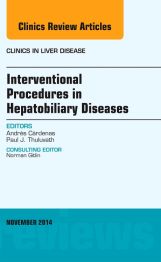
Interventional Procedures in Hepatobiliary Diseases, An Issue of Clinics in Liver Disease, 1st Edition
Author :
By Andres Cardenas, MD, MMSc
The field of hepatobiliary diseases has advanced enormously in the past 3 decades. The incorporation of new diagnostic and therapeutic interventions in clinical hepatology as well as liver transplantation has exponentially grown and specialty fields
...view more
The field of hepatobiliary diseases has advanced enormously in the past 3 decades. The incorporation of new diagnostic and therapeutic interventions in clinical hepatology as well as liver transplantation has exponentially grown and specialty fields have emerged within the liver disease arena. Interventional procedures play a critical role in the management of patients with hepatobiliary diseases as they offer diagnostic and definite treatment options for an array of conditions. Interventions include those that directly measure portal pressure, perform transjugular liver biopsy and place transjugular intrahepatic portsosystemic shunts as therapy for complications of portal hypertension. Other commonly performed intervention is digestive and hepatobiliary endoscopy which offers not only diagnostic but also therapeutic choices in various areas such as portal hypertension and hepatobiliary disease. Endoscopy plays a fundamental role in the management of patients with almost all types of liver disease. Additionally, both the fields of hepatology and endoscopy have become very specialized and thus a thorough knowledge of the indications, findings, therapeutic possibilities and complications that arise from endoscopic interventions is a must for the practicing clinician. The rising incidence of liver cancer has also placed radiofrequency ablation and chemoembolization of liver lesions at the forefront of interventional therapies for hepatocellular carcinoma. Finally the management of acute liver failure has certainly evolved with new therapeutic options such as liver assist devices that can help manage these patients in the intensive care unit. This issue of Clinics in Liver Disease devoted to Interventional Hepatology is a timely and unique one. The Guest Editors have assembled an outstanding group of experts in several fields that can provide practitioners with state of the art and evidence based articles that help manage patients with hepatobiliary disease.
The field of hepatobiliary diseases has advanced enormously in the past 3 decades. The incorporation of new diagnostic and therapeutic interventions in clinical hepatology as well as liver transplantation has exponentially grown and specialty fields have emerged within the liver disease arena. Interventional procedures play a critical role in the management of patients with hepatobiliary diseases as they offer diagnostic and definite treatment options for an array of conditions. Interventions include those that directly measure portal pressure, perform transjugular liver biopsy and place transjugular intrahepatic portsosystemic shunts as therapy for complications of portal hypertension. Other commonly performed intervention is digestive and hepatobiliary endoscopy which offers not only diagnostic but also therapeutic choices in various areas such as portal hypertension and hepatobiliary disease. Endoscopy plays a fundamental role in the management of patients with almost all types of liver disease. Additionally, both the fields of hepatology and endoscopy have become very specialized and thus a thorough knowledge of the indications, findings, therapeutic possibilities and complications that arise from endoscopic interventions is a must for the practicing clinician. The rising incidence of liver cancer has also placed radiofrequency ablation and chemoembolization of liver lesions at the forefront of interventional therapies for hepatocellular carcinoma. Finally the management of acute liver failure has certainly evolved with new therapeutic options such as liver assist devices that can help manage these patients in the intensive care unit. This issue of Clinics in Liver Disease devoted to Interventional Hepatology is a timely and unique one. The Guest Editors have assembled an outstanding group of experts in several fields that can provide practitioners with state of the art and evidence based articles that help manage patients with hepatobiliary disease.
Author Information
By Andres Cardenas, MD, MMSc, Hospital Clinic of Barcelona,
https://www.elsevierhealth.com.au/interventional-procedures-in-hepatobiliary-diseases-an-issue-of-clinics-in-liver-disease-9780323326582.html294222Interventional Procedures in Hepatobiliary Diseases, An Issue of Clinics in Liver Diseasehttps://www.elsevierhealth.com.au/media/catalog/product/9/7/9780323326582_7.jpg126.71168.95AUDInStock/Medicine & Surgery/Gastroenterology & Hepatology/Clinics/Medicine/Gastroenterology & Hepatology/Clinics/Clinics/Medicine/Gastroenterology & Hepatology/Japan Titles43351394388725505460750546665255041525989452631601418269243350884886536505455351451205259833The field of hepatobiliary diseases has advanced enormously in the past 3 decades. The incorporation of new diagnostic and therapeutic interventions in clinical hepatology as well as liver transplantation has exponentially grown and specialty fields have emerged within the liver disease arena. Interventional procedures play a critical role in the management of patients with hepatobiliary diseases as they offer diagnostic and definite treatment options for an array of conditions. Interventions include those that directly measure portal pressure, perform transjugular liver biopsy and place transjugular intrahepatic portsosystemic shunts as therapy for complications of portal hypertension. Other commonly performed intervention is digestive and hepatobiliary endoscopy which offers not only diagnostic but also therapeutic choices in various areas such as portal hypertension and hepatobiliary disease. Endoscopy plays a fundamental role in the management of patients with almost all types of liver disease. Additionally, both the fields of hepatology and endoscopy have become very specialized and thus a thorough knowledge of the indications, findings, therapeutic possibilities and complications that arise from endoscopic interventions is a must for the practicing clinician. The rising incidence of liver cancer has also placed radiofrequency ablation and chemoembolization of liver lesions at the forefront of interventional therapies for hepatocellular carcinoma. Finally the management of acute liver failure has certainly evolved with new therapeutic options such as liver assist devices that can help manage these patients in the intensive care unit. This issue of Clinics in Liver Disease devoted to Interventional Hepatology is a timely and unique one. The Guest Editors have assembled an outstanding group of experts in several fields that can provide practitioners with state of the art and evidence based articles that help manage patients with hepatobiliary disease. The field of hepatobiliary diseases has advanced enormously in the past 3 decades. The incorporation of new diagnostic and therapeutic interventions in clinical hepatology as well as liver transplantation has exponentially grown and specialty fields have emerged within the liver disease arena. Interventional procedures play a critical role in the management of patients with hepatobiliary diseases as they offer diagnostic and definite treatment options for an array of conditions. Interventions include those that directly measure portal pressure, perform transjugular liver biopsy and place transjugular intrahepatic portsosystemic shunts as therapy for complications of portal hypertension. Other commonly performed intervention is digestive and hepatobiliary endoscopy which offers not only diagnostic but also therapeutic choices in various areas such as portal hypertension and hepatobiliary disease. Endoscopy plays a fundamental role in the management of patients with almost all types of liver disease. Additionally, both the fields of hepatology and endoscopy have become very specialized and thus a thorough knowledge of the indications, findings, therapeutic possibilities and complications that arise from endoscopic interventions is a must for the practicing clinician. The rising incidence of liver cancer has also placed radiofrequency ablation and chemoembolization of liver lesions at the forefront of interventional therapies for hepatocellular carcinoma. Finally the management of acute liver failure has certainly evolved with new therapeutic options such as liver assist devices that can help manage these patients in the intensive care unit. This issue of Clinics in Liver Disease devoted to Interventional Hepatology is a timely and unique one. The Guest Editors have assembled an outstanding group of experts in several fields that can provide practitioners with state of the art and evidence based articles that help manage patients with hepatobiliary disease.00add-to-cart97803233265822014ProfessionalBy Andres Cardenas, MD, MMSc20141Book152w x 229h (6.00" x 9.00")Elsevier013 Nov 2014Please allow 10-14 working days for deliveryBy <STRONG>Andres Cardenas</STRONG>, MD, MMSc, Hospital Clinic of Barcelona,ClinicsClinicsThe Clinics: Internal MedicineUnited StatesNoNoNoNoPlease SelectPlease SelectPlease Select