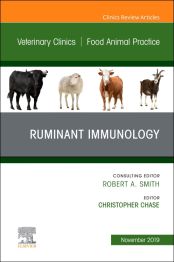
Immunology,An Issue of Veterinary Clinics of North America: Food Animal Practice, 1st Edition
Author :
Edited by Christopher Chase
This issue of Veterinary Clinics: Food Animal Practice, guest edited by Dr. Christopher Chase in collaboration with Consulting Editor Dr. Robert Smith, focuses on Ruminant Immunology. Article topics include: Herd immunity: an epidemiologist's view;
...view more
This issue of Veterinary Clinics: Food Animal Practice, guest edited by Dr. Christopher Chase in collaboration with Consulting Editor Dr. Robert Smith, focuses on Ruminant Immunology. Article topics include: Herd immunity: an epidemiologist's view; Genetics of immunoresponsive and correlates of immunity; Microbiome and immunity: an evolving field; Vaccine administration dos and don'ts (endotoxin stacking; delayed MLV); Mycoplasma bovis: interations with the immune system and failure to generate an immune response; Nutriceuticals and their effect on immune response; Adjuvants; Immunology of maximizing passive transfer; Mucosal immunity and common mucosal response; Vaccinating in the face of maternal immunity; and Gamma Delta T cells in ruminants: their role, function, and importance.
This issue of Veterinary Clinics: Food Animal Practice, guest edited by Dr. Christopher Chase in collaboration with Consulting Editor Dr. Robert Smith, focuses on Ruminant Immunology. Article topics include: Herd immunity: an epidemiologist's view; Genetics of immunoresponsive and correlates of immunity; Microbiome and immunity: an evolving field; Vaccine administration dos and don'ts (endotoxin stacking; delayed MLV); Mycoplasma bovis: interations with the immune system and failure to generate an immune response; Nutriceuticals and their effect on immune response; Adjuvants; Immunology of maximizing passive transfer; Mucosal immunity and common mucosal response; Vaccinating in the face of maternal immunity; and Gamma Delta T cells in ruminants: their role, function, and importance.
https://www.elsevierhealth.com.au/immunologyan-issue-of-veterinary-clinics-of-north-america-food-animal-practice-9780323683456.html296458Immunology,An Issue of Veterinary Clinics of North America: Food Animal Practicehttps://www.elsevierhealth.com.au/media/catalog/product/9/7/9780323683456_6.jpg139.46185.94AUDInStock/Veterinary/Veterinary Medicine/Clinics/Veterinary/Veterinary Medicine/Clinics/Clinics/Veterinary/Veterinary Medicine/Japan Titles43350974388725505456350546665255041525984352631601418269243350964886536505456251451205259842This issue of Veterinary Clinics: Food Animal Practice, guest edited by Dr. Christopher Chase in collaboration with Consulting Editor Dr. Robert Smith, focuses on Ruminant Immunology. Article topics include: Herd immunity: an epidemiologist's view; Genetics of immunoresponsive and correlates of immunity; Microbiome and immunity: an evolving field; Vaccine administration dos and don'ts (endotoxin stacking; delayed MLV); Mycoplasma bovis: interations with the immune system and failure to generate an immune response; Nutriceuticals and their effect on immune response; Adjuvants; Immunology of maximizing passive transfer; Mucosal immunity and common mucosal response; Vaccinating in the face of maternal immunity; and Gamma Delta T cells in ruminants: their role, function, and importance. This issue of Veterinary Clinics: Food Animal Practice, guest edited by Dr. Christopher Chase in collaboration with Consulting Editor Dr. Robert Smith, focuses on Ruminant Immunology. Article topics include: Herd immunity: an epidemiologist's view; Genetics of immunoresponsive and correlates of immunity; Microbiome and immunity: an evolving field; Vaccine administration dos and don'ts (endotoxin stacking; delayed MLV); Mycoplasma bovis: interations with the immune system and failure to generate an immune response; Nutriceuticals and their effect on immune response; Adjuvants; Immunology of maximizing passive transfer; Mucosal immunity and common mucosal response; Vaccinating in the face of maternal immunity; and Gamma Delta T cells in ruminants: their role, function, and importance.00add-to-cart97803236834562019ProfessionalEdited by Christopher Chase20201Book152w x 229h (6.00" x 9.00")Elsevier08 Oct 2019Please allow 10-14 working days for deliveryEdited by <STRONG>Christopher Chase</STRONG>ClinicsClinicsThe Clinics: Veterinary MedicineUnited StatesNoNoNoNoPlease SelectPlease SelectPlease Select
43350974335096Veterinary Medicinehttps://www.elsevierhealth.com.au/veterinary/veterinary-medicine1/4182692/4335096/43350971/Veterinary/Veterinary Medicine