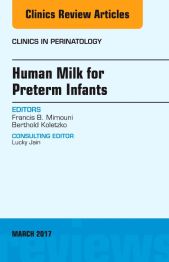
Human Milk for Preterm Infants, An Issue of Clinics in Perinatology, 1st Edition
Author :
By Francis B. Mimouni, MD, FAAP, FACN, MPH and Berthold Koletzko, Univ.-Prof. Dr. Dr. h.c.mult. Prof. h.c
Dr. Mimouni and Dr. Koletzko have assembled some of the world's leaders on breast milk for preterm infants to provide a current overview of the benefits and barriers. Authors address the following topics: Preterm human milk macronutrient composition
...view more
Dr. Mimouni and Dr. Koletzko have assembled some of the world's leaders on breast milk for preterm infants to provide a current overview of the benefits and barriers. Authors address the following topics: Preterm human milk macronutrient composition; Bed-side human milk analysis in the NICU; Human milk fortification; DHA supplements; Potential benefits of bioactive proteins in human milk for preterm infants; New insights into variations of metabolite and hormone contents in human milk; Immune properties of human milk in relation to preterm infant feeding; Human milk oligosaccharides; Treatment and quality of banked human milk; Use of donor milk: collection, storage and safety; Postnatal CMV infection through human milk in preterm infants: Transmission, clinical presentation, and prevention; NEC and human milk feeding; Neurodevelopmental outcomes of preterm infants fed human milk; Evidence-based methods that promote human milk feeding of preterm infants; and Human flavor learning: the breastfeeding experience. Lactiation consultants, NICU nurses, and neonatologists will find these clinical review articles to be very valuable.
Dr. Mimouni and Dr. Koletzko have assembled some of the world's leaders on breast milk for preterm infants to provide a current overview of the benefits and barriers. Authors address the following topics: Preterm human milk macronutrient composition; Bed-side human milk analysis in the NICU; Human milk fortification; DHA supplements; Potential benefits of bioactive proteins in human milk for preterm infants; New insights into variations of metabolite and hormone contents in human milk; Immune properties of human milk in relation to preterm infant feeding; Human milk oligosaccharides; Treatment and quality of banked human milk; Use of donor milk: collection, storage and safety; Postnatal CMV infection through human milk in preterm infants: Transmission, clinical presentation, and prevention; NEC and human milk feeding; Neurodevelopmental outcomes of preterm infants fed human milk; Evidence-based methods that promote human milk feeding of preterm infants; and Human flavor learning: the breastfeeding experience. Lactiation consultants, NICU nurses, and neonatologists will find these clinical review articles to be very valuable.
Author Information
By Francis B. Mimouni, MD, FAAP, FACN, MPH, Professor of Pediatrics, the Sackler School of Medicine, Tel Aviv, Israel, Chief of Staff, the Wilf Children's Hospital at Shaare Zedek Medical Center, and the Hebrew University of Jerusalem Medical School, Jerusalem, Israel and Berthold Koletzko, Univ.-Prof. Dr. Dr. h.c.mult. Prof. h.c, Dr. von Hauner Children’s Hospital, Univ. of Munich Medical Center, Campus Innenstadt, Muenchen, Germany
By Francis B. Mimouni, MD, FAAP, FACN, MPH, Professor of Pediatrics, the Sackler School of Medicine, Tel Aviv, Israel, Chief of Staff, the Wilf Children's Hospital at Shaare Zedek Medical Center, and the Hebrew University of Jerusalem Medical School, Jerusalem, Israel and Berthold Koletzko, Univ.-Prof. Dr. Dr. h.c.mult. Prof. h.c, Dr. von Hauner Children’s Hospital, Univ. of Munich Medical Center, Campus Innenstadt, Muenchen, Germany
https://www.elsevierhealth.com.au/human-milk-for-preterm-infants-an-issue-of-clinics-in-perinatology-9780323509831.html295168Human Milk for Preterm Infants, An Issue of Clinics in Perinatologyhttps://www.elsevierhealth.com.au/media/catalog/product/9/7/9780323509831_8.jpg127.47169.95AUDInStock/Medicine & Surgery/Neonatology/Perinatology/Clinics/Medicine/Neonatology/Perinatology/Clinics/Clinics/Medicine/Neonatology/Perinatology/Japan Titles433514343887255054620505466652550415259909526316014182692433508848865365054553514512052598335259908Dr. Mimouni and Dr. Koletzko have assembled some of the world's leaders on breast milk for preterm infants to provide a current overview of the benefits and barriers. Authors address the following topics: Preterm human milk macronutrient composition; Bed-side human milk analysis in the NICU; Human milk fortification; DHA supplements; Potential benefits of bioactive proteins in human milk for preterm infants; New insights into variations of metabolite and hormone contents in human milk; Immune properties of human milk in relation to preterm infant feeding; Human milk oligosaccharides; Treatment and quality of banked human milk; Use of donor milk: collection, storage and safety; Postnatal CMV infection through human milk in preterm infants: Transmission, clinical presentation, and prevention; NEC and human milk feeding; Neurodevelopmental outcomes of preterm infants fed human milk; Evidence-based methods that promote human milk feeding of preterm infants; and Human flavor learning: the breastfeeding experience. Lactiation consultants, NICU nurses, and neonatologists will find these clinical review articles to be very valuable. Dr. Mimouni and Dr. Koletzko have assembled some of the world's leaders on breast milk for preterm infants to provide a current overview of the benefits and barriers. Authors address the following topics: Preterm human milk macronutrient composition; Bed-side human milk analysis in the NICU; Human milk fortification; DHA supplements; Potential benefits of bioactive proteins in human milk for preterm infants; New insights into variations of metabolite and hormone contents in human milk; Immune properties of human milk in relation to preterm infant feeding; Human milk oligosaccharides; Treatment and quality of banked human milk; Use of donor milk: collection, storage and safety; Postnatal CMV infection through human milk in preterm infants: Transmission, clinical presentation, and prevention; NEC and human milk feeding; Neurodevelopmental outcomes of preterm infants fed human milk; Evidence-based methods that promote human milk feeding of preterm infants; and Human flavor learning: the breastfeeding experience. Lactiation consultants, NICU nurses, and neonatologists will find these clinical review articles to be very valuable.00add-to-cart97803235098312017ProfessionalBy Francis B. Mimouni, MD, FAAP, FACN, MPH and Berthold Koletzko, Univ.-Prof. Dr. Dr. h.c.mult. Prof. h.c20171BookOtherElsevier09 Feb 2017Please allow 10-14 working days for deliveryBy <STRONG>Francis B. Mimouni</STRONG>, MD, FAAP, FACN, MPH, Professor of Pediatrics, the Sackler School of Medicine, Tel Aviv, Israel, Chief of Staff, the Wilf Children's Hospital at Shaare Zedek Medical Center, and the Hebrew University of Jerusalem Medical School, Jerusalem, Israel and <STRONG>Berthold Koletzko</STRONG>, Univ.-Prof. Dr. Dr. h.c.mult. Prof. h.c, Dr. von Hauner Children’s Hospital, Univ. of Munich Medical Center, Campus Innenstadt, Muenchen, GermanyClinicsClinicsThe Clinics: Internal MedicineUnited StatesNoNoNoNoPlease SelectPlease SelectPlease Select