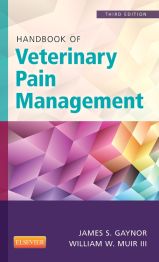
Handbook of Veterinary Pain Management, 3rd Edition
Author :
By James S. Gaynor, DVM, MS, DACVA, DAAPM and William W. Muir, DVM, MSc, PhD, DACVA, DACVECC
Trust the Handbook of Veterinary Pain Management, 3rd Edition to help you meet the increasing need for effective pain management in the animals you treat. This user-friendly guide contains the most up-to-date and clinically relevant information on an
...view more
Trust the Handbook of Veterinary Pain Management, 3rd Edition to help you meet the increasing need for effective pain management in the animals you treat. This user-friendly guide contains the most up-to-date and clinically relevant information on analgesic drugs and managing pain in dogs, cats, birds, reptiles, ferrets, and rabbits. It specifically covers the areas of pain assessment, pharmaceutical and non-pharmaceutical treatment options, guidelines for managing acute and chronic pain, and unique aspects of pain management. This edition also incorporates expanded information on cats, exotics, the latest drugs, and more to keep you on top of today’s best practices in veterinary pain management.
Trust the Handbook of Veterinary Pain Management, 3rd Edition to help you meet the increasing need for effective pain management in the animals you treat. This user-friendly guide contains the most up-to-date and clinically relevant information on analgesic drugs and managing pain in dogs, cats, birds, reptiles, ferrets, and rabbits. It specifically covers the areas of pain assessment, pharmaceutical and non-pharmaceutical treatment options, guidelines for managing acute and chronic pain, and unique aspects of pain management. This edition also incorporates expanded information on cats, exotics, the latest drugs, and more to keep you on top of today’s best practices in veterinary pain management.
New to this edition
NEW! Eight new chapters
include the latest information on:
the human-animal bond
local and regional techniques
preventive and multimodal analgesia
energy modalities
acupuncture
physical examination with emphasis on isolating and locating pain
therapeutic goals
pain in laboratory animals
NEW! Completely updated drug information, with new agents, doseforms, and routes provides the most current pain management therapies for use in the clinical setting.
NEW! Expanded sections on the cat and exotics address the growing popularity of these pets by providing additional species-specific information.
Key Features
The latest information on complementary and alternative strategies for pain management offers the guidance to help youincorporate non-pharmacologic treatments into their pain management programs.
Numerous boxes and tables summarize pharmacologic protocols and clinical applications, with dosages, indications, contraindications, and side effects to provide you with the comprehensive drug information needed to find the most effective and appropriate treatment.
User-friendly format helps you quickly and easily find essential information.
Case studies illustrating realistic clinical scenarios help you learn how to assess and manage pain in the clinical setting.
Author Information
By James S. Gaynor, DVM, MS, DACVA, DAAPM, Certified Veterinary Acupuncturist, International Veterinary Acupuncture Society; Director, Animal Anesthesia and Pain Management Center, Colorado Springs, CO and William W. Muir, DVM, MSc, PhD, DACVA, DACVECC, Regional Director, American Academy of Pain Management, Veterinary Clinical Pharmacology Consulting Services, Columbus, Ohio
By James S. Gaynor, DVM, MS, DACVA, DAAPM, Certified Veterinary Acupuncturist, International Veterinary Acupuncture Society; Director, Animal Anesthesia and Pain Management Center, Colorado Springs, CO and William W. Muir, DVM, MSc, PhD, DACVA, DACVECC, Regional Director, American Academy of Pain Management, Veterinary Clinical Pharmacology Consulting Services, Columbus, Ohio
1. The Human-Animal Bond and Pain 2. Nociception and Pain Mechanisms 3. Pain: Physiologic Consequences and Stress 4. Pain Nomenclature 5. Pain Behaviors and Pain Assessment Scales 6. Quality of Life Assessment 7. Drug Classes and Drugs Used for Pain Therapy: An Overview 8. NSAIDs 9. Opioids 10. Alpha-2s 11. Local Anesthetics 12. Local and Regional Anesthetic Techniques 13. Corticosteroids 14. Other “Drugs and Injectable Modalities 15. Drug Delivery Methods 16. Preventative and “Multimodal Analgesia; “Masking and Pitfalls: Theory and Consequences 17. Energy Modalities: Therapeutic Laser and Pulsed Electromagnetic Field Therapy 18. Acupuncture 19. Physical Rehabilitation and Exercise 20. Physical Examination with Emphasis on Isolating and Detecting Pain 21. Therapeutic Goals 22. Acute Pain Cases 23. Chronic Pain Cases 24. Cat Specific Considerations 25. Rabbit and Small Mammal Specific Considerations 26. Bird Specific Considerations 27. Reptile Specific Considerations 28. Regulations in Pain and Distress in Laboratory Animals
There is a considerable amount of information in this small and relatively reasonably priced book, its compact dimensions belying the page numbers held within. The style is concise with a good use of bullet points. There are few books available with such a comprehensive coverage of material related to analgesia.
https://www.elsevierhealth.com.au/handbook-of-veterinary-pain-management-9780323089357.html293853Handbook of Veterinary Pain Managementhttps://www.elsevierhealth.com.au/media/catalog/product/9/7/9780323089357_7.jpg98.96131.93AUDInStock/Veterinary/Veterinary Medicine/Books/Veterinary/Veterinary Medicine/Books/Books/Veterinary/Veterinary Medicine/Japan Titles43350974388722505456350546645255039525984352631601418269243350964886536505456251451205259842<P>Trust the <B>Handbook of Veterinary Pain Management, 3rd Edition</B> to help you meet the increasing need for effective pain management in the animals you treat. This user-friendly guide contains the most up-to-date and clinically relevant information on analgesic drugs and managing pain in dogs, cats, birds, reptiles, ferrets, and rabbits. It specifically covers the areas of pain assessment, pharmaceutical and non-pharmaceutical treatment options, guidelines for managing acute and chronic pain, and unique aspects of pain management. This edition also incorporates expanded information on cats, exotics, the latest drugs, and more to keep you on top of today’s best practices in veterinary pain management.</P> <P>Trust the <B>Handbook of Veterinary Pain Management, 3rd Edition</B> to help you meet the increasing need for effective pain management in the animals you treat. This user-friendly guide contains the most up-to-date and clinically relevant information on analgesic drugs and managing pain in dogs, cats, birds, reptiles, ferrets, and rabbits. It specifically covers the areas of pain assessment, pharmaceutical and non-pharmaceutical treatment options, guidelines for managing acute and chronic pain, and unique aspects of pain management. This edition also incorporates expanded information on cats, exotics, the latest drugs, and more to keep you on top of today’s best practices in veterinary pain management.</P>00add-to-cart97803230893572014ProfessionalBy James S. Gaynor, DVM, MS, DACVA, DAAPM and William W. Muir, DVM, MSc, PhD, DACVA, DACVECC20153BookOtherApprox. 140 illustrationsMosby62428 Aug 2014Please allow 3-4 weeks for deliveryBy <STRONG>James S. Gaynor</STRONG>, DVM, MS, DACVA, DAAPM, Certified Veterinary Acupuncturist, International Veterinary Acupuncture Society; Director, Animal Anesthesia and Pain Management Center, Colorado Springs, CO and <STRONG>William W. Muir</STRONG>, DVM, MSc, PhD, DACVA, DACVECC, Regional Director, American Academy of Pain Management, Veterinary Clinical Pharmacology Consulting Services, Columbus, OhioBooksBookUnited StatesNoNoNoNoPlease SelectPlease SelectPlease Select