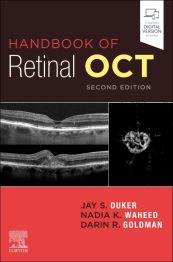
Handbook of Retinal OCT: Optical Coherence Tomography, 2nd Edition
Author :
By Jay S. Duker, MD, Nadia K. Waheed, MD MPH and Darin Goldman, MD
Arguably the most important ancillary test available to ophthalmologists worldwide, optical coherence tomography (OCT) has revolutionized the field, and now includes angiographic evaluations (OCTA) that provide vascular flow data without eye injectio
...view more
Arguably the most important ancillary test available to ophthalmologists worldwide, optical coherence tomography (OCT) has revolutionized the field, and now includes angiographic evaluations (OCTA) that provide vascular flow data without eye injection. Handbook of Retinal OCT is an easy-to-use, high-yield guide to both OCT and OCTA imaging for practitioners at any stage of their career. Highly templated, concise, and portable, this revised edition helps you master the latest imaging methods used to evaluate retinal disease, uveitis, and optic nerve disorders.
Arguably the most important ancillary test available to ophthalmologists worldwide, optical coherence tomography (OCT) has revolutionized the field, and now includes angiographic evaluations (OCTA) that provide vascular flow data without eye injection. Handbook of Retinal OCT is an easy-to-use, high-yield guide to both OCT and OCTA imaging for practitioners at any stage of their career. Highly templated, concise, and portable, this revised edition helps you master the latest imaging methods used to evaluate retinal disease, uveitis, and optic nerve disorders.
Key Features
Helps all health professionals with an interest in OCT to better and more quickly interpret OCT imaging, offering quick, highly visual guidance for evaluating age-related macular degeneration, diabetic retinopathy, retinal vein occlusion, and much more.
Provides quick answers with bulleted, templated chapters, each focused on one specific diagnosis or group of diagnoses with a particular OCT appearance.
Demonstrates how the full spectrum of diseases presents through approximately 400 illustrations, including the highest-quality spectral-domain OCT images available and more than 50 new OCTA images.
Includes five new chapters covering optic nerve disease with retinal findings, pachychoroid diseases, paracentral acute middle maculopathy (PAMM), auto-immune retinopathies, and primary uveal lymphoma.
Offers clear visual guidance on image patterns with multiple arrows and labels throughout to highlight key details of each disease.
Enhanced eBook version included with purchase. Your enhanced eBook allows you to access bonus images plus all of the text, figures, and references from the book on a variety of devices.
Author Information
By Jay S. Duker, MD, Director, New England Eye Center, Chairman and Professor of Ophthalmology, Tufts Medical Center, Tufts University School of Medicine, Boston, Massachusetts; Nadia K. Waheed, MD MPH, Associate Professor of Ophthalmology, New England Eye Center, Tufts University School of Medicine, Boston, Massachusetts and Darin Goldman, MD, Vitreoretinal Surgeon, Retina Group of Florida, Fort Lauderdale, FL, USA
By Jay S. Duker, MD, Director, New England Eye Center, Chairman and Professor of Ophthalmology, Tufts Medical Center, Tufts University School of Medicine, Boston, Massachusetts; Nadia K. Waheed, MD MPH, Associate Professor of Ophthalmology, New England Eye Center, Tufts University School of Medicine, Boston, Massachusetts and Darin Goldman, MD, Vitreoretinal Surgeon, Retina Group of Florida, Fort Lauderdale, FL, USA
https://www.elsevierhealth.com.au/handbook-of-retinal-oct-optical-coherence-tomography-9780323757720.html296959Handbook of Retinal OCT: Optical Coherence Tomographyhttps://www.elsevierhealth.com.au/media/catalog/product/9/7/9780323757720_7.jpg176.21234.95AUDInStock/Medicine & Surgery/Ophthalmology/Books/Medicine/Ophthalmology/Books/Books/Medicine/Ophthalmology/Japan Titles44312104388722505455750546645255039525983752631601418269243350884886536505455351451205259833Arguably the most important ancillary test available to ophthalmologists worldwide, optical coherence tomography (OCT) has revolutionized the field, and now includes angiographic evaluations (OCTA) that provide vascular flow data without eye injection. Handbook of Retinal OCT is an easy-to-use, high-yield guide to both OCT and OCTA imaging for practitioners at any stage of their career. Highly templated, concise, and portable, this revised edition helps you master the latest imaging methods used to evaluate retinal disease, uveitis, and optic nerve disorders. Arguably the most important ancillary test available to ophthalmologists worldwide, optical coherence tomography (OCT) has revolutionized the field, and now includes angiographic evaluations (OCTA) that provide vascular flow data without eye injection. Handbook of Retinal OCT is an easy-to-use, high-yield guide to both OCT and OCTA imaging for practitioners at any stage of their career. Highly templated, concise, and portable, this revised edition helps you master the latest imaging methods used to evaluate retinal disease, uveitis, and optic nerve disorders. 00add-to-cart97803237577202021ProfessionalBy Jay S. Duker, MD, Nadia K. Waheed, MD MPH and Darin Goldman, MD20222Book152w x 229h (6.00" x 9.00")Approx. 470 illustrations (245 in full color)Elsevier2562 Nov 2021IN STOCKBy <STRONG>Jay S. Duker</STRONG>, MD, Director, New England Eye Center, Chairman and Professor of Ophthalmology, Tufts Medical Center, Tufts University School of Medicine, Boston, Massachusetts; <STRONG>Nadia K. Waheed</STRONG>, MD MPH, Associate Professor of Ophthalmology, New England Eye Center, Tufts University School of Medicine, Boston, Massachusetts and <STRONG>Darin Goldman</STRONG>, MD, Vitreoretinal Surgeon, Retina Group of Florida, Fort Lauderdale, FL, USABooksBookUnited StatesNoNoNoNoPlease SelectPlease SelectPlease Select