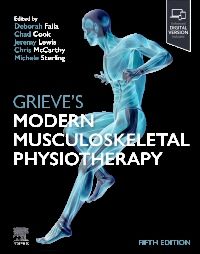
Grieve's Modern Musculoskeletal Physiotherapy, 5th Edition
Author :
Edited by Deborah Falla, PhD, BPhty, Jeremy Lewis, BApSci (Physio), PhD, FCSP, Christopher McCarthy, PhD, PGDs Biomech, Manual Therapy, Physiotherapy, FMACP, FCSP, Chad E Cook, PhD, PT, FAAOMPT and Michele Sterling, PhD, MPhty, BPhty, Grad Dip Manip Physio, FACP
Originally edited by Gregory Grieve, a founder of modern manual therapy, the fifth edition of Grieve's Modern Musculoskeletal Physiotherapy, Fifth Edition continues to offer contemporary evidence, models of diagnosis and practice that make this one o
...view more
Originally edited by Gregory Grieve, a founder of modern manual therapy, the fifth edition of Grieve's Modern Musculoskeletal Physiotherapy, Fifth Edition continues to offer contemporary evidence, models of diagnosis and practice that make this one of the most highly respected reference books for physiotherapists.
This edition has been fully updated to provide an overview of the latest science in a rapidly evolving field. It includes detailed directions for research-informed patient care for a range of musculoskeletal disorders, as well as up-to-date information on the global burden, research methodologies, measurements, and principles of assessment and management.
A new international editorial board, with experience in both research and clinical practice, bring a truly comprehensive perspective to this book, meaning those practising musculoskeletal physiotherapy today will find it highly clinically relevant to their work.
Originally edited by Gregory Grieve, a founder of modern manual therapy, the fifth edition of Grieve's Modern Musculoskeletal Physiotherapy, Fifth Edition continues to offer contemporary evidence, models of diagnosis and practice that make this one of the most highly respected reference books for physiotherapists.
This edition has been fully updated to provide an overview of the latest science in a rapidly evolving field. It includes detailed directions for research-informed patient care for a range of musculoskeletal disorders, as well as up-to-date information on the global burden, research methodologies, measurements, and principles of assessment and management.
A new international editorial board, with experience in both research and clinical practice, bring a truly comprehensive perspective to this book, meaning those practising musculoskeletal physiotherapy today will find it highly clinically relevant to their work.
New to this edition
Global burden of musculoskeletal disorders – including history, epidemiology and new models of care
A range of new research methodologies, including N of 1 research designs, systematic reviews and meta-analyses, population-based cohort studies, consensus research and response analyses in musculoskeletal research
How to navigate the endless wave of information and assess different levels of evidence
New measures
New chapter on cost analyses and value-based care
Digital rehabilitation methods
Key Features
Edited by an internationally recognised editorial board – brings expertise in both research and clinical practice
Fully updated with the latest published evidence
Clear guidance on evidence-based contemporary practice
Management of conditions relating to both the vertebral column and peripheral joints
Updated reviews on the science and practice of a wide range of treatment modalities
Principles of effective communication, screening, clinical reasoning, lifestyle considerations, behavioural change and self-management
Summary boxes and clinical tips to support clinical assessment and management
More than 300 figures and illustrations
Author Information
Edited by Deborah Falla, PhD, BPhty, Professor, Chair in Rehabilitation Science and Physiotherapy, School of Sport, Exercise and Rehabilitation Sciences, University of Birmingham, UK; Jeremy Lewis, BApSci (Physio), PhD, FCSP, Consultant Physiotherapist for London Shoulder Clinic, Centre for Health and Human Performance & for Central London Community Healthcare NHS Trust; University of Limerick, Ireland; School of Health and Social Work, University of Hertfordshire, UK; Christopher McCarthy, PhD, PGDs Biomech, Manual Therapy, Physiotherapy, FMACP, FCSP, Clinical Fellow, Manchester School of Physiotherapy, Manchester Metropolitan University, Manchester, UK; Chad E Cook, PhD, PT, FAAOMPT, Program Director, Professor, Doctor of Physical Therapy Division, School of Medicine, Duke University, Durham, NC, USA; Michele Sterling, PhD, MPhty, BPhty, Grad Dip Manip Physio, FACP, NHMRC Investigator Leadership 2 Fellow; Director, NHMRC Centre of Research Excellence: Better Health Outcomes for Compensable Injury and Program Lead, RECOVER Injury Research Centre, The University of Queensland, Australia
Edited by Deborah Falla, PhD, BPhty, Professor, Chair in Rehabilitation Science and Physiotherapy, School of Sport, Exercise and Rehabilitation Sciences, University of Birmingham, UK; Jeremy Lewis, BApSci (Physio), PhD, FCSP, Consultant Physiotherapist for London Shoulder Clinic, Centre for Health and Human Performance & for Central London Community Healthcare NHS Trust; University of Limerick, Ireland; School of Health and Social Work, University of Hertfordshire, UK; Christopher McCarthy, PhD, PGDs Biomech, Manual Therapy, Physiotherapy, FMACP, FCSP, Clinical Fellow, Manchester School of Physiotherapy, Manchester Metropolitan University, Manchester, UK; Chad E Cook, PhD, PT, FAAOMPT, Program Director, Professor, Doctor of Physical Therapy Division, School of Medicine, Duke University, Durham, NC, USA; Michele Sterling, PhD, MPhty, BPhty, Grad Dip Manip Physio, FACP, NHMRC Investigator Leadership 2 Fellow; Director, NHMRC Centre of Research Excellence: Better Health Outcomes for Compensable Injury and Program Lead, RECOVER Injury Research Centre, The University of Queensland, Australia
PART II Global Burden of Musculoskeletal Disorders 2.1 Historic Management Perspectives 2.2 Epidemiologic Measures of Musculoskeletal Disorders 2.3 An Overview of Contributors to Pain and Disability 2.4 Biological Contributors to Musculoskeletal Pain and Disability 2.5 Psychological Contributors to Musculoskeletal Pain 2.6 Social Contributors to Pain and Disability 2.7 Musculoskeletal Models of Care
PART III Research Design and Navigating the Endless Wave of Information 3.1 What Is Information, and Where Are People Getting It From? 3.2 Information Credibility: Navigating the Endless Wave of Information 3.3 Levels of Evidence SECTION 3.4 Research Design 3.4.1 Quantitative Research 3.4.2 Introduction To Qualitative Design 3.4.3 Mixed Methods Research 3.4.4 Living Evidence: Is the Randomised Controlled Trial the Missing Link? 3.4.5 N-of-1 Research Designs 3.4.6 Standardized Data Collection, Audit, and Clinical Profiling 3.4.7 Systematic Reviews: Informing Evidence-Based Practice 3.4.8 Why Are Population-Based Cohorts Important in Progressing Our Understanding of Musculoskeletal Pain Conditions? 3.4.9 Implementation Research 3.4.10 Consensus Research 3.4.11 Responder Analyses in Musculoskeletal Research
PART IV Measurements in Musculoskeletal Physiotherapy 4.1 Patient-Reported Outcome Measures in Musculoskeletal Physiotherapy 4.2 Patient-Reported Experience Measures 4.3 Physical Performance Measures 4.4 Assessing Cost Analyses and Value-Based Care in Rehabilitation SECTION 4.5 Advances in Measurement 4.5.1 Quantitative Sensory Testing and Clinical Sensory Testing 4.5.2 Pain in the Brain: The Role and Future of Functional Neuroimaging 4.5.3 Advances in Magnetic Resonance Imaging Measures 4.5.4 Ultrasound in Musculoskeletal Practice 4.5.5 Surface Electromyography 4.5.6 Movement Analysis and Musculoskeletal Modeling 4.5.7 Electroencephalography 4.5.8 Transcranial Magnetic Stimulation
PART V Principles of Assessment and Management 5.1 Communication 5.2 Red Flags SECTION 5.3 Lifestyle and Health 5.3.1 Lifestyle and Musculoskeletal Health: Basis for a Health and Lifestyle Framework 5.3.2 Implementing a Health and Lifestyle Framework: Competencies for Musculoskeletal Physiotherapists 5.4 Clinical Reasoning and Models for Clinical Management 5.5 Consideration of Cognitive and Behavioral Influences on Physiotherapy Practice 5.6 Educational Approaches to Pain Management 5.7 Behavior Change and Self-Management 5.8 Hemodynamics and Clinical Practice 5.9 Neurodynamics 5.10 Neuromuscular Adaptations to Exercise 5.11 The Analgesic Effects of Exercise 5.12 Management of Sensorimotor Control in Musculoskeletal Disorders 5.13 Manual Therapy SECTION 5.14 Adjunct Modalities 5.14.1 Electrophysical Modalities 5.14.2 Acupuncture and Its Role in Musculoskeletal Pain and Rehabilitation 5.15 Digital Rehabilitation Methods 5.16 Advanced Practice in Physiotherapy
PART VI Region Specific Management 6.1 Idiopathic Neck Pain 6.2 Whiplash-Associated Disorders 6.3 Temporomandibular Disorders and Orofacial Pain 6.4 Thoracic Pain 6.5 Low Back Pain Examination and Treatment 6.6 Clinical Reasoning in Sacroiliac Joint and Pelvic Girdle Pain: A Tunnel Vision of Physiotherapy Experts? 6.7 The Shoulder 6.8 The Elbow 6.9 Wrist and hand 6.10 The Hip 6.11 Knee Conditions 6.12 Foot and Ankle
https://www.elsevierhealth.com.au/grieves-modern-musculoskeletal-physiotherapy-9780702080890.html311514Grieve's Modern Musculoskeletal Physiotherapyhttps://www.elsevierhealth.com.au/media/catalog/product/9/7/9780702080890_2.jpg210.55233.95AUDInStock/Health Professions/Physiotherapy/Health Professions/Sports Medicine/Health Professions/Manual Therapy/Health Professions/Physiotherapy/Health Professions/Sports Medicine/Health Professions/Manual Therapy/Health Professions/Physiotherapy/Health Professions/Sports Medicine/Health Professions/Manual Therapy/Books/Books/Books/Japan Titles/Bestsellers433509443351124335107505456050545815054573525984052598635259854438872250546645255039526316050613771418269243350924886536505455851451205259838Originally edited by Gregory Grieve, a founder of modern manual therapy, the fifth edition of <b>Grieve's Modern Musculoskeletal Physiotherapy, Fifth Edition</b> continues to offer contemporary evidence, models of diagnosis and practice that make this one of the most highly respected reference books for physiotherapists.<BR><BR>This edition has been fully updated to provide an overview of the latest science in a rapidly evolving field. It includes detailed directions for research-informed patient care for a range of musculoskeletal disorders, as well as up-to-date information on the global burden, research methodologies, measurements, and principles of assessment and management.<BR><BR>A new international editorial board, with experience in both research and clinical practice, bring a truly comprehensive perspective to this book, meaning those practising musculoskeletal physiotherapy today will find it highly clinically relevant to their work. Originally edited by Gregory Grieve, a founder of modern manual therapy, the fifth edition of <b>Grieve's Modern Musculoskeletal Physiotherapy, Fifth Edition</b> continues to offer contemporary evidence, models of diagnosis and practice that make this one of the most highly respected reference books for physiotherapists.<BR><BR>This edition has been fully updated to provide an overview of the latest science in a rapidly evolving field. It includes detailed directions for research-informed patient care for a range of musculoskeletal disorders, as well as up-to-date information on the global burden, research methodologies, measurements, and principles of assessment and management.<BR><BR>A new international editorial board, with experience in both research and clinical practice, bring a truly comprehensive perspective to this book, meaning those practising musculoskeletal physiotherapy today will find it highly clinically relevant to their work.00add-to-cart97807020808902024ProfessionalEdited by Deborah Falla, PhD, BPhty, Jeremy Lewis, BApSci (Physio), PhD, FCSP, Christopher McCarthy, PhD, PGDs Biomech, Manual Therapy, Physiotherapy, FMACP, FCSP, Chad E Cook, PhD, PT, FAAOMPT and Michele Sterling, PhD, MPhty, BPhty, Grad Dip Manip Physio, FACP20255Book216w x 276h (8.50" x 10.875")Elsevier6005 Aug 2024IN STOCKEdited by <STRONG>Deborah Falla</STRONG>, PhD, BPhty, Professor, Chair in Rehabilitation Science and Physiotherapy, School of Sport, Exercise and Rehabilitation Sciences, University of Birmingham, UK; <STRONG>Jeremy Lewis</STRONG>, BApSci (Physio), PhD, FCSP, Consultant Physiotherapist for London Shoulder Clinic, Centre for Health and Human Performance & for Central London Community Healthcare NHS Trust; University of Limerick, Ireland; School of Health and Social Work, University of Hertfordshire, UK; <STRONG>Christopher McCarthy</STRONG>, PhD, PGDs Biomech, Manual Therapy, Physiotherapy, FMACP, FCSP, Clinical Fellow, Manchester School of Physiotherapy, Manchester Metropolitan University, Manchester, UK; <STRONG>Chad E Cook</STRONG>, PhD, PT, FAAOMPT, Program Director, Professor, Doctor of Physical Therapy Division, School of Medicine, Duke University, Durham, NC, USA; <STRONG>Michele Sterling</STRONG>, PhD, MPhty, BPhty, Grad Dip Manip Physio, FACP, NHMRC Investigator Leadership 2 Fellow; Director, NHMRC Centre of Research Excellence: Better Health Outcomes for Compensable Injury and Program Lead, RECOVER Injury Research Centre, The University of Queensland, AustraliaBooksBookUnited KingdomYesYesNoNoPlease SelectPlease SelectPlease Select