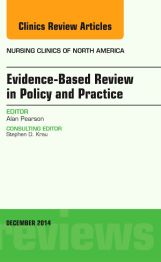
Evidence-Based Review in Policy and Practice, An Issue of Nursing Clinics, 1st Edition
Author :
By Alan Pearson
Evidence synthesis is the evaluation or analysis of research evidence and opinion on a specific topic to aid in decision-making in health care. Although the science of evidence synthesis has developed most rapidly in relation to the meta-analysis of
...view more
Evidence synthesis is the evaluation or analysis of research evidence and opinion on a specific topic to aid in decision-making in health care. Although the science of evidence synthesis has developed most rapidly in relation to the meta-analysis of numerical data linked to theories of cause and effect, the further development of theoretical understandings and propositions of the nature of evidence, its role in health care delivery, and the facilitation of improved global health have increased rapidly since 2000. The articles appearing in this issue examine the role of evidence synthesis in nursing and health care and are written by expert translational scientists from across the world. Three introductory articles overview evidence synthesis and its role in evidence-based health care; methods, issues, and trends in the systematic review of health care evidence; and the development of a robust evidence base for nursing. Subsequent articles explore the impact of systematic reviews on policy and practice in a variety of settings, including perioperative care, pediatrics, rehabilitation and long-term/continuing care, mental health, and public health. The final articles discuss the impact of evidence on health policy and practice and the complexities of translating evidence into policy and practice. These articles show the importance of synthesizing evidence and translating policy and practice into action in our quest to improve health care and health outcomes.
Evidence synthesis is the evaluation or analysis of research evidence and opinion on a specific topic to aid in decision-making in health care. Although the science of evidence synthesis has developed most rapidly in relation to the meta-analysis of numerical data linked to theories of cause and effect, the further development of theoretical understandings and propositions of the nature of evidence, its role in health care delivery, and the facilitation of improved global health have increased rapidly since 2000. The articles appearing in this issue examine the role of evidence synthesis in nursing and health care and are written by expert translational scientists from across the world. Three introductory articles overview evidence synthesis and its role in evidence-based health care; methods, issues, and trends in the systematic review of health care evidence; and the development of a robust evidence base for nursing. Subsequent articles explore the impact of systematic reviews on policy and practice in a variety of settings, including perioperative care, pediatrics, rehabilitation and long-term/continuing care, mental health, and public health. The final articles discuss the impact of evidence on health policy and practice and the complexities of translating evidence into policy and practice. These articles show the importance of synthesizing evidence and translating policy and practice into action in our quest to improve health care and health outcomes.
https://www.elsevierhealth.com.au/evidence-based-review-in-policy-and-practice-an-issue-of-nursing-clinics-9780323326629.html294224Evidence-Based Review in Policy and Practice, An Issue of Nursing Clinicshttps://www.elsevierhealth.com.au/media/catalog/product/9/7/9780323326629_7.jpg128.96171.95AUDInStock/Medicine & Surgery/Clinical/General Medicine/Nursing & Midwifery/General Nursing/Clinics/Medicine/Clinical/General Medicine/Nursing & Midwifery/General Nursing/Clinics/Clinics/Medicine/Clinical/General Medicine/Nursing & Midwifery/General Nursing/Japan Titles433510243351164388725505459150545755054666525504152598745259856526316014182692433508843351054886536505455350545715145120525983352598735259852Evidence synthesis is the evaluation or analysis of research evidence and opinion on a specific topic to aid in decision-making in health care. Although the science of evidence synthesis has developed most rapidly in relation to the meta-analysis of numerical data linked to theories of cause and effect, the further development of theoretical understandings and propositions of the nature of evidence, its role in health care delivery, and the facilitation of improved global health have increased rapidly since 2000. The articles appearing in this issue examine the role of evidence synthesis in nursing and health care and are written by expert translational scientists from across the world. Three introductory articles overview evidence synthesis and its role in evidence-based health care; methods, issues, and trends in the systematic review of health care evidence; and the development of a robust evidence base for nursing. Subsequent articles explore the impact of systematic reviews on policy and practice in a variety of settings, including perioperative care, pediatrics, rehabilitation and long-term/continuing care, mental health, and public health. The final articles discuss the impact of evidence on health policy and practice and the complexities of translating evidence into policy and practice. These articles show the importance of synthesizing evidence and translating policy and practice into action in our quest to improve health care and health outcomes. Evidence synthesis is the evaluation or analysis of research evidence and opinion on a specific topic to aid in decision-making in health care. Although the science of evidence synthesis has developed most rapidly in relation to the meta-analysis of numerical data linked to theories of cause and effect, the further development of theoretical understandings and propositions of the nature of evidence, its role in health care delivery, and the facilitation of improved global health have increased rapidly since 2000. The articles appearing in this issue examine the role of evidence synthesis in nursing and health care and are written by expert translational scientists from across the world. Three introductory articles overview evidence synthesis and its role in evidence-based health care; methods, issues, and trends in the systematic review of health care evidence; and the development of a robust evidence base for nursing. Subsequent articles explore the impact of systematic reviews on policy and practice in a variety of settings, including perioperative care, pediatrics, rehabilitation and long-term/continuing care, mental health, and public health. The final articles discuss the impact of evidence on health policy and practice and the complexities of translating evidence into policy and practice. These articles show the importance of synthesizing evidence and translating policy and practice into action in our quest to improve health care and health outcomes.00add-to-cart97803233266292014ProfessionalBy Alan Pearson20141BookOtherElsevier02 Dec 2014Please allow 10-14 working days for deliveryBy <STRONG>Alan Pearson</STRONG>, Adelaide UniversityClinicsClinicsThe Clinics: NursingUnited StatesNoNoNoNoPlease SelectPlease SelectPlease Select