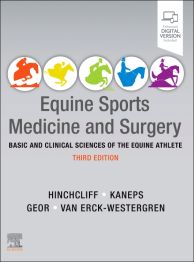
Equine Sports Medicine and Surgery, 3rd Edition
Key Features
- NEW! Chapters in this edition include:
- History of Equine Exercise Physiology
- Welfare of Equine Athletes in Sport and the Social License to Operate
- The Connected Horse (focusing on innovative, cloud-based technologies used to monitor athletic horses)
- Conditioning of the Equine Athlete
- Principles of Sport Horse Farriery
- Epidemiology and Control of Infectious Respiratory Disease in Populations of Athletic Horses
- Behavior and Behavioral Abnormalities in Athletic Horses
- Vision and Disorders of Vision in Performance Horses
- Detection of Drug Use in Athletic Horses
- Drug Effects on Performance of the Equine Athlete
- Comprehensive coverage is based on sound research and evidence-based practice and provides an understanding of the physiologic processes underlying the responses of horses to exercise and physical conditioning — from musculoskeletal and respiratory disorders to nutrition and physical rehabilitation.
- International perspective on equine athletics includes guidelines pertinent to different geographic areas and racing jurisdictions.
- More than 1,000 images include medical illustrations and clinical photos depicting equine anatomy, testing, and treatment scenarios, as well as radiographic, ultrasonographic, CAT, and MRI imaging to support understanding and diagnosis.
- Coverage of abnormalities of the upper airway is now divided into two chapters: Disease of the Nasopharynx and Diseases of the Larynx and Trachea.
- Coverage of diseases of the heart is divided into two chapters: Arrhythmias and Abnormalities of the Cardiac Conduction System and Structural Heart Disease, Cardiomyopathy, and Diseases of Large Vessels.
- eBook version, included with print purchase, gives you the power to access all the text, figures, and references, with the ability to search, customize your content, make notes and highlights, and have content read aloud.
Author Information
| ISBN Number | 9780702083709 |
|---|---|
| Description Author List | By Kenneth W Hinchcliff, BVSc, MS, PhD, DACVIM (Large Animal), Warden and CEO, Trinity College, Parkville Victoria, Australia; Professor (Emeritus), Melbourne Veterinary School, Faculty of Science, University of Melbourne, Melbourne, Victoria, Australia; Andris J. Kaneps, DVM, MS, PhD, DACVS, DACVSMR, Owner Kaneps Equine Sports Medicine and Surgery Beverly, Massachusetts; Raymond J. Geor, BVSc, MVSc, PhD, Diplomate ACVIM (Large Animal Internal Medicine, Nutrition) and ACVSMR (Equine), Professor of Equine Medicine and Pro Vice-Chancellor, College of Sciences, Massey University, Palmerston North, New Zealand and Emmanuelle Van Erck-Westergren, BVSc, MVSc, PhD, ECEIM, ECVSMR, Founder & Owner, Equine Sports Medicine Practice, Waterloo, Belgium |
| Copyright Year | 2024 |
| Edition Number | 3 |
| Format | Book |
| Trim | 216w x 276h (8.50" x 10.875") |
| Illustrations | 160 illustrations (100 in full color) |
| Imprint | Saunders Ltd. |
| Page Count | 1428 |
| Publication Date | 12 Apr 2024 |
| Stock Status | IN STOCK |


eBooks : Built for busy schedules & tailored for your goals.


Affordable knowledge, built for you
Get the resources you need-often at a lower cost than print. Quality content designed to support your goals, without stretching your budget.


Seamless access wherever you are


Always in sync


Tools the make learning stick
Your eBook is ready whenever you are!
1. Check your email for your access code.


2. Sign into or create your VitalSource account and redeem your code.


3. Open your eBook - ready whenever you are!
FAQ
The access code for your new eBook will be sent in your order confirmation email. Your code can also be accessed in your My Account section on the Elsevier webshop. If you do not receive your code within a few minutes, please check your spam folder.
Step-by-step guidance on how to download Bookshelf and also redeem your code can be found here.
The access code for your new eBook does not expire. However, we always suggest redeeming immediately after purchase to start experiencing the benefits of and insights from your purchase. Important to note - the code provided is a single use code and only valid for the edition you purchase. It does not provide access to past nor future editions of the title.
You will have unlimited access to your eBook on the device to which it was downloaded.
Discover the various learning features that our eBooks offer on the Bookshelf® Reader! For example, you can highlight different text passages, create notes and flashcards, have the text read to you, etc. Particularly practical: You can also use your eBooks offline. More information on the learning functions can be found on the Vitalsource page.
Quality is our top priority. That's why we collaborate with the leading eBook reader provider VitalSource. VitalSource has its own eBook reader Bookshelf®, which you can easily download. This reader is very user-friendly and offers more features than other standard readers. For example, you can highlight different text passages, create notes and flashcards, have the text read to you, etc. Particularly practical: You can also use your eBooks offline. More information can be found on the Vitalsource page.
Elsevier offers its eBooks in ePub format, as we believe this format is best suited to display our content ideally on as many devices as possible.
You can return your eBook within 13 days of purchase. eBooks that have been partially printed or flipped through more than 15% are excluded from returns.
Any questions ?
Top Picks from Our Community
E-Book
Edited by Kimberly Washington
Nov 2025
E-Book
Edited by Prashanthi N. Thota
Nov 2025
E-Book
Edited by Christopher Filippi
Nov 2025
E-Book
Edited by Davis C. Thomas
Nov 2025
E-Book
Edited by Corey B. Simon
Nov 2025
E-Book
Edited by Catherine N. Petchprapa
Nov 2025
E-Book
Edited by Galal Omami
Nov 2025
E-Book
Edited by Hanan Goldberg
Nov 2025
E-Book
Edited by Sarah M. Perman
Nov 2025
E-Book
Edited by Michael W. Neumeister
Nov 2025
E-Book
Edited by Michael J. Alaia
Nov 2025
E-Book
Edited by Evie G. Marcolini
Nov 2025
E-Book
Edited by Kris Pyles-Sweet
Nov 2025
E-Book
Edited by Vin Paleri and Sue S. Yom
Nov 2025
E-Book
Edited by Frederick M. Azar
Nov 2025
E-Book
Edited by Brendon M. Stiles
Nov 2025
E-Book
Edited by Robert S. Brown Jr
Nov 2025
E-Book
Edited by Helio Autran de Morais
Nov 2025
E-Book
Nicholas J. Talley
Nov 2025
E-Book
Edited by Jeffrey D. Wayne
Nov 2025
E-Book
Edited by Andrew W. Harris
Nov 2025
E-Book
Edited by Arman Rahmim
Nov 2025
E-Book
Edited by Tamiko R. Katsumoto
Nov 2025
E-Book
Edited by Zoher Ghogawala
Nov 2025
E-Book
Edited by Consuelo C. Cagande
Nov 2025
1. History of Equine Exercise Physiology
2. The Horse as an Athlete
3. Welfare of Equine Athletes in Sport and the Social License to Operate
4. Laboratory Exercise Testing
5. Exercise Testing in the Field
6. The Connected Horse
7. Conditioning of the Equine Athlete
8. Genetic Basis of Equine Performance
Section 2: Musculoskeletal System and Lameness
9. Muscle Physiology: Responses to Exercise and Conditioning
10. Muscle Disorders of Equine Athletes
11. Epidemiology of Orthopedic Injury and Death in Athletic Horses
12. Skeletal Physiology: Responses to Exercise and Training
13. Tendon and Ligament Physiology
14. Joint Physiology: Response to Exercise and Training
15. Quantitative Assessment of Locomotion in the Athletic Horse
16. Objective Measurement of Lameness
17. Diagnosis of Lameness
18. Diseases of the Foot
19. Principles of Sport Horse Farriery
20. Distal Limb: Fetlock and Pastern
21. Metacarpus/Metatarsus
22. The Carpus
23. Elbow and Shoulder
24. Tarsus and Stifle
25. Axial Skeleton: Neck, Back, and Pelvis
26. Neurologic Causes of Gait Abnormalities in Athletic Horses
27. Soft Tissue Injuries: Tendinitis and Desmitis
28. Pharmacotherapy of Joint and Tendon Disease
29. Equine Rehabilitation
Section 3: Respiratory System
30. Upper Airway Function of Normal Horses During Exercise
31. Abnormalities of the Nasopharynx
32. Diseases of the Larynx and Trachea
33. Lower Airway Function: Response to Exercise and Training
34. Noninfectious Inflammatory Diseases of the Lower Airway of Athletic Horses (Including Equine Asthma)
35. Exercise-Induced Pulmonary Hemorrhage
36. Epidemiology and Control of Infectious Respiratory Disease in Populations of Athletic Horses
Section 4: Cardiovascular System
37. Heart and Vessels: Function During Exercise and Conditioning Adaptations
38. Arrhythmias and Abnormalities of the Cardiac Conduction System in Athletic Horses
39. Structural Heart Disease, Cardiomyopathy, and Diseases of the Large Vessels in Athletic Horses
Section 5: Metabolism and Nutrition
40. Energy Metabolism: Responses to Exercise and Training
41. Nutrition for the Equine Athlete: Nutrient Requirements and Key Principles in Ration Design
Section 6: Body Fluids, Electrolytes, Acid-Base, and Thermoregulation
42. Body Fluids and Electrolytes: Responses to Exercise and Training
43. Acid-Base Physiology at Rest, During Exercise, and in Response to Training
44. Abnormalities of Body Fluids and Electrolytes in Athletic Horses
45. Thermoregulation and Exercise-Associated Heat Illnesses
Section 7: Hematology, Biochemistry, and Immunity
46. Evaluation of Clinicopathological Abnormalities in Athletic Horses
47. Exercise and Immunity in Horses
Section 8: Gastrointestinal System
48. Gastrointestinal Disorders in Athletic Horses
Section 9: Behavior
49. Behavior and Behavioral Abnormalities in Athletic Horses
Section 10: Vision
50. Vision and Disorders of Vision in Performance Horses
Section 11: Veterinary Management of Athletic Horses
51. Veterinary Aspects of Training, Conditioning, and Racing Thoroughbred Racehorses
52. Veterinary Aspects of Training, Conditioning, and Racing Horses Used for Harness Racing
53. Veterinary Aspects of Conditioning, Training, and Competing Event Horses
54. Veterinary Aspects of Conditioning, Training, and Competing Dressage Horses
55. Veterinary Aspects of Conditioning, Training, and Competing the Showjumping Horse
56. Veterinary Aspects of Conditioning, Training, and Competing Polo Ponies
57. Veterinary Aspects of Conditioning, Training, and Competing Endurance Horses
58. Veterinary Aspects of Conditioning, Training, and Competing Western Performance Horses
59. Veterinary Aspects of the Aged Equine Athlete
60. Reproductive Management of the Athletic Horse
61. Emergency Procedures and First Aid for the Equine Athlete
62. Examination of the Equine Athlete Prior to Purchase
Section 12: Drug and Medication Use in Athletic Horses
63. Detection of Drug Use in Athletic Horses
64. Drug Effects on Performance of the Equine Athlete
Appendix A: Reference Values for Red Cell Variables in Athletic Horses
Appendix B: Reference Values for the Leukogram of Athletic Horses
Appendix C: Reference Values for Biochemical Variables in Athletic Horses