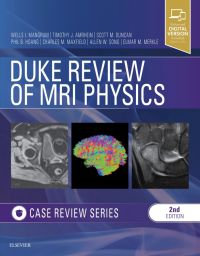
Duke Review of MRI Physics: Case Review Series, 2nd Edition
Author :
By Wells Mangrum, MD, Quoc Bao Hoang, MD, Tim J Amrhein, MD, Scott M Duncan, MD, Charles M Maxfield, MD, Elmar Merkle, MD and Allen W Song, MD
A solid understanding of MRI physics is essential for both residents and practicing radiologists, and Duke Review of MRI Physics Principles: Case Review Series, 2nd Edition, provides practical applications, board-style self-assessment questions, and
...view more
A solid understanding of MRI physics is essential for both residents and practicing radiologists, and Duke Review of MRI Physics Principles: Case Review Series, 2nd Edition, provides practical applications, board-style self-assessment questions, and clinically relevant cases in a high-yield, easy-to-digest format. Designed to help you solve clinical questions, arrive at accurate diagnoses, and use MRI more effectively in your practice, it uses a case-based approach to demonstrate the basic physics of MRI and how it applies to successful and accurate imaging, interpretation, and diagnosis.
A solid understanding of MRI physics is essential for both residents and practicing radiologists, and Duke Review of MRI Physics Principles: Case Review Series, 2nd Edition, provides practical applications, board-style self-assessment questions, and clinically relevant cases in a high-yield, easy-to-digest format. Designed to help you solve clinical questions, arrive at accurate diagnoses, and use MRI more effectively in your practice, it uses a case-based approach to demonstrate the basic physics of MRI and how it applies to successful and accurate imaging, interpretation, and diagnosis.
New to this edition
Includes a new chapter on MRI Safety, as well as new and improved color images in functional MRI, perfusion MRI, and diffusion tensor imaging.
Contains more than 300 all-new multiple-choice self-assessment questions following the board review certification and recertification question format.
Includes new Take-Home-Points at the end of each chapter for easy recall and review.
Expert Consult™ eBook version included with purchase. This enhanced eBook experience allows you to search all of the text, figures, and references from the book on a variety of devices.
Key Features
Focuses on 18 key MRI principles (such as T1 contrast, T2 contrast, and proton density), using a series of cases that make difficult concepts engaging and understandable.
Features over800 high-quality MR images in a full-color, user-friendly case format with clear explanations of physics and other MRI principles.
Shares the experience and knowledge of a multidisciplinary author team comprising radiology residents, practicing radiologists, and radiology physicists who provide practical guidance for each body system – neurologic, breast, body, vascular, and musculoskeletal.
Author Information
By Wells Mangrum, MD, Medical Director & Neuroradiologist, Center for Diagnostic Imaging (CDI), Eau Claire, Wisconsin; Quoc Bao Hoang, MD, Assistant Chief of Radiology, Southeast Louisiana Veterans Healthcare System, New Orleans, Louisiana; Tim J Amrhein, MD, Assistant Professor of Radiology, Division of Neuroradiology, Department of Radiology, Duke University Medical Center, Durham, North Carolina; Scott M Duncan, MD, Diagnostic and Interventional Radiologist, Radiology Associates, Jefferson, Indiana; Charles M Maxfield, MD, Professor of Pediatric Radiology, Duke University Medical Center, Durham, North Carolina; Elmar Merkle, MD, Chief Physician, Radiology and Nuclear Medicine, University of Basel, Basel, Switzerland and Allen W Song, MD, Professor and Director of the Center for Brain Imaging and Analysis, Biomedical Engineering Department, Duke University, Durham, North Carolina
By Wells Mangrum, MD, Medical Director & Neuroradiologist, Center for Diagnostic Imaging (CDI), Eau Claire, Wisconsin; Quoc Bao Hoang, MD, Assistant Chief of Radiology, Southeast Louisiana Veterans Healthcare System, New Orleans, Louisiana; Tim J Amrhein, MD, Assistant Professor of Radiology, Division of Neuroradiology, Department of Radiology, Duke University Medical Center, Durham, North Carolina; Scott M Duncan, MD, Diagnostic and Interventional Radiologist, Radiology Associates, Jefferson, Indiana; Charles M Maxfield, MD, Professor of Pediatric Radiology, Duke University Medical Center, Durham, North Carolina; Elmar Merkle, MD, Chief Physician, Radiology and Nuclear Medicine, University of Basel, Basel, Switzerland and Allen W Song, MD, Professor and Director of the Center for Brain Imaging and Analysis, Biomedical Engineering Department, Duke University, Durham, North Carolina
https://www.elsevierhealth.com.au/duke-review-of-mri-physics-case-review-series-9780323530385.html295310Duke Review of MRI Physics: Case Review Serieshttps://www.elsevierhealth.com.au/media/catalog/product/9/7/9780323530385_7.jpg91.47121.95AUDInStock/Medicine & Surgery/Radiology/Books/Medicine/Radiology/Books/Books/Medicine/Radiology/Japan Titles43351194388722505459250546645255039525987552631601418269243350884886536505455351451205259833<P>A solid understanding of MRI physics is essential for both residents and practicing radiologists, and <I>Duke Review of MRI Physics Principles: Case Review Series, 2nd Edition</I>, provides <B>practical applications, board-style self-assessment questions, and clinically relevant cases</B> in a high-yield, easy-to-digest format. Designed to help you <B>solve clinical questions, arrive at accurate diagnoses, and use MRI more effectively in your practice</B>, it uses a case-based approach to demonstrate the basic physics of MRI and how it applies to successful and accurate imaging, interpretation, and diagnosis.</P> <P>A solid understanding of MRI physics is essential for both residents and practicing radiologists, and <I>Duke Review of MRI Physics Principles: Case Review Series, 2nd Edition</I>, provides <B>practical applications, board-style self-assessment questions, and clinically relevant cases</B> in a high-yield, easy-to-digest format. Designed to help you <B>solve clinical questions, arrive at accurate diagnoses, and use MRI more effectively in your practice</B>, it uses a case-based approach to demonstrate the basic physics of MRI and how it applies to successful and accurate imaging, interpretation, and diagnosis.</P>00add-to-cart97803235303852018ProfessionalBy Wells Mangrum, MD, Quoc Bao Hoang, MD, Tim J Amrhein, MD, Scott M Duncan, MD, Charles M Maxfield, MD, Elmar Merkle, MD and Allen W Song, MD20192Book216w x 276h (8.50" x 10.875")535 illustrations (535 in full color)Elsevier25018 May 2018Please allow 3-4 weeks for deliveryBy <STRONG>Wells Mangrum</STRONG>, MD, Medical Director & Neuroradiologist, Center for Diagnostic Imaging (CDI), Eau Claire, Wisconsin; <STRONG>Quoc Bao Hoang</STRONG>, MD, Assistant Chief of Radiology, Southeast Louisiana Veterans Healthcare System, New Orleans, Louisiana; <STRONG>Tim J Amrhein</STRONG>, MD, Assistant Professor of Radiology, Division of Neuroradiology, Department of Radiology, Duke University Medical Center, Durham, North Carolina; <STRONG>Scott M Duncan</STRONG>, MD, Diagnostic and Interventional Radiologist, Radiology Associates, Jefferson, Indiana; <STRONG>Charles M Maxfield</STRONG>, MD, Professor of Pediatric Radiology, Duke University Medical Center, Durham, North Carolina; <STRONG>Elmar Merkle</STRONG>, MD, Chief Physician, Radiology and Nuclear Medicine, University of Basel, Basel, Switzerland and <STRONG>Allen W Song</STRONG>, MD, Professor and Director of the Center for Brain Imaging and Analysis, Biomedical Engineering Department, Duke University, Durham, North CarolinaBooksBookCase ReviewUnited StatesNoNoNoNoPlease SelectPlease SelectPlease Select