
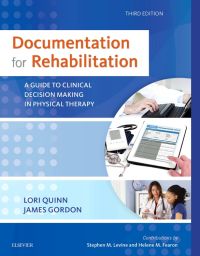
Documentation for Rehabilitation, 3rd Edition
Better patient management starts with better documentation! Documentation for Rehabilitation: A Guide to Clinical Decision Making in Physical Therapy, 3rd Edition shows how to accurately document treatment progress and patient outcomes. Designed for use by rehabilitation professionals, documentation guidelines are easily adaptable to different practice settings and patient populations. Realistic examples and practice exercises reinforce concepts and encourage you to apply what you’ve learned. Written by expert physical therapy educators Lori Quinn and James Gordon, this book will improve your skills in both documentation and clinical reasoning.
New to this edition
- NEW Standardized Outcome Measures chapter leads to better care and patient management by helping you select the right outcome measures for use in evaluations, re-evaluations, and discharge summaries.
- UPDATED content is based on data from current research, federal policies and APTA guidelines, including incorporation of new terminology from the Guide to Physical Therapist 3.0 and ICD-10 coding.
- EXPANDED number of case examples covers an even broader range of clinical practice areas.
Key Features
- A practical framework shows how to organize and structure PT records, making it easier to document functional outcomes in many practice settings, and is based on the International Classification for Functioning, Disability, and Health (ICF) model — the one adopted by the APTA.
- Coverage of practice settings includes documentation examples in acute care, rehabilitation, outpatient, home care, and nursing homes, as well as a separate chapter on documentation in pediatric settings.
- Guidelines to systematic documentation describe how to identify, record, measure, and evaluate treatment and therapies — especially important when insurance companies require evidence of functional progress in order to provide reimbursement.
- Workbook/textbook format uses examples and exercises in each chapter to reinforce your understanding of concepts.
Author Information
| ISBN Number | 9780323312332 |
|---|---|
| Description Author List | By Lori Quinn, EdD, PT, Associate Professor of Movement Science and KinesiologyDirector, Neurorehabilitation Research LabTeachers College, Columbia University, USA and James Gordon, EdD, PT, FAPTA, Professor and Associate DeanDivision of Biokinesiology and Physical Therapy, Herman Ostrow School of Dentistry, University of Southern California, USA |
| Copyright Year | 2016 |
| Edition Number | 3 |
| Format | Book |
| Trim | 216w x 276h (8.50" x 10.875") |
| Illustrations | 60 illustrations (25 in full color) |
| Imprint | Saunders |
| Page Count | 276 |
| Publication Date | 11 Dec 2015 |
| Stock Status | Please allow 10-14 working days for delivery |


eBooks : Built for busy schedules & tailored for your goals.


Affordable knowledge, built for you
Get the resources you need-often at a lower cost than print. Quality content designed to support your goals, without stretching your budget.


Seamless access wherever you are


Always in sync


Tools the make learning stick
Your eBook is ready whenever you are!
1. Check your email for your access code.


2. Sign into or create your VitalSource account and redeem your code.


3. Open your eBook - ready whenever you are!
FAQ
The access code for your new eBook will be sent in your order confirmation email. Your code can also be accessed in your My Account section on the Elsevier webshop. If you do not receive your code within a few minutes, please check your spam folder.
Step-by-step guidance on how to download Bookshelf and also redeem your code can be found here.
The access code for your new eBook does not expire. However, we always suggest redeeming immediately after purchase to start experiencing the benefits of and insights from your purchase. Important to note - the code provided is a single use code and only valid for the edition you purchase. It does not provide access to past nor future editions of the title.
You will have unlimited access to your eBook on the device to which it was downloaded.
Discover the various learning features that our eBooks offer on the Bookshelf® Reader! For example, you can highlight different text passages, create notes and flashcards, have the text read to you, etc. Particularly practical: You can also use your eBooks offline. More information on the learning functions can be found on the Vitalsource page.
Quality is our top priority. That's why we collaborate with the leading eBook reader provider VitalSource. VitalSource has its own eBook reader Bookshelf®, which you can easily download. This reader is very user-friendly and offers more features than other standard readers. For example, you can highlight different text passages, create notes and flashcards, have the text read to you, etc. Particularly practical: You can also use your eBooks offline. More information can be found on the Vitalsource page.
Elsevier offers its eBooks in ePub format, as we believe this format is best suited to display our content ideally on as many devices as possible.
You can return your eBook within 13 days of purchase. eBooks that have been partially printed or flipped through more than 15% are excluded from returns.
Any questions ?
Top Picks from Our Community
1. Disablement Models, ICF Framework and Clinical Decision Making
2. Essentials of Documentation
3. Legal Aspects of Documentation
4. Standardized Outcome Measures NEW!
5. Payment Policy and Coding
6 Electronic Medical Records
II: COMPONENTS OF PHYSICAL THERAPY DOCUMENTATION
7. Clinical Decision Making and the Initial Evaluation Format
8. Documenting Reason for Referral: Health Condition and Participation
9. Documenting Activities
10. Documenting Impairments
11. Document the Assessment: Summary and Diagnosis
12. Developing and Documenting Effective Goals
13. Documenting the Plan of Care
14. Documenting Session Notes and Progress Notes Using a Modified SOAP Note Format
15. Special Formats: Documenting Screenings, Discharge Summaries, Letters and Patient Education Materials
16. Documentation in Pediatrics
References
Appendix A: Guidelines: Physical Therapy Documentation of Patient/Client Management
Appendix B: Rehabilitation Abbreviations
Appendix C: Answers to Exercises
Appendix D: Documentation Review Sample Checklist
Appendix E: Strength and Range of Motion Forms
"A clear and concise message with a rigid format which has something for newbies and seasoned pros"
"easily accessible, easy to follow and easy to use with enough complexity to cater for all needs."