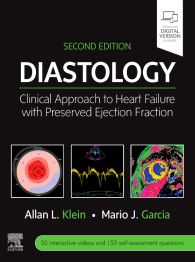
Accounting for more than 40% of all heart failure problems, diastolic heart failure is a complex and often difficult diagnosis with rapidly evolving diagnostic management protocols. Diastology: Clinical Approach to Heart Failure with Preserved Ejecti
...view more
Accounting for more than 40% of all heart failure problems, diastolic heart failure is a complex and often difficult diagnosis with rapidly evolving diagnostic management protocols. Diastology: Clinical Approach to Heart Failure with Preserved Ejection Fraction, 2nd Edition, brings you up to date and equips you to successfully diagnose and manage even the most challenging incidences of diastolic heart failure and their comorbidities. It incorporates the latest guidelines for the diagnostic evaluation of the patient with suspected or known diastolic dysfunction, provides a comprehensive review of clinical conditions associated with heart failure with preserved ejection fraction, and describes the complementary role of imaging modalities and novel therapeutic approaches.
Accounting for more than 40% of all heart failure problems, diastolic heart failure is a complex and often difficult diagnosis with rapidly evolving diagnostic management protocols. Diastology: Clinical Approach to Heart Failure with Preserved Ejection Fraction, 2nd Edition, brings you up to date and equips you to successfully diagnose and manage even the most challenging incidences of diastolic heart failure and their comorbidities. It incorporates the latest guidelines for the diagnostic evaluation of the patient with suspected or known diastolic dysfunction, provides a comprehensive review of clinical conditions associated with heart failure with preserved ejection fraction, and describes the complementary role of imaging modalities and novel therapeutic approaches.
Key Features
Keeps you current with recent extensive changes in the understanding of the mechanisms of diastolic heart failure with preserved ejection fraction (HFpEF) that have resulted in dramatic changes in treatment guidelines.
Covers the latest molecular, genetic, and cellular mechanisms behind diastolic heart failure as a basis for the latest clinical approaches, diagnosis, and treatment of common and uncommon pathological conditions such as hypertensive heart disease, cardiomyopathies, arterial and valvular diseases, pericardial diseases, congenital heart disease, diabetes mellitus, and metabolic syndrome.
Features 50 video cases, new key summary points, new multiple-choice review questions, and six new chapters: Evaluation of Diastolic Function by Radionuclide Techniques; Diastology Stress Test; ASE/EACVI Diastolic Guidelines; Valve Disease; Perioperative Assessment of Diastolic Dysfunction; and Pulmonary Hypertension.
Reviews new techniques and indices for assessing diastolic function, such as 3D echo, strain rate imaging, late gadolinium enhancement and T1-mapping by CMR, and novel nuclear scintigraphic methods – as well as the traditional indices of LV filling, LA function, and tissue Doppler indices.
Covers emerging topics such as the role of neurohormones, global and regional systolic function of the left ventricle, chronotopic incompetence and pacing, aging, perioperative assessment, and more.
Presents information in a quick-retrieval format, covering Epidemiology, Pathophysiology, Diagnostic Evaluation, Differential Diagnosis, Treatment, and Future Directions.
Helps you learn efficiently and prepare for self-assessment with key summaries and multiple-choice questions and answers for each chapter.
Enhanced
eBook version included with purchase. Your enhanced eBook allows you to access all of the text, figures, and references from the book on a variety of devices.
Author Information
By Allan L. Klein, MD, Department of Cardiovascular Medicine, The Cleveland Clinic, Cleveland, OH and Mario J. Garcia, MD, Professor, Department of Medicine, Pauline Levitt Chair in Medicine, Chief, Department of Medicine Division of Cardiology, Co-Director, Montefiore Einstein Center for Heart and Vascular Care, Albert Einstein College of Medicine, Bronx, New York, USA
By Allan L. Klein, MD, Department of Cardiovascular Medicine, The Cleveland Clinic, Cleveland, OH and Mario J. Garcia, MD, Professor, Department of Medicine, Pauline Levitt Chair in Medicine, Chief, Department of Medicine Division of Cardiology, Co-Director, Montefiore Einstein Center for Heart and Vascular Care, Albert Einstein College of Medicine, Bronx, New York, USA
https://www.elsevierhealth.com.au/diastology-9780323640671.html295965Diastologyhttps://www.elsevierhealth.com.au/media/catalog/product/9/7/9780323640671_9.jpg292.47389.95AUDInStock/Medicine & Surgery/Cardiology/Books/Medicine/Cardiology/Books/Books/Medicine/Cardiology/Japan Titles44312124388722505456950546645255039525985052631601418269243350884886536505455351451205259833<P>Accounting for more than 40% of all heart failure problems, diastolic heart failure is a complex and often difficult diagnosis with rapidly evolving diagnostic management protocols. <I>Diastology: Clinical Approach to Heart Failure with Preserved Ejection Fraction, 2nd Edition</I>, brings you up to date and equips you to <B>successfully diagnose and manage even the most challenging incidences of diastolic heart failure and their comorbidities</B>. It incorporates the latest guidelines for the diagnostic evaluation of the patient with suspected or known diastolic dysfunction, provides a <B>comprehensive review of clinical conditions</B> associated with heart failure with preserved ejection fraction, and describes the complementary role of <B>imaging modalities and novel therapeutic approaches</B><I>.</P></I> <P>Accounting for more than 40% of all heart failure problems, diastolic heart failure is a complex and often difficult diagnosis with rapidly evolving diagnostic management protocols. <I>Diastology: Clinical Approach to Heart Failure with Preserved Ejection Fraction, 2nd Edition</I>, brings you up to date and equips you to <B>successfully diagnose and manage even the most challenging incidences of diastolic heart failure and their comorbidities</B>. It incorporates the latest guidelines for the diagnostic evaluation of the patient with suspected or known diastolic dysfunction, provides a <B>comprehensive review of clinical conditions</B> associated with heart failure with preserved ejection fraction, and describes the complementary role of <B>imaging modalities and novel therapeutic approaches</B><I>.</P></I>00add-to-cart97803236406712020ProfessionalBy Allan L. Klein, MD and Mario J. Garcia, MD20212Book216w x 276h (8.50" x 10.875")400 illustrations (350 in full color)Elsevier52818 Nov 2020Please allow 3-4 weeks for deliveryBy <STRONG>Allan L. Klein</STRONG>, MD, Department of Cardiovascular Medicine, The Cleveland Clinic, Cleveland, OH and <STRONG>Mario J. Garcia</STRONG>, MD, Professor, Department of Medicine, Pauline Levitt Chair in Medicine, Chief, Department of Medicine Division of Cardiology, Co-Director, Montefiore Einstein Center for Heart and Vascular Care, Albert Einstein College of Medicine, Bronx, New York, USABooksBookUnited StatesNoNoNoNoPlease SelectPlease SelectPlease Select