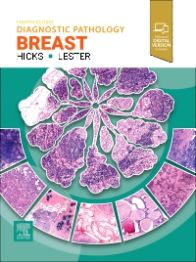
By Susan C. Lester, MD, PhD and David G. Hicks, MD
This expert volume in the Diagnostic Pathology series is not only an up-to-date, comprehensive diagnostic support tool for surgical pathologists, but also a valuable resource for all health care workers who provide care to patients with breast diseas
...view more
This expert volume in the Diagnostic Pathology series is not only an up-to-date, comprehensive diagnostic support tool for surgical pathologists, but also a valuable resource for all health care workers who provide care to patients with breast disease, including radiologists as well as surgical, medical, and radiation oncologists. An excellent point-of-care reference for practitioners at all levels of experience and training, the fourth edition of Diagnostic Pathology: Breast, Fourth Edition provides details on normal breast histology, information to assist in processing breast specimens, and multichapter sections on diagnostic patterns, benign lesions, carcinomas, predictive and prognostic factors, stromal lesions, inflammatory lesions, lymphomas, and hereditary breast disease. Richly illustrated and easy to use, this volume is ideal as a one-stop resource for day-to-day reference or as a reliable training resource.
This expert volume in the Diagnostic Pathology series is not only an up-to-date, comprehensive diagnostic support tool for surgical pathologists, but also a valuable resource for all health care workers who provide care to patients with breast disease, including radiologists as well as surgical, medical, and radiation oncologists. An excellent point-of-care reference for practitioners at all levels of experience and training, the fourth edition of Diagnostic Pathology: Breast, Fourth Edition provides details on normal breast histology, information to assist in processing breast specimens, and multichapter sections on diagnostic patterns, benign lesions, carcinomas, predictive and prognostic factors, stromal lesions, inflammatory lesions, lymphomas, and hereditary breast disease. Richly illustrated and easy to use, this volume is ideal as a one-stop resource for day-to-day reference or as a reliable training resource.
Key Features
Incorporates the most up-to-date scientific and technical knowledge, providing a comprehensive overview of all key issues relevant to today’s practice
Emphasizes the correlation of pathologic lesions with findings on breast imaging and provides guidance on the interpretation of core needle biopsies
Contains new overview chapters that lay the groundwork for initial evaluation and assistance with differential diagnosis, as well as new chapters on HER2-low breast carcinoma, immunohistochemical studies for diagnosis, proliferation, and more
Provides important updates throughout, covering the evaluation of ESR1, PIK3CA, AKT, and BRCA1 mutations to guide therapy; tumor-infiltrating lymphocytes and PD-L1 for treatment planning; HER2-low assessment to determine eligibility for antibody-drug conjugates; and much more
Features new animations and new videos to assist in understanding three-dimensional anatomy, radiologic-pathologic correlation, the processing of breast specimens, and the gross identification of breast lesions
Contains more than 3,700 extensively annotated images, including gross pathology photographs, histopathology photomicrographs, a wide range of immunohistochemical stains, fluorescent in situ hybridization, breast-imaging studies, and full-color illustrations
Employs consistently templated chapters, bulleted content, key facts, annotated images, and an extensive index for quick, expert reference at the point of care
Includes an eBook version that enables you to access all text, figures, and references, with the ability to search, customize your content, make notes and highlights, and have content read aloud
Author Information
By Susan C. Lester, MD, PhD, Former Chief of Breast Pathology Services, Brigham and Women’s Hospital, Associate Professor, Harvard Medical School, Boston, Massachusetts, USA and David G. Hicks, MD, Professor and Director of IHC-ISH Laboratory and Breast Subspecialty Service, University of Rochester Medical Center, Rochester, New York, USA
By Susan C. Lester, MD, PhD, Former Chief of Breast Pathology Services, Brigham and Women’s Hospital, Associate Professor, Harvard Medical School, Boston, Massachusetts, USA and David G. Hicks, MD, Professor and Director of IHC-ISH Laboratory and Breast Subspecialty Service, University of Rochester Medical Center, Rochester, New York, USA
SECTION 1: NORMAL BREAST Histology of Normal Breast Breast Life Cycle Changes
SECTION 2: BREAST SPECIMENS Breast Specimens Overview Core Needle Biopsies Excisions and Oncoplastic Surgery Margins and Reexcisions Mastectomies Reduction Mammoplasties Lymph Nodes Intraoperative Consultation
SECTION 3: OVERVIEW Papillary Lesions Spindle Cell Lesions Small Acinar Proliferations Epithelial/Myoepithelial Lesions Vascular and Pseudovascular Lesions Lesions with Inflammatory Cells Nipple Lesions Iatrogenic Changes Immunohistochemical Studies
SECTION 4: BENIGN CHANGES Nonproliferative Changes Columnar Cell Change, Columnar Cell Hyperplasia, and Flat Epithelial Atypia Usual Ductal Hyperplasia Sclerosing Adenosis Radial Sclerosing Lesion/Radial Scar Papilloma, Large Duct and Small Duct Nipple Adenoma Mucocele-Like Lesions Collagenous Spherulosis Juvenile Papillomatosis Gynecomastia in Men and Gynecomastia-Like Changes in Women Hamartoma (Fibroadenolipoma) Syringomatous Tumor of the Nipple Adenomyoepithelioma Cystic Hypersecretory Lesions Microglandular Adenosis Atypical Ductal Hyperplasia Atypical Lobular Hyperplasia
SECTION 5: CARCINOMAS Risk Factors for Developing Carcinoma Risk Factors for Developing Breast Carcinoma Epidemiology: Lesions Conferring Increased Risk of Breast Carcinoma Carcinoma In Situ Lobular Carcinoma In Situ Ductal Carcinoma In Situ Ductal Carcinoma In Situ, Paget Disease Special Papillary Carcinomas Encapsulated Papillary Carcinoma Solid Papillary Carcinoma INVASIVE CARCINOMA Invasive Carcinoma: Histologic and Molecular Classifications Male Breast Carcinoma Histologic Types Invasive Breast Carcinoma of No Special Type Microinvasive Carcinoma Invasive Lobular Carcinoma Invasive Tubular Carcinoma and Invasive Cribriform Carcinoma Invasive Mucinous (Colloid) Carcinoma Invasive Papillary Carcinoma Invasive Micropapillary Carcinoma Invasive Apocrine Carcinoma Invasive Neuroendocrine Carcinoma Invasive Carcinoma with Osteoclast-Like Giant Cells Metaplastic Carcinoma Adenoid Cystic Carcinoma Secretory Carcinoma Biologic Types Luminal Carcinoma (ER Positive/HER2 Negative) HER2-Positive Carcinoma HER2-Low Breast Carcinoma Triple Negative Breast Carcinomas and Basal-Like Carcinomas
SECTION 6: PROGNOSTIC AND PREDICTIVE FACTORS Overview of Prognostic and Predictive Factors AJCC Breast Cancer Staging Anatomic Factors Histologic Grade Size and Multiple Foci Lymphovascular Invasion Inflammatory Carcinoma Locally Advanced Carcinoma Lymph Node Metastases Response to Neoadjuvant Therapy Locally Recurrent Carcinoma Carcinoma with Extensive Intraductal Component Molecular Factors Hormone Receptors (ER/PR/AR) HER2 Proliferation DNA Analysis and Gene Copy Number Alterations Circulating Tumor Cells, Circulating Tumor DNA, and Next-Generation Sequencing Immunotherapy Expression Profiling, mRNA: Overview Expression Profiling: Oncotype DX Assay Expression Profiling: MammaPrint Assay Expression Profiling: Prosigna Expression Profiling: EndoPredict Expression Profiling: Protein
https://www.elsevierhealth.com.au/diagnostic-pathology-breast-9780443286810.html323308Diagnostic Pathology: Breasthttps://www.elsevierhealth.com.au/media/catalog/product/9/7/9780443286810_2.jpg358.47477.95AUDInStock/Medicine/Pathology/Books/Coming soon/Medicine/Pathology/Books/Japan Titles/Medicine & Surgery/Pathology50545565054664505466952598365255039526316043350911488653650545535145120525983341826924335088This expert volume in the <i>Diagnostic Pathology </i>series is not only an <b>up-to-date, comprehensive diagnostic support tool</b> for surgical pathologists, but also a valuable resource for all health care workers who provide care to patients with breast disease, including radiologists as well as surgical, medical, and radiation oncologists. An <b>excellent point-of-care reference for practitioners at all levels of experience and training</b>, the fourth edition of <i>Diagnostic Pathology: Breast, Fourth Edition </i>provides details on normal breast histology, information to assist in processing breast specimens, and multichapter sections on diagnostic patterns, benign lesions, carcinomas, predictive and prognostic factors, stromal lesions, inflammatory lesions, lymphomas, and hereditary breast disease. <b>Richly illustrated and easy to use</b>, this volume is ideal as <b>a one-stop resource</b> for day-to-day reference or as a reliable training resource. This expert volume in the <i>Diagnostic Pathology </i>series is not only an <b>up-to-date, comprehensive diagnostic support tool</b> for surgical pathologists, but also a valuable resource for all health care workers who provide care to patients with breast disease, including radiologists as well as surgical, medical, and radiation oncologists. An <b>excellent point-of-care reference for practitioners at all levels of experience and training</b>, the fourth edition of <i>Diagnostic Pathology: Breast, Fourth Edition </i>provides details on normal breast histology, information to assist in processing breast specimens, and multichapter sections on diagnostic patterns, benign lesions, carcinomas, predictive and prognostic factors, stromal lesions, inflammatory lesions, lymphomas, and hereditary breast disease. <b>Richly illustrated and easy to use</b>, this volume is ideal as <b>a one-stop resource</b> for day-to-day reference or as a reliable training resource.00add-to-cart97804432868102025ProfessionalBy Susan C. Lester, MD, PhD and David G. Hicks, MD20264Book216w x 276h (8.50" x 10.875")Approx. 3750 (3750 in full color)Elsevier7629 Apr 2025Please allow 3-4 weeks for deliveryBy <STRONG>Susan C. Lester</STRONG>, MD, PhD, Former Chief of Breast Pathology Services, Brigham and Women’s Hospital, Associate Professor, Harvard Medical School, Boston, Massachusetts, USA and <STRONG>David G. Hicks</STRONG>, MD, Professor and Director of IHC-ISH Laboratory and Breast Subspecialty Service, University of Rochester Medical Center, Rochester, New York, USABooksBookDiagnostic PathologyUnited StatesYesYesNoNoPlease SelectPlease SelectPlease Select