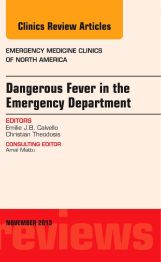
Dangerous Fever in the Emergency Department, An Issue of Emergency Medicine Clinics, 1st Edition
Author :
By Emilie J.B. Calvello, MD and Christian Theodosis, MD
This issue is centered on emergency situations and complications brought about by high fevers. Guest edited by Emilie Calvello and Christian Theodosis, this issue focuses on topics such as: Approach to Dangerous Fever in the Emergency Department, Fev
...view more
This issue is centered on emergency situations and complications brought about by high fevers. Guest edited by Emilie Calvello and Christian Theodosis, this issue focuses on topics such as: Approach to Dangerous Fever in the Emergency Department, Fever in the Returning Traveler, Drug Induced Hyperthermic Syndromes Part I: Hyperthermia in Overdose, Drug Induced Hyperthermic Syndromes Part II: Hyperthermia caused by drug interactions, withdrawal syndromes, and idiopathic mechanisms, Fever and Signs of Shock, Fever and Neurologic Abnormalities, Fever and Endocrine Derangements, and Fever in the Post Procedure Patient.
This issue is centered on emergency situations and complications brought about by high fevers. Guest edited by Emilie Calvello and Christian Theodosis, this issue focuses on topics such as: Approach to Dangerous Fever in the Emergency Department, Fever in the Returning Traveler, Drug Induced Hyperthermic Syndromes Part I: Hyperthermia in Overdose, Drug Induced Hyperthermic Syndromes Part II: Hyperthermia caused by drug interactions, withdrawal syndromes, and idiopathic mechanisms, Fever and Signs of Shock, Fever and Neurologic Abnormalities, Fever and Endocrine Derangements, and Fever in the Post Procedure Patient.
Author Information
By Emilie J.B. Calvello, MD, University of Maryland and Christian Theodosis, MD, University of Maryland
https://www.elsevierhealth.com.au/dangerous-fever-in-the-emergency-department-an-issue-of-emergency-medicine-clinics-9780323242196.html293951Dangerous Fever in the Emergency Department, An Issue of Emergency Medicine Clinicshttps://www.elsevierhealth.com.au/media/catalog/product/9/7/9780323242196_7.jpg126.71168.95AUDInStock/Nursing & Midwifery/Specialist Nursing/Clinics/Medicine & Surgery/Emergency Medicine/Medicine/Emergency Medicine/Nursing & Midwifery/Specialist Nursing/Clinics/Clinics/Medicine/Emergency Medicine/Nursing & Midwifery/Specialist Nursing/Japan Titles43351064388725433513550545705054572505466652550415259851525985352631601418269243351054335088488653650545535054571514512052598335259852This issue is centered on emergency situations and complications brought about by high fevers. Guest edited by Emilie Calvello and Christian Theodosis, this issue focuses on topics such as: Approach to Dangerous Fever in the Emergency Department, Fever in the Returning Traveler, Drug Induced Hyperthermic Syndromes Part I: Hyperthermia in Overdose, Drug Induced Hyperthermic Syndromes Part II: Hyperthermia caused by drug interactions, withdrawal syndromes, and idiopathic mechanisms, Fever and Signs of Shock, Fever and Neurologic Abnormalities, Fever and Endocrine Derangements, and Fever in the Post Procedure Patient. This issue is centered on emergency situations and complications brought about by high fevers. Guest edited by Emilie Calvello and Christian Theodosis, this issue focuses on topics such as: Approach to Dangerous Fever in the Emergency Department, Fever in the Returning Traveler, Drug Induced Hyperthermic Syndromes Part I: Hyperthermia in Overdose, Drug Induced Hyperthermic Syndromes Part II: Hyperthermia caused by drug interactions, withdrawal syndromes, and idiopathic mechanisms, Fever and Signs of Shock, Fever and Neurologic Abnormalities, Fever and Endocrine Derangements, and Fever in the Post Procedure Patient.00add-to-cart97803232421962013ProfessionalBy Emilie J.B. Calvello, MD and Christian Theodosis, MD20131Book152w x 229h (6.00" x 9.00")Elsevier06 Nov 2013Please allow 10-14 working days for deliveryBy <STRONG>Emilie J.B. Calvello</STRONG>, MD, University of Maryland and <STRONG>Christian Theodosis</STRONG>, MD, University of MarylandClinicsClinicsThe Clinics: Internal MedicineUnited StatesNoNoNoNoPlease SelectPlease SelectPlease Select