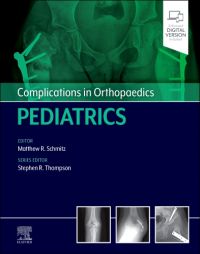
Complications in Orthopaedics: Pediatrics, 1st Edition
Author :
Edited by Matthew Schmitz and Stephen Thompson, MD, MEd, FRCSC
The difference between an average surgeon and a master surgeon is often an ability to navigate and resolve surgical complications. Complications in Orthopaedics: Pediatrics provides expert guidance and offers real solutions to improve patient outcome
...view more
The difference between an average surgeon and a master surgeon is often an ability to navigate and resolve surgical complications. Complications in Orthopaedics: Pediatrics provides expert guidance and offers real solutions to improve patient outcomes, both for the trainee and for the experienced surgeon. This brand new volume in the new Complications in Orthopaedics series from Dr. Stephen R. Thompson, co-editor of Miller’s Orthopaedics and DeLee & Drez's Orthopaedic Sports Medicine, and Dr. Matthew R. Schmitz, focuses on how to get out of the weeds, with practical, use-now advice on pediatric trauma, upper extremity, spine, lower extremity, and neuromuscular/congenital disorders.
The difference between an average surgeon and a master surgeon is often an ability to navigate and resolve surgical complications. Complications in Orthopaedics: Pediatricsprovides expert guidance and offers real solutions to improve patient outcomes, both for the trainee and for the experienced surgeon. This brand new volume in the new Complications in Orthopaedics series from Dr. Stephen R. Thompson, co-editor of Miller’s Orthopaedics and DeLee & Drez's Orthopaedic Sports Medicine, and Dr. Matthew R. Schmitz, focuses on how to get out of the weeds, with practical, use-now advice on pediatric trauma, upper extremity, spine, lower extremity, and neuromuscular/congenital disorders.
Key Features
Describes how to navigate the most common or most devastating errors and complications in pediatric orthopaedic surgery, combining the breadth of knowledge of academic surgeons with the “in-the-trenches” skills of community surgeons.
Follows a templated, reader-friendly format throughout.
Emphasizes how to recognize and avoid errors, with thorough coverage of preoperative errors, intraoperative issues, and postoperative complications.
Includes video clips, clinical images, and MRI and CT scans to enhance and reinforce the material.
An eBook version is included with purchase. The eBook allows you to access all of the text, figures, and references, with the ability to search, customize your content, make notes and highlights, and have content read aloud.
Author Information
Edited by Matthew Schmitz, Chief, Pediatric Orthopaedics and Young Adult Hip
Preservation
Department of Orthopaedics and Rehabilitation and Stephen Thompson, MD, MEd, FRCSC, Medical Director, EMMC Sports Health, Eastern Maine Medical Center, Bangor, Maine, USA
Edited by Matthew Schmitz, Chief, Pediatric Orthopaedics and Young Adult Hip
Preservation
Department of Orthopaedics and Rehabilitation and Stephen Thompson, MD, MEd, FRCSC, Medical Director, EMMC Sports Health, Eastern Maine Medical Center, Bangor, Maine, USA
Section 1 Pediatric Trauma 1 Proximal Humerus and Clavicle Complications 2 Supracondylar Humerus Fractures 3 Lateral Condyle Fractures 4 Medial Condyle and Medial Epicondyle Fractures 5 Forearm Fractures 6 Complications of Distal Radius and Ulna Fractures in Children 7 Hand/Finger Fractures 8 Complications in Pediatric Cervical Spine Trauma 9 Complications in Thoracolumbar Spine Trauma 10 Complications in Pediatric Pelvic and Proximal Femur Fractures 11 Complications in the Treatment of Pediatric Femoral Shaft Fractures 12 Fractures About the Knee 13 Complications in Tibial Shaft Fractures 14 Ankle Fractures 15 Foot Fractures Section 2 Upper Extremity 16 Brachial Plexus Reconstruction 17 Syndactyly 18 Complications in Surgery of the Thumb 19 Cubitus Varus/Valgus Correction Section 3 Spine 20 Complications in the Treatment of Adolescent Idiopathic Scoliosis 21 Complications in the Treatment of Neuromuscular Spine 22 Congenital Spine Deformities 23 Complications in Kyphosis in Children 24 Pediatric Complications: Growing Rod Treatment Section 4 Lower Extremity 25 Complications Associated With Management of Septic Arthritis of the Hip in Pediatric Patients 26 Complications of Closed Reduction of Developmental Dysplasia of the Hip 27 Complications in Open Treatment of Developmental Dysplasia of the Hip 28 Complications of the Periacetabular Osteotomy for Treatment of Adolescent Hip Dysplasia 29 Proximal Femoral Osteotomies 30 Complications of Surgical Treatment of Perthes Disease 31 Complications in Treatment of Slipped Capital Femoral Epiphysis 32 Complications in Surgical Management of Adolescent Blount Disease 33 Complications Associated with Epiphysiodesis and Hemiepiphysiodesis 34 Surgical Management of Clubfoot 35 Complications in Pediatric Flatfoot Reconstruction 36 Tarsal Coalition Resection 37 Cavus Foot Correction Section 5 Neuromuscular/Congenital Disorders 38 Osteotomies for Osteogenesis Imperfecta 39 Spastic Hip Dislocation 40 Complications of Upper Extremity Surgery for Neuromuscular Disorders 41 Complications in Lower Extremity Soft Tissue Surgery in Neuromuscular Patients Index
https://www.elsevierhealth.com.au/complications-in-orthopaedics-pediatrics-9780323873970.html308778Complications in Orthopaedics: Pediatricshttps://www.elsevierhealth.com.au/media/catalog/product/9/7/9780323873970_4.jpg350.96389.95AUDInStock/Health Professions/Sports Medicine/Medicine & Surgery/Orthopedics/Medicine/Surgery/Health Professions/Sports Medicine/Medicine/Orthopedics/Books/Dentistry/Oral Pathology/Health Professions/Sports Medicine/Medicine/Orthopedics/Japan Titles/Books/Books43351124335113505458350545815054582525503952599215259863525986452631604388722505466414182692433509243350884886536505455350545585145120525984752598385259833The difference between an average surgeon and a master surgeon is often an ability to navigate and resolve surgical complications. <i>Complications in Orthopaedics: Pediatrics</i> <b>provides expert guidance and offers real solutions to improve patient outcomes</b>, both for the trainee and for the experienced surgeon. This brand new volume in the new <i>Complications in Orthopaedics</i> series from Dr. Stephen R. Thompson, co-editor of <i>Miller’s Orthopaedics</i> and <i>DeLee & Drez's Orthopaedic Sports Medicine</i>, and Dr. Matthew R. Schmitz, <b>focuses on how to <i>get out of the weeds</i>,</b> with practical, use-now advice on pediatric trauma, upper extremity, spine, lower extremity, and neuromuscular/congenital disorders. The difference between an average surgeon and a master surgeon is often an ability to navigate and resolve surgical complications. <i>Complications in Orthopaedics: Pediatrics</i> <b>provides expert guidance and offers real solutions to improve patient outcomes</b>, both for the trainee and for the experienced surgeon. This brand new volume in the new <i>Complications in Orthopaedics</i> series from Dr. Stephen R. Thompson, co-editor of <i>Miller’s Orthopaedics</i> and <i>DeLee & Drez's Orthopaedic Sports Medicine</i>, and Dr. Matthew R. Schmitz, <b>focuses on how to <i>get out of the weeds</i>,</b> with practical, use-now advice on pediatric trauma, upper extremity, spine, lower extremity, and neuromuscular/congenital disorders.00add-to-cart97803238739702023ProfessionalEdited by Matthew Schmitz and Stephen Thompson, MD, MEd, FRCSC20241Book216w x 276h (8.50" x 10.875")Elsevier41812 Dec 2023Please allow 3-4 weeks for deliveryEdited by <STRONG>Matthew Schmitz</STRONG>, Chief, Pediatric Orthopaedics and Young Adult Hip
Preservation
Department of Orthopaedics and Rehabilitation and <STRONG>Stephen Thompson</STRONG>, MD, MEd, FRCSC, Medical Director, EMMC Sports Health, Eastern Maine Medical Center, Bangor, Maine, USABooksBookComplications in OrthopaedicsUnited StatesNoNoNoNoPlease SelectPlease SelectPlease Select