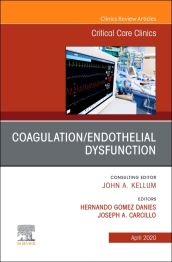
Coagulation/Endothelial Dysfunction ,An Issue of Critical Care Clinics, 1st Edition
Author :
Edited by Hernando Gomez and Joseph Carcillo
This issue of Critical Care Clinics, guest edited by Drs. Hernando Gomez Danies and Joseph Carcillo, focuses on Coagulation/Endothelial Dysfunction. This is one of four issues each year selected by the series consulting editor, Dr. John Kellum. Arti
...view more
This issue of Critical Care Clinics, guest edited by Drs. Hernando Gomez Danies and Joseph Carcillo, focuses on Coagulation/Endothelial Dysfunction. This is one of four issues each year selected by the series consulting editor, Dr. John Kellum. Articles in this issue include, but are not limited to: Cell-cell communication breakdown and endothelial dysfunction; Role of the Tie2/Angiopoetin pathway in endothelial dysfunction; The Glycocalyx; Platelet activation and endothelial dysfunction; Role of antithrombin III and tissue factor pathway; Red blood cell dysfunction; Microvascular hemodynamics, autoregulation and mechanotransduction control of blood flow distribution; Nitric oxide and endothelial dysfunction; Microvascular dysfunction; Hemolytic Uremic Syndrome and atypical HUS; Thrombotic thrombocytopenic purpura, Heparin induced thrombocytopenia and Disseminated intravascular coagulation in the critically ill; Thrombocytopenia associated multiple organ failure (TAMOF); Meningococcemia; Immune consequences of endothelial dysfunction during sepsis; Therapeutic targets in thrombotic microangiopathies with a focus on endothelial disorders; and Coagulation disorders in HLH/Macrophage activation syndrome.
This issue of Critical Care Clinics, guest edited by Drs. Hernando Gomez Danies and Joseph Carcillo, focuses on Coagulation/Endothelial Dysfunction. This is one of four issues each year selected by the series consulting editor, Dr. John Kellum. Articles in this issue include, but are not limited to: Cell-cell communication breakdown and endothelial dysfunction; Role of the Tie2/Angiopoetin pathway in endothelial dysfunction; The Glycocalyx; Platelet activation and endothelial dysfunction; Role of antithrombin III and tissue factor pathway; Red blood cell dysfunction; Microvascular hemodynamics, autoregulation and mechanotransduction control of blood flow distribution; Nitric oxide and endothelial dysfunction; Microvascular dysfunction; Hemolytic Uremic Syndrome and atypical HUS; Thrombotic thrombocytopenic purpura, Heparin induced thrombocytopenia and Disseminated intravascular coagulation in the critically ill; Thrombocytopenia associated multiple organ failure (TAMOF); Meningococcemia; Immune consequences of endothelial dysfunction during sepsis; Therapeutic targets in thrombotic microangiopathies with a focus on endothelial disorders; and Coagulation disorders in HLH/Macrophage activation syndrome.
https://www.elsevierhealth.com.au/coagulationendothelial-dysfunction-an-issue-of-critical-care-clinics-9780323712538.html296689Coagulation/Endothelial Dysfunction ,An Issue of Critical Care Clinicshttps://www.elsevierhealth.com.au/media/catalog/product/9/7/9780323712538_6.jpg100.46133.95AUDInStock/Medicine & Surgery/Critical Care/Clinics/Medicine/Critical Care/Clinics/Clinics/Medicine/Critical Care/Japan Titles43351044388725505456850546665255041525984952631601418269243350884886536505455351451205259833This issue of Critical Care Clinics, guest edited by Drs. Hernando Gomez Danies and Joseph Carcillo, focuses on Coagulation/Endothelial Dysfunction. This is one of four issues each year selected by the series consulting editor, Dr. John Kellum. Articles in this issue include, but are not limited to: Cell-cell communication breakdown and endothelial dysfunction; Role of the Tie2/Angiopoetin pathway in endothelial dysfunction; The Glycocalyx; Platelet activation and endothelial dysfunction; Role of antithrombin III and tissue factor pathway; Red blood cell dysfunction; Microvascular hemodynamics, autoregulation and mechanotransduction control of blood flow distribution; Nitric oxide and endothelial dysfunction; Microvascular dysfunction; Hemolytic Uremic Syndrome and atypical HUS; Thrombotic thrombocytopenic purpura, Heparin induced thrombocytopenia and Disseminated intravascular coagulation in the critically ill; Thrombocytopenia associated multiple organ failure (TAMOF); Meningococcemia; Immune consequences of endothelial dysfunction during sepsis; Therapeutic targets in thrombotic microangiopathies with a focus on endothelial disorders; and Coagulation disorders in HLH/Macrophage activation syndrome. This issue of Critical Care Clinics, guest edited by Drs. Hernando Gomez Danies and Joseph Carcillo, focuses on Coagulation/Endothelial Dysfunction. This is one of four issues each year selected by the series consulting editor, Dr. John Kellum. Articles in this issue include, but are not limited to: Cell-cell communication breakdown and endothelial dysfunction; Role of the Tie2/Angiopoetin pathway in endothelial dysfunction; The Glycocalyx; Platelet activation and endothelial dysfunction; Role of antithrombin III and tissue factor pathway; Red blood cell dysfunction; Microvascular hemodynamics, autoregulation and mechanotransduction control of blood flow distribution; Nitric oxide and endothelial dysfunction; Microvascular dysfunction; Hemolytic Uremic Syndrome and atypical HUS; Thrombotic thrombocytopenic purpura, Heparin induced thrombocytopenia and Disseminated intravascular coagulation in the critically ill; Thrombocytopenia associated multiple organ failure (TAMOF); Meningococcemia; Immune consequences of endothelial dysfunction during sepsis; Therapeutic targets in thrombotic microangiopathies with a focus on endothelial disorders; and Coagulation disorders in HLH/Macrophage activation syndrome.00add-to-cart97803237125382020ProfessionalEdited by Hernando Gomez and Joseph Carcillo20201Book152w x 229h (6.00" x 9.00")Elsevier24020 Mar 2020Please allow 10-14 working days for deliveryEdited by <STRONG>Hernando Gomez</STRONG> and <STRONG>Joseph Carcillo</STRONG>ClinicsClinicsThe Clinics: Internal MedicineUnited StatesNoNoNoNoPlease SelectPlease SelectPlease Select