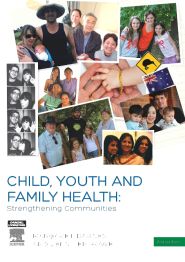
Child, Youth and Family Health: Strengthening Communities, 2nd Edition
Author :
By Margaret Barnes, PhD, RM, RN and Jennifer Rowe, PhD, MPhil, Grad Dip Ed (Nurs), BA, Dip Ed, RN
A fresh new edition, focusing on the importance of collaboration between healthcare professionals and the community.
The second edition of Child, Youth and Family Health builds its focus on the importance of a collaborative partnership between healt
...view more
A fresh new edition, focusing on the importance of collaboration between healthcare professionals and the community.
The second edition of Child, Youth and Family Health builds its focus on the importance of a collaborative partnership between healthcare professionals and members of the community. This approach is vital in supporting, maintaining and strengthening individual and community health across a range of contexts and life stages.
Child, Youth and Family Health 2e begins by discussing issues and challenges in child, youth and family health, before addressing contexts for nursing and midwifery, all of which helps readers apply theory to practice.
This community healthcare textbook offers additional insight into the importance of the healthcare professional’s role when working with children, young people and their families, and looks at practical approaches such as program development, supporting family transitions and mental health promotion.
There are three new chapters: ‘Communication with children, young people and families – a family strengths-based approach’, ‘Acute illness: Care for the child and their family’ and 'Health promotion through early childhood' along with a range of clinical scenarios, research highlights, practice highlights and critical questions and reflections.
Written by authors who are nurses, midwives, early childhood educators and academics, along with a respected team of contributors and editors, Child, Youth and Family Health 2e provides an engaging perspective on the fundamental challenges and issues affecting the health and wellness of infants, children, young people and their families in Australia and New Zealand.
A fresh new edition, focusing on the importance of collaboration between healthcare professionals and the community.
The second edition of Child, Youth and Family Health builds its focus on the importance of a collaborative partnership between healthcare professionals and members of the community. This approach is vital in supporting, maintaining and strengthening individual and community health across a range of contexts and life stages.
Child, Youth and Family Health 2e begins by discussing issues and challenges in child, youth and family health, before addressing contexts for nursing and midwifery, all of which helps readers apply theory to practice.
This community healthcare textbook offers additional insight into the importance of the healthcare professional’s role when working with children, young people and their families, and looks at practical approaches such as program development, supporting family transitions and mental health promotion.
There are three new chapters: ‘Communication with children, young people and families – a family strengths-based approach’, ‘Acute illness: Care for the child and their family’ and 'Health promotion through early childhood' along with a range of clinical scenarios, research highlights, practice highlights and critical questions and reflections.
Written by authors who are nurses, midwives, early childhood educators and academics, along with a respected team of contributors and editors, Child, Youth and Family Health 2e provides an engaging perspective on the fundamental challenges and issues affecting the health and wellness of infants, children, young people and their families in Australia and New Zealand.
New to this edition
Chapter 5 ‘Communication’ completely revised with a ‘family strengths’ approach.
New Chapter 8 'Health promotion through early childhood'.
New Chapter 9 ‘Acute illness: Care for the child and their family’.
Completely revised and updated with current statistics and data.
Inclusion of contemporary public health policy.
Inclusion of contemporary legislative and regulatory frameworks for health professionals.
Key Features
Clinical Scenarios integrated throughout to provide context for practice.
Research highlights provide examples of the most recent research and evidence based practice.
Practice highlights feature up-to-date examples of best practice, policies and procedures in Australia and New Zealand.
Key Points summarise the main issues in each chapter.
Critical questions and reflection feature at the end of each chapter as a tool for tutorials.
Useful Resources provide weblinks for up-to-date data, statistics, organisations and programs.
Extensive references provide for further reading and research.
Author Information
By Margaret Barnes, PhD, RM, RN, Associate Professor, and Head, School of Nursing and Midwifery, at the University of the Sunshine Coast, QLD and Jennifer Rowe, PhD, MPhil, Grad Dip Ed (Nurs), BA, Dip Ed, RN, Associate Professor, School of Nursing and Midwifery and Associate Dean, Faculty of Science, Health, Education and Engineering, University of the Sunshine Coast, QLD
By Margaret Barnes, PhD, RM, RN, Associate Professor, and Head, School of Nursing and Midwifery, at the University of the Sunshine Coast, QLD and Jennifer Rowe, PhD, MPhil, Grad Dip Ed (Nurs), BA, Dip Ed, RN, Associate Professor, School of Nursing and Midwifery and Associate Dean, Faculty of Science, Health, Education and Engineering, University of the Sunshine Coast, QLD
https://www.elsevierhealth.com.au/child-youth-and-family-health-strengthening-communities-9780729541558.html299043Child, Youth and Family Health: Strengthening Communitieshttps://www.elsevierhealth.com.au/media/catalog/product/9/7/9780729541558_6.jpg80.97107.95AUDInStock/Nursing & Midwifery/General Nursing/Books/Australian Titles/Flash Sale/Nursing/Books/Japan Titles43351164388722438872151126335255039526316014182692433510551126315145120<P><b>A fresh new edition, focusing on the importance of collaboration between healthcare professionals and the community.</b></P>
<P>The second edition of <i>Child, Youth and Family Health</i> builds its focus on the importance of a collaborative partnership between healthcare professionals and members of the community. This approach is vital in supporting, maintaining and strengthening individual and community health across a range of contexts and life stages.</P>
<P><i>Child, Youth and Family Health 2e</i> begins by discussing issues and challenges in child, youth and family health, before addressing contexts for nursing and midwifery, all of which helps readers apply theory to practice.</P>
<P>This community healthcare textbook offers additional insight into the importance of the healthcare professional’s role when working with children, young people and their families, and looks at practical approaches such as program development, supporting family transitions and mental health promotion.</P>
<P>There are three new chapters: ‘<i>Communication with children, young people and families – a family strengths-based approach</i>’, ‘<i>Acute illness: Care for the child and their family</i>’ and <i>'Health promotion through early childhood</i>' along with a range of clinical scenarios, research highlights, practice highlights and critical questions and reflections.</P>
<P>Written by authors who are nurses, midwives, early childhood educators and academics, along with a respected team of contributors and editors, <i>Child, Youth and Family Health 2e</i> provides an engaging perspective<BR>on the fundamental challenges and issues affecting the health and wellness of infants, children, young people and their families in Australia and New Zealand.</P>
<P></P> <P><b>A fresh new edition, focusing on the importance of collaboration between healthcare professionals and the community.</b></P>
<P>The second edition of <i>Child, Youth and Family Health</i> builds its focus on the importance of a collaborative partnership between healthcare professionals and members of the community. This approach is vital in supporting, maintaining and strengthening individual and community health across a range of contexts and life stages.</P>
<P><i>Child, Youth and Family Health 2e</i> begins by discussing issues and challenges in child, youth and family health, before addressing contexts for nursing and midwifery, all of which helps readers apply theory to practice.</P>
<P>This community healthcare textbook offers additional insight into the importance of the healthcare professional’s role when working with children, young people and their families, and looks at practical approaches such as program development, supporting family transitions and mental health promotion.</P>
<P>There are three new chapters: ‘<i>Communication with children, young people and families – a family strengths-based approach</i>’, ‘<i>Acute illness: Care for the child and their family</i>’ and <i>'Health promotion through early childhood</i>' along with a range of clinical scenarios, research highlights, practice highlights and critical questions and reflections.</P>
<P>Written by authors who are nurses, midwives, early childhood educators and academics, along with a respected team of contributors and editors, <i>Child, Youth and Family Health 2e</i> provides an engaging perspective<BR>on the fundamental challenges and issues affecting the health and wellness of infants, children, young people and their families in Australia and New Zealand.</P>
<P></P>00add-to-cart97807295415582013ProfessionalBy Margaret Barnes, PhD, RM, RN and Jennifer Rowe, PhD, MPhil, Grad Dip Ed (Nurs), BA, Dip Ed, RN20132Book175w x 245h (6.89" x 9.65")Churchill Livingstone Australia29620 Jun 2013Please allow 10-14 working days for deliveryBy <STRONG>Margaret Barnes</STRONG>, PhD, RM, RN, Associate Professor, and Head, School of Nursing and Midwifery, at the University of the Sunshine Coast, QLD and <STRONG>Jennifer Rowe</STRONG>, PhD, MPhil, Grad Dip Ed (Nurs), BA, Dip Ed, RN, Associate Professor, School of Nursing and Midwifery and Associate Dean, Faculty of Science, Health, Education and Engineering, University of the Sunshine Coast, QLDBooksBookAustraliaNoNoNoNoPlease SelectPlease SelectPlease Select