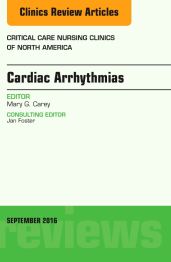
Cardiac Arrhythmias, An Issue of Critical Care Nursing Clinics of North America, 1st Edition
Author :
By Mary G. Carey, PhD, RN, FAHA, FAAN
A cardiac dysrhythmia is a disturbance in the cardiac rhythm which can be normal (e.g., sinus arrhythmia) or instantly lethal (e.g., sustained ventricular tachycardia). This issue of Critical Care Nursing Clinics of North America will provide state
...view more
A cardiac dysrhythmia is a disturbance in the cardiac rhythm which can be normal (e.g., sinus arrhythmia) or instantly lethal (e.g., sustained ventricular tachycardia). This issue of Critical Care Nursing Clinics of North America will provide state of the art diagnostic and treatment information for cardiac dysrhythmias as well as addressing how to achieve the most accurate diagnostic approach to interpreting an electrocardiogram, which is omnipresent in critical care and of critical importance in diagnosing arrhythmias. Articles in this issue are devoted to: The Normal Cardiac Conduction System; The Normal Electrocardiogram: Resting 12-lead and Continuous Cardiac Rhythm Strips; Premature Beats; Paroxysmal Supraventricular Tachycardia, Including the Special Type Called Wolff-Parkinson-White; Atrial Fibrillation, The Most Common Type of Supraventricular Arrhythmia; Ventricular Tachycardia and Its Disorganized Counterpart, Ventricular Fibrillation; Brady-Dysrhythmias, When Heart Rate Slows Myocardial Ischemia & Infarction and their Relationship to Dysrhythmias; Pharmacologically Induced Dysrhythmias; and Implantable Cardiac Devices and their Role in Dysrhythmias Management.
A cardiac dysrhythmia is a disturbance in the cardiac rhythm which can be normal (e.g., sinus arrhythmia) or instantly lethal (e.g., sustained ventricular tachycardia). This issue of Critical Care Nursing Clinics of North America will provide state of the art diagnostic and treatment information for cardiac dysrhythmias as well as addressing how to achieve the most accurate diagnostic approach to interpreting an electrocardiogram, which is omnipresent in critical care and of critical importance in diagnosing arrhythmias. Articles in this issue are devoted to: The Normal Cardiac Conduction System; The Normal Electrocardiogram: Resting 12-lead and Continuous Cardiac Rhythm Strips; Premature Beats; Paroxysmal Supraventricular Tachycardia, Including the Special Type Called Wolff-Parkinson-White; Atrial Fibrillation, The Most Common Type of Supraventricular Arrhythmia; Ventricular Tachycardia and Its Disorganized Counterpart, Ventricular Fibrillation; Brady-Dysrhythmias, When Heart Rate Slows Myocardial Ischemia & Infarction and their Relationship to Dysrhythmias; Pharmacologically Induced Dysrhythmias; and Implantable Cardiac Devices and their Role in Dysrhythmias Management.
Author Information
By Mary G. Carey, PhD, RN, FAHA, FAAN, Strong Memorial Hospital, University of Rochester Medical Center, Rochester, NY
https://www.elsevierhealth.com.au/cardiac-arrhythmias-an-issue-of-critical-care-nursing-clinics-of-north-america-9780323462549.html294904Cardiac Arrhythmias, An Issue of Critical Care Nursing Clinics of North Americahttps://www.elsevierhealth.com.au/media/catalog/product/9/7/9780323462549_8.jpg126.71168.95AUDInStock/Nursing & Midwifery/Specialist Nursing/Clinics/Nursing & Midwifery/Specialist Nursing/Clinics/Clinics/Nursing & Midwifery/Specialist Nursing/Japan Titles43351064388725505457250546665255041525985352631601418269243351054886536505457151451205259852A cardiac dysrhythmia is a disturbance in the cardiac rhythm which can be normal (e.g., sinus arrhythmia) or instantly lethal (e.g., sustained ventricular tachycardia). This issue of Critical Care Nursing Clinics of North America will provide state of the art diagnostic and treatment information for cardiac dysrhythmias as well as addressing how to achieve the most accurate diagnostic approach to interpreting an electrocardiogram, which is omnipresent in critical care and of critical importance in diagnosing arrhythmias. Articles in this issue are devoted to: The Normal Cardiac Conduction System; The Normal Electrocardiogram: Resting 12-lead and Continuous Cardiac Rhythm Strips; Premature Beats; Paroxysmal Supraventricular Tachycardia, Including the Special Type Called Wolff-Parkinson-White; Atrial Fibrillation, The Most Common Type of Supraventricular Arrhythmia; Ventricular Tachycardia and Its Disorganized Counterpart, Ventricular Fibrillation; Brady-Dysrhythmias, When Heart Rate Slows Myocardial Ischemia & Infarction and their Relationship to Dysrhythmias; Pharmacologically Induced Dysrhythmias; and Implantable Cardiac Devices and their Role in Dysrhythmias Management. A cardiac dysrhythmia is a disturbance in the cardiac rhythm which can be normal (e.g., sinus arrhythmia) or instantly lethal (e.g., sustained ventricular tachycardia). This issue of Critical Care Nursing Clinics of North America will provide state of the art diagnostic and treatment information for cardiac dysrhythmias as well as addressing how to achieve the most accurate diagnostic approach to interpreting an electrocardiogram, which is omnipresent in critical care and of critical importance in diagnosing arrhythmias. Articles in this issue are devoted to: The Normal Cardiac Conduction System; The Normal Electrocardiogram: Resting 12-lead and Continuous Cardiac Rhythm Strips; Premature Beats; Paroxysmal Supraventricular Tachycardia, Including the Special Type Called Wolff-Parkinson-White; Atrial Fibrillation, The Most Common Type of Supraventricular Arrhythmia; Ventricular Tachycardia and Its Disorganized Counterpart, Ventricular Fibrillation; Brady-Dysrhythmias, When Heart Rate Slows Myocardial Ischemia & Infarction and their Relationship to Dysrhythmias; Pharmacologically Induced Dysrhythmias; and Implantable Cardiac Devices and their Role in Dysrhythmias Management.00add-to-cart97803234625492016ProfessionalBy Mary G. Carey, PhD, RN, FAHA, FAAN20161Book152w x 229h (6.00" x 9.00")Elsevier09 Aug 2016Please allow 10-14 working days for deliveryBy <STRONG>Mary G. Carey</STRONG>, PhD, RN, FAHA, FAAN, Strong Memorial Hospital, University of Rochester Medical Center, Rochester, NYClinicsClinicsThe Clinics: NursingUnited StatesNoNoNoNoPlease SelectPlease SelectPlease Select