
Calculate with Confidence, 8th Edition
**Selected for Doody’s Core Titles® 2024 in Pharmacology**
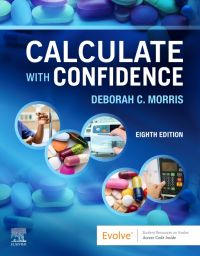
Learn how to make accurate drug calculations and administer medications safely! Calculate with Confidence, 8th Edition makes it easy to understand the three major methods of dosage calculation — ratio and proportion, formula method, and dimensional analysis. Clear, step-by-step instructions guide you through accurate calculation and safe administration of drug dosages. Thousands of practice problems ensure that you gain proficiency, QSEN principles prioritize client safety, and an emphasis on clinical reasoning helps you prevent medication errors. New Next Generation NCLEX® (NGN) case studies help in improving clinical judgment skills. With this popular text from educator Deborah C. Morris, you will learn to calculate drug dosages and administer medications with confidence.
**Selected for Doody’s Core Titles® 2024 in Pharmacology**
Learn how to make accurate drug calculations and administer medications safely! Calculate with Confidence, 8th Edition makes it easy to understand the three major methods of dosage calculation — ratio and proportion, formula method, and dimensional analysis. Clear, step-by-step instructions guide you through accurate calculation and safe administration of drug dosages. Thousands of practice problems ensure that you gain proficiency, QSEN principles prioritize client safety, and an emphasis on clinical reasoning helps you prevent medication errors. New Next Generation NCLEX® (NGN) case studies help in improving clinical judgment skills. With this popular text from educator Deborah C. Morris, you will learn to calculate drug dosages and administer medications with confidence.
New to this edition
- NEW! Five single-episode Next Generation NCLEX® (NGN) case studies are added to the book
- NEW! QSEN content is now included In Unit One, Math Review
- NEW! Updated medication labels are included
- NEW! Discussion of herbal meds is included in the Medication Administration chapter
- NEW! Latest research and information is included in the Insulin, Critical Care Calculations, and Pediatric and Adult Dosage Calculation Based on Weight chapters
- NEW! Updated information on the administration of fluids is added
- NEW! Updated information and examples of complex I&O problems are added to the Intake and Output section of the text, and it also includes more examples of complex I&O problems
- NEW! Updated Medication Index includes the latest drug information and removes drugs that are off the market or are not widely used
Key Features
- Thousands of practice problems ensure that you gain proficiency with drug calculations
- Safety Alert boxes help you prevent medication errors and avoid errors in dosage calculation
- Tips for Clinical Practice boxes call out information critical to math calculation and patient safety, and summarize best practices in client care (a Clinical Judgment feature for the Next Generation NCLEX®, or NGN)
- Rule boxes present instructions essential to math calculations and provide the information needed to accurately solve drug calculation problems
- Clinical Reasoning Scenarios discuss the safe administration of medications (also a Clinical Judgment feature for the NGN) and help you apply your knowledge to patient care
- Comprehensive Post-Test assesses your retention of the "big picture" concepts, with answers located in the back of the book
- Review of basic math, pre-tests, and post-tests allow you to evaluate your understanding of the material
- Medication Administration chapter covers medication safety, a discussion on client rights, the basic six rights of medication administration, and routes of medication administration
- Chapter review problems test your comprehension of all major topics, with the answers at the end of the chapter
- Points to Remember list bulleted key points from the chapter
Author Information
| ISBN Number | 9780323751575 |
|---|---|
| Description Author List | By Deborah C. Morris, RN, BSN, MA, LNC, Professor of Nursing, Department of Nursing and Allied Health Sciences, Bronx Community College, Bronx, NY |
| Copyright Year | 2022 |
| Edition Number | 8 |
| Format | Book |
| Trim | Other |
| Imprint | Elsevier |
| Page Count | 0 |
| Publication Date | 12 Oct 2021 |
| Stock Status | IN STOCK |


eBooks : Built for busy schedules & tailored for your goals.


Affordable knowledge, built for you
Get the resources you need-often at a lower cost than print. Quality content designed to support your goals, without stretching your budget.


Seamless access wherever you are


Always in sync


Tools the make learning stick
Your eBook is ready whenever you are!
1. Check your email for your access code.


2. Sign into or create your VitalSource account and redeem your code.


3. Open your eBook - ready whenever you are!
FAQ
The access code for your new eBook will be sent in your order confirmation email. Your code can also be accessed in your My Account section on the Elsevier webshop. If you do not receive your code within a few minutes, please check your spam folder.
Step-by-step guidance on how to download Bookshelf and also redeem your code can be found here.
The access code for your new eBook does not expire. However, we always suggest redeeming immediately after purchase to start experiencing the benefits of and insights from your purchase. Important to note - the code provided is a single use code and only valid for the edition you purchase. It does not provide access to past nor future editions of the title.
You will have unlimited access to your eBook on the device to which it was downloaded.
Discover the various learning features that our eBooks offer on the Bookshelf® Reader! For example, you can highlight different text passages, create notes and flashcards, have the text read to you, etc. Particularly practical: You can also use your eBooks offline. More information on the learning functions can be found on the Vitalsource page.
Quality is our top priority. That's why we collaborate with the leading eBook reader provider VitalSource. VitalSource has its own eBook reader Bookshelf®, which you can easily download. This reader is very user-friendly and offers more features than other standard readers. For example, you can highlight different text passages, create notes and flashcards, have the text read to you, etc. Particularly practical: You can also use your eBooks offline. More information can be found on the Vitalsource page.
Elsevier offers its eBooks in ePub format, as we believe this format is best suited to display our content ideally on as many devices as possible.
You can return your eBook within 13 days of purchase. eBooks that have been partially printed or flipped through more than 15% are excluded from returns.
Any questions ?
Top Picks from Our Community
Pre-Test
1. Fractions
2. Decimals
3. Ratio and Proportion
4. Percentages
Post-Test
Unit Two: Systems of Measurement
5. Metric System
6. Apothecary and Household Systems
7. Converting Within and Between Systems
8. Additional Conversions Useful in the Health Care Setting
Unit Three: Methods of Administration and Calculation
9. Medication Administration
10. Understanding and Interpreting Medication Orders
11. Medication Administration Records and Drug Distribution Systems
12. Reading Medication Labels
13. Dosage Calculation Using the Ratio and Proportion Method
14. Dosage Calculation Using the Formula Method
15. Dosage Calculation Using the Dimensional Analysis Method
Unit Four: Oral and Parenteral Dosage Forms, Insulin and Pediatric Dosage Calculations
16. Calculation of Oral Medications
17. Parenteral Medications
18. Reconstitution of Solutions
19. Insulin
Unit Five: Intravenous, Heparin, and Critical Care Calculations and Pediatric Dosage Calculations
20: Intravenous Solutions and Equipment
21. Basic Intravenous Calculations
22. Heparin Calculations
23. Critical Care Calculations
24. Pediatric and Adult Dosage Calculation Based on Weight
Comprehensive Post-Test
Bibliography
Appendix
A: Apothecary System
B: FDA and ISMP Lists of Look-Alike Drug Names with Recommended Tall Man Letters
C: TJC’s “Do Not Use” List of Abbreviations
D: ISMP’s List of Error-Prone Abbreviations, Symbols, and Dose Designations
E: ISMP List of High-Alert Medications in Acute Care Settings
F: ISMP List of High-Alert Medications in Community/Ambulatory Healthcare
Index
Drug Label Index