



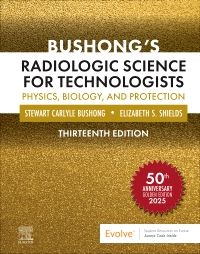
Bushong’s Radiologic Science for Technologists, 13th Edition
This item will be released on 07-07-2025
**Selected for 2025 Doody’s Core Titles® in Radiologic Technology**
Develop the skills you need to produce diagnostic-quality medical images! Bushong’s Radiologic Science for Technologists, 13th Edition, provides a solid foundation in the concepts of medical imaging and digital radiography. Featuring hundreds of radiographs and illustrations, this comprehensive text helps you learn how to make informed decisions regarding technical factors, image quality, and radiation safety for both patients and providers. With updates reflecting the latest ARRT® guidelines, including shielding practices and streamlined physics and math sections focused on key concepts, this edition equips you with the knowledge needed to succeed on the certification exam and excel in clinical settings.
Develop the skills you need to produce diagnostic-quality medical images! Bushong’s Radiologic Science for Technologists, 13th Edition, provides a solid foundation in the concepts of medical imaging and digital radiography. Featuring hundreds of radiographs and illustrations, this comprehensive text helps you learn how to make informed decisions regarding technical factors, image quality, and radiation safety for both patients and providers. With updates reflecting the latest ARRT® guidelines, including shielding practices and streamlined physics and math sections focused on key concepts, this edition equips you with the knowledge needed to succeed on the certification exam and excel in clinical settings.
ISBN :
9780323765367
Publication Date :
07-07-2025
Stock Status :
Available for Pre-Order
**Selected for 2025 Doody’s Core Titles® in Radiologic Technology**
Develop the skills you need to produce diagnostic-quality medical images! Bushong’s Radiologic Science for Technologists, 13th Edition, provides a solid foundation in the concepts of medical imaging and digital radiography. Featuring hundreds of radiographs and illustrations, this comprehensive text helps you learn how to make informed decisions regarding technical factors, image quality, and radiation safety for both patients and providers. With updates reflecting the latest ARRT® guidelines, including shielding practices and streamlined physics and math sections focused on key concepts, this edition equips you with the knowledge needed to succeed on the certification exam and excel in clinical settings.
Develop the skills you need to produce diagnostic-quality medical images! Bushong’s Radiologic Science for Technologists, 13th Edition, provides a solid foundation in the concepts of medical imaging and digital radiography. Featuring hundreds of radiographs and illustrations, this comprehensive text helps you learn how to make informed decisions regarding technical factors, image quality, and radiation safety for both patients and providers. With updates reflecting the latest ARRT® guidelines, including shielding practices and streamlined physics and math sections focused on key concepts, this edition equips you with the knowledge needed to succeed on the certification exam and excel in clinical settings.
Key Features
- NEW! Chapters on artificial intelligence and quantum computing help you stay abreast of key technological changes.
- NEW! Streamlined physics and math sections focus on the content you need to know to prepare for the ARRT exam, while also providing the background you need to perform well in the clinical environment
- UPDATED! Content reflects the latest ARRT guidelines, including the latest released shielding guidelines
- Broad coverage of radiologic science topics includes radiologic physics, imaging, radiobiology, and radiation protection. Special topics include mammography, fluoroscopy, spiral computed tomography, and cardiovascular interventional procedures
- Strong pedagogy, including objectives, key terms, outlines, chapter introductions, and summaries, helps you organize information and ensure that you understand what is most important in every chapter
- Quick-reference information, including formulas, conversion tables, abbreviations, and more, provides easy access to frequently used information
- End-of-chapter questions, such as definition exercises, short answer, and calculations, offer valuable review opportunities
- Key terms are bolded and defined at first mention in the text and are included in an expanded glossary to ensure you understand key terms as they are used in discussions of important concepts
- Math formulas are highlighted in special color boxes for quick reference
- Important concepts boxes are denoted with a penguin icon
- Evolve companion website provides answers to challenge questions, answers to workbook questions, an image collection, and review questions to reinforce your understanding of key content
Author Information
By Stewart C. Bushong, ScD, FAAPM, FACR, Professor of Radiologic Science, Baylor College of Medicine, Houston, TX, USA and Elizabeth Shields, MHA, RT(R), Program Director, Radiologic Technology Program, Novant Health Presbyterian Medical Center, USA
