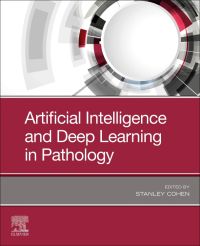
Artificial Intelligence and Deep Learning in Pathology, 1st Edition
Author :
Edited by Stanley Cohen, MD
Recent advances in computational algorithms, along with the advent of whole slide imaging as a platform for embedding artificial intelligence (AI), are transforming pattern recognition and image interpretation for diagnosis and prognosis. Yet most pa
...view more
Recent advances in computational algorithms, along with the advent of whole slide imaging as a platform for embedding artificial intelligence (AI), are transforming pattern recognition and image interpretation for diagnosis and prognosis. Yet most pathologists have just a passing knowledge of data mining, machine learning, and AI, and little exposure to the vast potential of these powerful new tools for medicine in general and pathology in particular. In Artificial Intelligence and Deep Learning in Pathology, with a team of experts, Dr. Stanley Cohen covers the nuts and bolts of all aspects of machine learning, up to and including AI, bringing familiarity and understanding to pathologists at all levels of experience.
Recent advances in computational algorithms, along with the advent of whole slide imaging as a platform for embedding artificial intelligence (AI), are transforming pattern recognition and image interpretation for diagnosis and prognosis. Yet most pathologists have just a passing knowledge of data mining, machine learning, and AI, and little exposure to the vast potential of these powerful new tools for medicine in general and pathology in particular. In Artificial Intelligence and Deep Learning in Pathology, with a team of experts, Dr. Stanley Cohen covers the nuts and bolts of all aspects of machine learning, up to and including AI, bringing familiarity and understanding to pathologists at all levels of experience.
Key Features
Focuses heavily on applications in medicine, especially pathology, making unfamiliar material accessible and avoiding complex mathematics whenever possible.
Covers digital pathology as a platform for primary diagnosis and augmentation via deep learning, whole slide imaging for 2D and 3D analysis, and general principles of image analysis and deep learning.
Discusses and explains recent accomplishments such as algorithms used to diagnose skin cancer from photographs, AI-based platforms developed to identify lesions of the retina, using computer vision to interpret electrocardiograms, identifying mitoses in cancer using learning algorithms vs. signal processing algorithms, and many more.
"We do, however, need to understand AI and adapt to it. This book is a great introduction, as well as a stimulating read. It is recommended for those interested in AI, software or the future of pathology." -Dr Niall O’Neill (Bulletin of the Royal College of Pathologists, January 2021)
https://www.elsevierhealth.com.au/artificial-intelligence-and-deep-learning-in-pathology-9780323675383.html296252Artificial Intelligence and Deep Learning in Pathologyhttps://www.elsevierhealth.com.au/media/catalog/product/9/7/9780323675383_6.jpg128.22170.95AUDInStock/Medicine & Surgery/Pathology/Books/Medicine/Pathology/Books/Books/Medicine/Pathology/Japan Titles43350914388722505455650546645255039525983652631601418269243350884886536505455351451205259833<p>Recent advances in computational algorithms, along with the advent of whole slide imaging as a platform for embedding artificial intelligence (AI), are transforming pattern recognition and image interpretation for diagnosis and prognosis. Yet most pathologists have just a passing knowledge of data mining, machine learning, and AI, and little exposure to the vast potential of these powerful new tools for medicine in general and pathology in particular. In <i>Artificial Intelligence and Deep Learning in Pathology</i>, with a team of experts, Dr. Stanley Cohen covers the nuts and bolts of all aspects of machine learning, up to and including AI, bringing familiarity and understanding to pathologists at all levels of experience.</p>
<P></p> <p>Recent advances in computational algorithms, along with the advent of whole slide imaging as a platform for embedding artificial intelligence (AI), are transforming pattern recognition and image interpretation for diagnosis and prognosis. Yet most pathologists have just a passing knowledge of data mining, machine learning, and AI, and little exposure to the vast potential of these powerful new tools for medicine in general and pathology in particular. In <i>Artificial Intelligence and Deep Learning in Pathology</i>, with a team of experts, Dr. Stanley Cohen covers the nuts and bolts of all aspects of machine learning, up to and including AI, bringing familiarity and understanding to pathologists at all levels of experience.</p>
<P></p>00add-to-cart97803236753832020ProfessionalEdited by Stanley Cohen, MD20211Book191w x 235h (7.50" x 9.25")Elsevier2702 Jun 2020Please allow 10-14 working days for deliveryEdited by <STRONG>Stanley Cohen</STRONG>, MD, PhD, MDBooksBookUnited StatesNoNoNoNoPlease SelectPlease SelectPlease Select