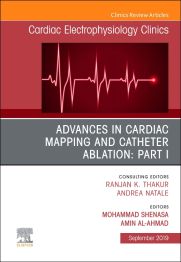
Advances in Cardiac Mapping and Catheter Ablation: Part I, An Issue of Cardiac Electrophysiology Clinics, 1st Edition
Author :
By Mohammad Shenasa, MD and Amin Al-Ahmad, MD
This issue of Cardiac Electrophysiology Clinics, guest edited by Mohammad Shenasa and Amin Al-Ahmad, will focus on Advances in Cardiac Mapping and Catheter Ablation. This is part one of a two-part issue and will include articles centered around Basic
...view more
This issue of Cardiac Electrophysiology Clinics, guest edited by Mohammad Shenasa and Amin Al-Ahmad, will focus on Advances in Cardiac Mapping and Catheter Ablation. This is part one of a two-part issue and will include articles centered around Basic Concepts in Cardiac Mapping, Novel Mapping & Imaging Systems & Technologies, and Catheter and Energy Sources. Topics include, but are not limited to, Embryology of the Cardiac Conduction System Relevant to Cardiac Arrhythmias; Anatomical Consideration Relevant to Atrial and Ventricular Arrhythmias; Fundamentals of Cardiac Mapping; Novel Cardiac Mapping Systems; Non-invasive Mapping & ECGI in Atrial and Ventricular Arrhythmias; Optical Mapping; Omnipolar Mapping; Cardiac CT, MRI, and Fibrosis Quantification; High resolution mapping in patients with atrial and ventricular arrhythmias; Contact Force and Ablation Index; and New Catheter Balloons Including Radiofrequency.
This issue of Cardiac Electrophysiology Clinics, guest edited by Mohammad Shenasa and Amin Al-Ahmad, will focus on Advances in Cardiac Mapping and Catheter Ablation. This is part one of a two-part issue and will include articles centered around Basic Concepts in Cardiac Mapping, Novel Mapping & Imaging Systems & Technologies, and Catheter and Energy Sources. Topics include, but are not limited to, Embryology of the Cardiac Conduction System Relevant to Cardiac Arrhythmias; Anatomical Consideration Relevant to Atrial and Ventricular Arrhythmias; Fundamentals of Cardiac Mapping; Novel Cardiac Mapping Systems; Non-invasive Mapping & ECGI in Atrial and Ventricular Arrhythmias; Optical Mapping; Omnipolar Mapping; Cardiac CT, MRI, and Fibrosis Quantification; High resolution mapping in patients with atrial and ventricular arrhythmias; Contact Force and Ablation Index; and New Catheter Balloons Including Radiofrequency.
Author Information
By Mohammad Shenasa, MD, Department of Cardiovascular Services, O’Conner Hospital, Heart & Rhythm Medical Group, San Jose CA and Amin Al-Ahmad, MD, Electrophysiologist, Texas Cardiac Arrhythmia Institute, Austin, TX
By Mohammad Shenasa, MD, Department of Cardiovascular Services, O’Conner Hospital, Heart & Rhythm Medical Group, San Jose CA and Amin Al-Ahmad, MD, Electrophysiologist, Texas Cardiac Arrhythmia Institute, Austin, TX
https://www.elsevierhealth.com.au/advances-in-cardiac-mapping-and-catheter-ablation-part-i-an-issue-of-cardiac-electrophysiology-clinics-9780323683470.html296459Advances in Cardiac Mapping and Catheter Ablation: Part I, An Issue of Cardiac Electrophysiology Clinicshttps://www.elsevierhealth.com.au/media/catalog/product/9/7/9780323683470_6.jpg120.55133.95AUDInStock/Clinics/Medicine & Surgery/Cardiology/Medicine/Cardiology/Clinics/Clinics/Medicine/Cardiology/Japan Titles43887254431212505456950546665255041525985052631601418269243350884886536505455351451205259833This issue of Cardiac Electrophysiology Clinics, guest edited by Mohammad Shenasa and Amin Al-Ahmad, will focus on Advances in Cardiac Mapping and Catheter Ablation. This is part one of a two-part issue and will include articles centered around Basic Concepts in Cardiac Mapping, Novel Mapping & Imaging Systems & Technologies, and Catheter and Energy Sources. Topics include, but are not limited to, Embryology of the Cardiac Conduction System Relevant to Cardiac Arrhythmias; Anatomical Consideration Relevant to Atrial and Ventricular Arrhythmias; Fundamentals of Cardiac Mapping; Novel Cardiac Mapping Systems; Non-invasive Mapping & ECGI in Atrial and Ventricular Arrhythmias; Optical Mapping; Omnipolar Mapping; Cardiac CT, MRI, and Fibrosis Quantification; High resolution mapping in patients with atrial and ventricular arrhythmias; Contact Force and Ablation Index; and New Catheter Balloons Including Radiofrequency. This issue of Cardiac Electrophysiology Clinics, guest edited by Mohammad Shenasa and Amin Al-Ahmad, will focus on Advances in Cardiac Mapping and Catheter Ablation. This is part one of a two-part issue and will include articles centered around Basic Concepts in Cardiac Mapping, Novel Mapping & Imaging Systems & Technologies, and Catheter and Energy Sources. Topics include, but are not limited to, Embryology of the Cardiac Conduction System Relevant to Cardiac Arrhythmias; Anatomical Consideration Relevant to Atrial and Ventricular Arrhythmias; Fundamentals of Cardiac Mapping; Novel Cardiac Mapping Systems; Non-invasive Mapping & ECGI in Atrial and Ventricular Arrhythmias; Optical Mapping; Omnipolar Mapping; Cardiac CT, MRI, and Fibrosis Quantification; High resolution mapping in patients with atrial and ventricular arrhythmias; Contact Force and Ablation Index; and New Catheter Balloons Including Radiofrequency.00add-to-cart97803236834702019ProfessionalBy Mohammad Shenasa, MD and Amin Al-Ahmad, MD20191Book178w x 254h (7.00" x 10.00")Elsevier09 Aug 2019Please allow 10-14 working days for deliveryBy <STRONG>Mohammad Shenasa</STRONG>, MD, Department of Cardiovascular Services, O’Conner Hospital, Heart & Rhythm Medical Group, San Jose CA and <STRONG>Amin Al-Ahmad</STRONG>, MD, Electrophysiologist, Texas Cardiac Arrhythmia Institute, Austin, TXClinicsClinicsThe Clinics: Internal MedicineUnited StatesNoNoNoNoPlease SelectPlease SelectPlease Select