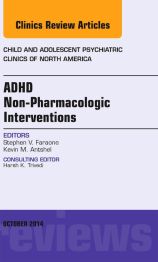
ADHD: Non-Pharmacologic Interventions, An Issue of Child and Adolescent Psychiatric Clinics of North America, 1st Edition
Author :
By Stephen V. Faraone
This issue of Child and Adolescent Psychiatric Clinics provides an overview of childhood traumatic exposures and their impact for health care providers: child and adolescent psychiatrists, general psychiatrists, other pediatric behavioral health prov
...view more
This issue of Child and Adolescent Psychiatric Clinics provides an overview of childhood traumatic exposures and their impact for health care providers: child and adolescent psychiatrists, general psychiatrists, other pediatric behavioral health providers and primary care clinicians. Children in the United States are exposed to trauma more frequently than most clinicians are aware - either as a single occurrence, or through repeated events. These exposures result in neurobiological, developmental and clinical sequelae that can undermine children's health and well-being. This publication describes the multiple types of traumatic exposures and their sequelae, methods of screening and assessment, and principles of effective prevention and clinical treatment. Emphasis is on areas of particular relevance to children - disasters, war, domestic violence, school and community violence, sexual victimization, complex trauma - and differentiates disasters as unique traumas, requiring trauma-informed systems of care to effectively meet the needs of the exposed population. The third section of the issue describes strategies for primary prevention - violence prevention, useful public policies - and risk mitigation - skill and resilience building strategies. Evidence based treatments for trauma-induced clinical disorders are reviewed.
This issue of Child and Adolescent Psychiatric Clinics provides an overview of childhood traumatic exposures and their impact for health care providers: child and adolescent psychiatrists, general psychiatrists, other pediatric behavioral health providers and primary care clinicians. Children in the United States are exposed to trauma more frequently than most clinicians are aware - either as a single occurrence, or through repeated events. These exposures result in neurobiological, developmental and clinical sequelae that can undermine children's health and well-being. This publication describes the multiple types of traumatic exposures and their sequelae, methods of screening and assessment, and principles of effective prevention and clinical treatment. Emphasis is on areas of particular relevance to children - disasters, war, domestic violence, school and community violence, sexual victimization, complex trauma - and differentiates disasters as unique traumas, requiring trauma-informed systems of care to effectively meet the needs of the exposed population. The third section of the issue describes strategies for primary prevention - violence prevention, useful public policies - and risk mitigation - skill and resilience building strategies. Evidence based treatments for trauma-induced clinical disorders are reviewed.
https://www.elsevierhealth.com.au/adhd-non-pharmacologic-interventions-an-issue-of-child-and-adolescent-psychiatric-clinics-of-north-america-9780323326018.html294194ADHD: Non-Pharmacologic Interventions, An Issue of Child and Adolescent Psychiatric Clinics of North Americahttps://www.elsevierhealth.com.au/media/catalog/product/9/7/9780323326018_7.jpg126.71168.95AUDInStock/Medicine & Surgery/Clinical/General Medicine/Clinics/Medicine & Surgery/Psychiatry/Medicine/Clinical/General Medicine/Medicine/Psychiatry/Clinics/Clinics/Medicine/Clinical/General Medicine/Medicine/Psychiatry/Japan Titles433510243887254335148505459150545985054666525504152598745259882526316014182692433508848865365054553514512052598335259873This issue of Child and Adolescent Psychiatric Clinics provides an overview of childhood traumatic exposures and their impact for health care providers: child and adolescent psychiatrists, general psychiatrists, other pediatric behavioral health providers and primary care clinicians. Children in the United States are exposed to trauma more frequently than most clinicians are aware - either as a single occurrence, or through repeated events. These exposures result in neurobiological, developmental and clinical sequelae that can undermine children's health and well-being. This publication describes the multiple types of traumatic exposures and their sequelae, methods of screening and assessment, and principles of effective prevention and clinical treatment. Emphasis is on areas of particular relevance to children - disasters, war, domestic violence, school and community violence, sexual victimization, complex trauma - and differentiates disasters as unique traumas, requiring trauma-informed systems of care to effectively meet the needs of the exposed population. The third section of the issue describes strategies for primary prevention - violence prevention, useful public policies - and risk mitigation - skill and resilience building strategies. Evidence based treatments for trauma-induced clinical disorders are reviewed. This issue of Child and Adolescent Psychiatric Clinics provides an overview of childhood traumatic exposures and their impact for health care providers: child and adolescent psychiatrists, general psychiatrists, other pediatric behavioral health providers and primary care clinicians. Children in the United States are exposed to trauma more frequently than most clinicians are aware - either as a single occurrence, or through repeated events. These exposures result in neurobiological, developmental and clinical sequelae that can undermine children's health and well-being. This publication describes the multiple types of traumatic exposures and their sequelae, methods of screening and assessment, and principles of effective prevention and clinical treatment. Emphasis is on areas of particular relevance to children - disasters, war, domestic violence, school and community violence, sexual victimization, complex trauma - and differentiates disasters as unique traumas, requiring trauma-informed systems of care to effectively meet the needs of the exposed population. The third section of the issue describes strategies for primary prevention - violence prevention, useful public policies - and risk mitigation - skill and resilience building strategies. Evidence based treatments for trauma-induced clinical disorders are reviewed.00add-to-cart97803233260182014ProfessionalBy Stephen V. Faraone20141Book152w x 229h (6.00" x 9.00")Elsevier017 Sep 2014Please allow 10-14 working days for deliveryBy <STRONG>Stephen V. Faraone</STRONG>ClinicsClinicsThe Clinics: Internal MedicineUnited StatesNoNoNoNoPlease SelectPlease SelectPlease Select