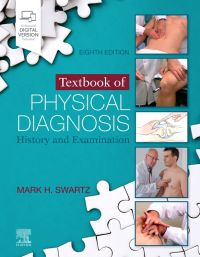
Mastering each aspect of the patient interview and physical exam is fundamental to medical education, resulting in more accurate diagnostic skills, more effective patient management, and better patient outcomes! Dr. Swartz’s Textbook of Physical Diagnosis is a highly respected reference in this critical area, offering a compassionate, humanistic approach to the art and science of interviewing and physical examination. From cover to cover, you’ll learn how your interpersonal awareness is just as important in physical diagnosis as your level of skill – and why clinical competence in this area is essential for physicians, nurse practitioners, physician assistants, and all members of the healthcare profession.
Key Features
- Explores how cultural differences can influence communication, diet, family relationships, and health practices and beliefs – which may affect your approach to a patient’s treatment.
- Features hundreds of high-quality color images, an easy-to-use design, and detailed descriptions of practical techniques throughout.
- Offers clear, easy-to-understand explanations of interviewing and examination techniques, clinical presentations, pathophysiology, complementary and alternative medicine, and physical diagnosis standards and tests. All chapters completely reviewed and revised.
- Features a new chapter on deconstructing racism and bias in clinical medicine.
- Provides expanded coverage of the musculoskeletal system with more specialty examinations of joints.
- Emphasizes precision, accuracy, and critical thinking in clinical assessment.
- Highlights clinical ethics and professionalism.
- Includes more than 6 hours of in-depth video, featuring step-by-step key aspects of the physical examination for adults, toddlers, and newborns, important interviewing scenarios, and audio of heart and lung sounds.
- Enhanced eBook version included with purchase.
Your enhanced eBook allows you to access all of the text, figures, and references from the book on a variety of devices.
Author Information
By Mark H. Swartz, MD, FACP, Professor of Medicine, State University of New York (SUNY), Downstate College of Medicine, Brooklyn, New York; Adjunct Professor of Medicine, New York Medical College, Valhalla, New York; Professor of Medical Sciences, New York College of Podiatric Medicine, New York, New York and Director, C3NY--Clinical Competence Center of New York, New York, New York
SECTION 1 Mastering the Art of Interviewing 1 The Interviewer’s Questions Basic Principles Using an Interpreter Important Interviewing Concepts Symptoms and Signs Conducting an Interview Basic Interviewing Techniques Format of the History Taking Notes Concluding Thoughts 2 The Patient’s Responses Responses to Illness Responses to the Interviewer Influence of Background and Age on Patient Response Influence of Disease on Patient Response 3 Understanding Complementary and Alternative Medicine General Consideration Classifications of Complementary and Alternative Medicine Traditional Chinese Medicine Concluding Thoughts 4 Putting the History Together Interview of Mr. John Doe Written History of Mr. John Doe SECTION 2 Valuing Diversity: Race, Gender, and Ethnicity 5 Deconstructing Racism and Bias in Clinical Medicine Introduction Before the Clinical Encounter (Pre-Visit Preparation) During the Clinical Encounter After the Clinical Encounter Biased Patient Behavior Conclusion Acknowledgments SECTION 3 Understanding the Science of the Physical Examination 6 The Physical Examination The Basic Procedures Preparation for the Examination Health Care Infection Prevention Practices, Goal of the Physical Examination 7 Assessment of Nutritional Status Medical History Physical Examination Special Population Clinicopathologic Correlation Concluding Thoughts 8 The Skin General Considerations Structure and Physiologic Characteristics Review of Specific Symptoms Effect of Skin Disease on the Patient Physical Examination Description of Lesions Clinicopathologic Correlations 9 The Head and Neck General Considerations, Structure and Physiology Effect of Head and Neck Disease on the Patient Physical Examination Clinicopathologic Correlations 10 The Eye, 167 Historical and General Consideration Structure and Physiology Review of Specific Symptoms Effect of Blindness on the Patient Physical Examination Clinicopathologic Correlations 11 The Ear and Nose General Considerations, Structure and Physiology Review of Specific Symptoms Effect of Deafness on the Patient Physical Examination Clinicopathologic Correlations 12 The Oral Cavity and Pharynx General Considerations Structure and Physiologic Characteristics The Pharynx The Larynx Review of Specific Symptom Effect of a Voice Disorder on the Patient Physical Examination Clinicopathologic Correlations 13 The Chest General Considerations Structure and Physiology Review of Specific Symptoms Effect of Lung Disease on the Patient Physical Examination Clinicopathologic Correlations 14 The Heart, 293 General Considerations Structure and Physiology Review of Specific Symptoms Effect of Cardiac Disease on the Patient Physical Examination Clinicopathologic Correlations, 15 The Peripheral Vascular System General Considerations Structure and Physiology Review of Specific Symptoms Effect of Vascular Disease on the Patient Physical Examination, Clinicopathologic Correlations 16 The Breast General Considerations Structure and Physiology Review of Specific Symptom Impact of Breast Disease on the Woman Physical Examination The Male Breast Clinicopathologic Correlations 17 The Abdomen General Considerations Structure and Physiology Review of Specific Symptoms Impact of Inflammatory Bowel Disease on the Patient Physical Examination 18 Male Genitalia and Hernias General Considerations Structure and Physiologic Characteristics Review of Specific Symptoms Impact of Erectile Dysfunction on the Man Physical Examination Clinicopathologic Correlations, 19 Female Genitalia General Considerations Structure and Physiologic Characteristics The OB-GYN History Review of Specific Symptoms Effect of Infertility on the Woman Physical Examination Preparation for the Examination Clinicopathologic Correlations 20 The Musculoskeletal System General Consideration Structure and Physiology Review of Specific Symptoms Effect of Musculoskeletal Disease on the Patient Physical Examination Clinicopathologic Correlations 21 The Nervous System General Considerations Structure and Physiologic Characteristic Review of Specific Symptoms Effect of Chronic Neurologic Disease on the Patient Physical Examination Clinicopathologic Correlations 22 Putting the Examination Together The Techniques The Written Physical Examination SECTION 4 Evaluating Specific Patients 23 The Pregnant Patient General Considerations Structure and Physiologic Characteristics Review of Specific Symptoms Obstetric Risk Assessment Calculation of Due Date Effect of Pregnancy on the Patient Physical Examination Clinicopathologic Correlations 24 The Pediatric Patient General Considerations Pediatric History Neonatal: Under 1 Month of Age Infancy: 1 Month to 12 Months Early Childhood: 1 Year to 4 Years Middle Childhood: 5 Years to 10 Years Adolescence: 11 Years to 21 Years, Clinicopathologic Correlations, Sample Write-Up of a Newborn’s History and Physical Exam, 25 The Geriatric Patient General Considerations The Geriatric Assessment Core Components of a Comprehensive Geriatrics Assessment Goals of Care and Advance Care Preferences Structure and Physiologic Characteristics Basic Principles of Geriatric Medicine The Geriatric Examination Clinicopathologic Correlations 26 The Acutely Ill or Injured Patient Personal Safety Approach to the Unconscious Patient Current Cardiopulmonary Resuscitation Guidelines C-A-B Cardiopulmonary Resuscitation Survey Summary of Cardiopulmonary Resuscitation Guidelines for Adults, Children, and Infant Assessment of the Acutely Ill or Injured Patient The Pediatric Emergency SECTION 5 Putting the Data to Work 27 Precision, Accuracy, and Critical Thinking in Clinical Assessment Art, Science, and Observation Diagnostic Reasoning From Signs and Symptoms Critical Thinking The Rational Clinical Examination 28 The Clinical Record Putting the History and Physical Examination Together Electronic Medical Record Protecting Patient’s Right to Privacy The Human Dimension 29 The Focused History and Physical Examination General Considerations Illustrative Case Diagnostic Evaluation SECTION 6 Analyzing Ethical Issues in Clinical Medicine 30 Clinical Ethics and Professionalism Introduction Principlism Moral Philosophy: Deontology Vs. Utilitarianis Casuistry Privacy and Confidentiality Informed Consent Decisional Capacity Advanced Directives Surrogate Decision Making Ethical Issues at the End of Life Ethics Committees and Clinical Ethics Consultation— Where to Find Assistance Closing Remarks
"This edition is a tremendous augmentation to the standard approaches to teaching the history and physical examination to medical students. It gives the traditional perspective and greatly improves the educational process by addressing the diversity concepts and the need for professionalism that medical students must keep in mind."
-Vincent F Carr, DO, MSA, FACC, FACP (Uniformed Services University of the Health Sciences) Doody's Review Score: 100-5 Stars!